
The Complete Guide to AI Automation for UK SMEs
🎯 Key Takeaway
For UK Small and Medium-sized Enterprises (SMEs), AI automation is the use of intelligent systems, powered by technologies like machine learning, to perform complex business tasks that traditionally require human judgement and decision-making. AI automation goes beyond simple rules-based tasks, handling unstructured data and making adaptive decisions. Key applications for SMEs include automating financial reporting, personalising marketing campaigns, and optimising supply chains. A successful strategy requires a clear business case, a focus on data security (including the General Data Protection Regulation (GDPR)), and strong governance to avoid risks. This guide provides a pragmatic roadmap for implementing AI automation to gain a competitive edge in the UK market.
The conversation around Artificial Intelligence (AI) can feel overwhelming, filled with hype and technical jargon that seems disconnected from the day-to-day realities of running a business. For many UK SME leaders, the key question isn't about futuristic robots but about practical solutions. For ai automation, the goal is simple: how can this technology make my business more efficient, profitable, and competitive? This guide is designed to cut through the noise. We'll provide a clear, jargon-free overview of what AI automation really means for your business, exploring how to implement it securely and compliantly while demonstrating a clear Return on Investment (ROI). This is your no-nonsense SME's playbook for turning a buzzword into a tangible asset.
👤 Written by: Content Team
Reviewed by: Editorial Team, Industry Specialists
Last updated: 18 September 2026
ℹ️ Transparency Disclosure: This article explores AI automation for UK SMEs based on analysis of government reports, academic studies, and industry data. Some links may connect to our AI consulting services. All information is verified by our editorial team to ensure accuracy and relevance as of September 2026. Up-Stride is a specialised AI consultancy for UK businesses.
What is AI Automation? (And What It Isn’t)
AI automation is the next evolution of business process automation, where software systems use artificial intelligence to perform complex tasks that require learning, adaptation, and decision-making. Think of it this way: if traditional automation is a calculator that performs fixed calculations perfectly every time, AI automation is an accountant who can interpret various financial documents, spot anomalies, and make recommendations. It's not about sentient robots taking over; it's about highly specialised software designed to handle complex, data-driven work.
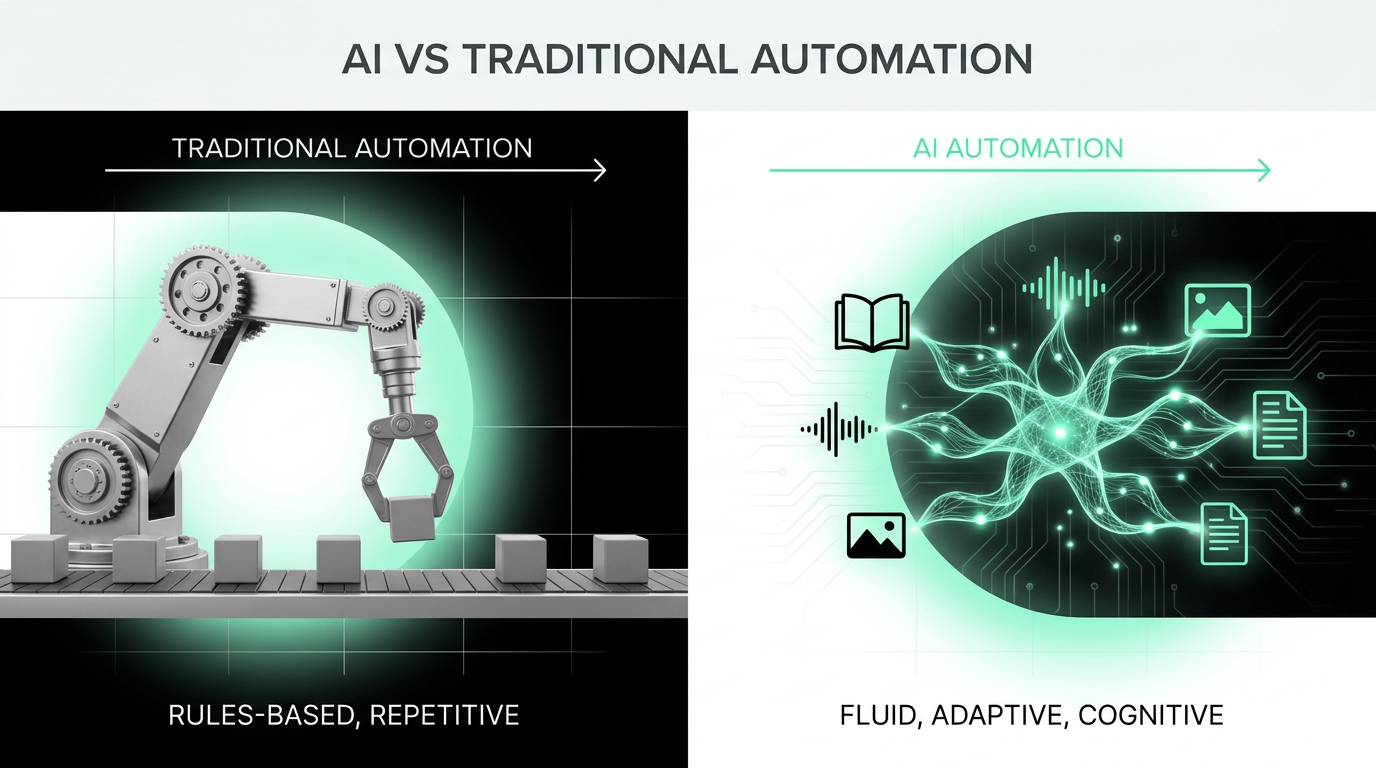
The core difference lies in the 'intelligence'. AI automation systems can process unstructured data - like customer emails, supplier invoices in PDF format, or social media comments - and understand their context. According to a foundational report by The Royal Society (2017), this capability stems from machine learning, where algorithms improve their performance over time as they are exposed to more data. This is a significant step up from tools that only handle structured, predictable information.
For UK SMEs, this must be approached with a clear understanding of compliance. The Information Commissioner's Office (ICO), the UK's independent authority for data protection, provides guidance stating that even automated decisions must be explainable, fair, and lawful under the UK's General Data Protection Regulation (GDPR). As the ICO (2024) guidance highlights, accountability is paramount. Therefore, true AI automation isn't just about efficiency; it's about building intelligent, compliant, and trustworthy systems.
AI vs. Traditional Automation: Why It Matters for Your Business
The key difference is that traditional automation executes pre-defined instructions, while AI automation interprets information and makes judgements. Robotic Process Automation (RPA), a common form of traditional automation, is about 'doing'. It's brilliant at mimicking repetitive, rules-based human actions like copying data from a spreadsheet to a Customer Relationship Management (CRM) system. By contrast, AI automation, which combines technologies like machine learning and natural language processing with automation, is about 'thinking and learning'.
Consider a UK-based e-commerce business processing supplier invoices.
- RPA can extract data from an invoice if every invoice uses the exact same digital template. If a supplier changes their format, the automation breaks.
- AI automation can read and understand invoices in hundreds of different formats - scanned PDFs, emails, or digital files. It identifies the supplier, invoice number, and line items, flags any unusual charges against past orders, and routes it for approval. It handles the variability of the real world.
The Alan Turing Institute, the UK's national institute for data science and AI, describes AI as a 'general-purpose technology' that augments human capabilities. This is the critical distinction: rigid automation replaces a task, whereas AI automation often handles the complex, data-heavy parts of a task, empowering your team to make the final strategic decision. This combination of ai and automation is what unlocks significant value.
| Capability | Traditional Automation (RPA) | AI Automation | Relevance for UK SMEs |
|---|---|---|---|
| Data Handling | Requires structured, predictable data (e.g., spreadsheets, fixed forms). | Can process unstructured data (e.g., emails, PDFs, images, voice). | Allows automation of real-world processes like customer service and document management. |
| Decision Making | Follows explicit 'if-this-then-that' rules defined by a human. | Makes predictive decisions based on patterns, context, and learned data. | Can handle exceptions and variability without manual intervention, saving time. |
| Learning Ability | Static; does not improve or adapt over time. Processes must be manually updated. | Adaptive; models learn from new data to improve accuracy and efficiency. | Systems get smarter and more valuable over time, improving ROI. |
| Task Complexity | Best for simple, high-volume, repetitive tasks with few exceptions. | Handles complex processes with multiple variables and judgement points. | Opens up higher-value processes like financial analysis and sales forecasting to automation. |
Practical AI Automation Examples for UK SMEs
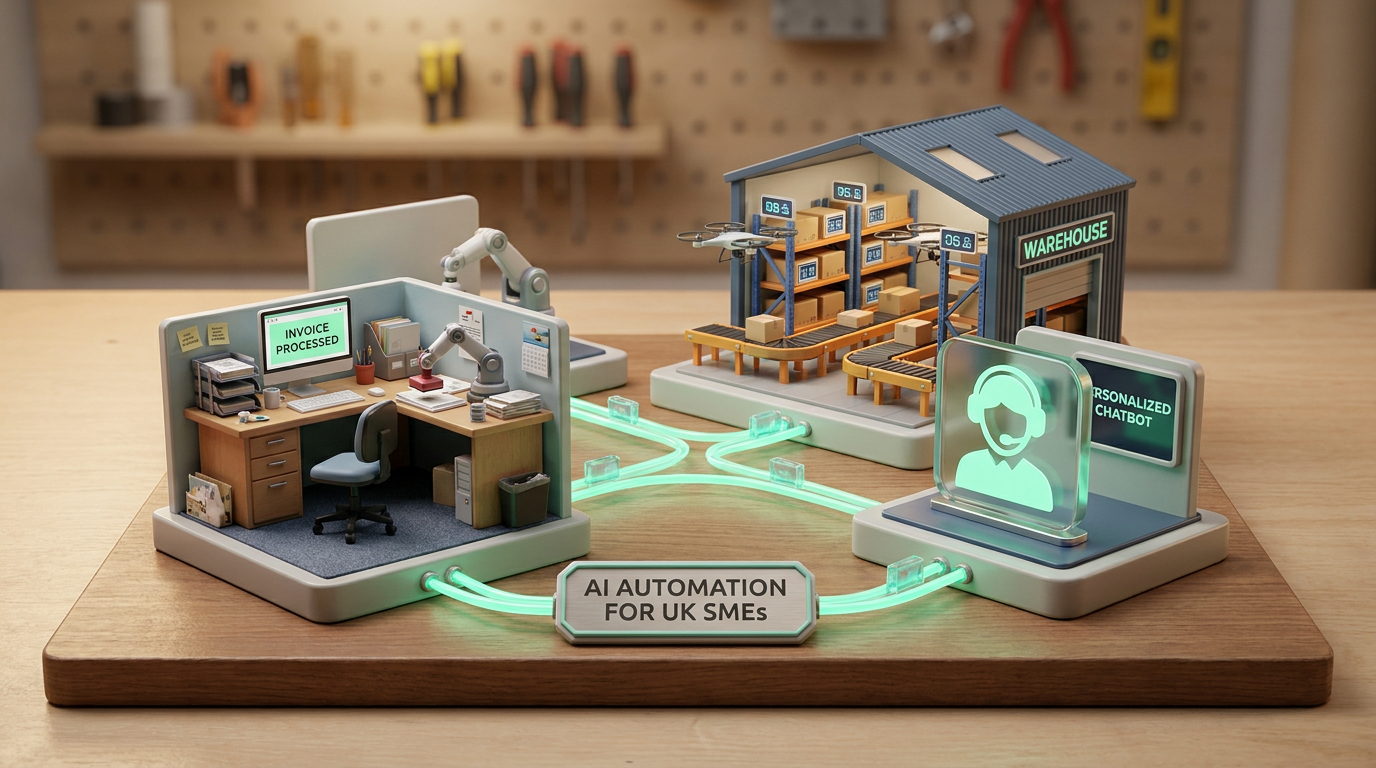
The power of ai automation lies in its application to specific, everyday business challenges. It’s not an abstract concept but a practical tool that can drive efficiency across your entire organisation. In our experience, an effective starting points are often tedious, data-heavy processes that create bottlenecks. A report from Innovate UK (2023) highlights numerous opportunities for the UK service sector, from professional services to finance.
Finance & Administration
This is often the most straightforward area to see immediate returns. Instead of manually processing invoices and chasing expense approvals, AI can transform the back office.
- Automated Invoice Processing: AI tools can read incoming invoices in any format, extract key data (supplier, amount, due date), match it against purchase orders, and flag any discrepancies for human review. This drastically reduces manual data entry and ensures compliance with programmes like Making Tax Digital.
- Expense Report Compliance: An AI system can automatically check employee expense reports against company policy and HMRC rules, flagging non-compliant items and speeding up reimbursement for valid claims.
Marketing & Sales
Personalisation is key to modern marketing, but it's incredibly time-consuming. AI can deliver tailored experiences at scale.
- Intelligent Lead Scoring: AI can analyse a lead's behaviour across your website, social media, and email interactions to predict their likelihood to buy. This allows your sales team to focus their efforts on the most promising prospects.
- Personalised Customer Communication: By analysing past purchase history and customer feedback, AI can help segment your audience and automatically generate personalised email campaigns or product recommendations, increasing engagement and sales.
Operations & Supply Chain
For businesses dealing with physical goods, optimising logistics is critical.
- Dynamic Inventory Management: AI can analyse sales trends, seasonality, and even external factors like weather forecasts to predict demand more accurately. This helps prevent stockouts of popular items while reducing overstocking of slow-movers.
- Route Optimisation: Delivery and service businesses can use AI to plan the most efficient routes in real-time, accounting for traffic, delivery windows, and vehicle capacity. This saves fuel, reduces delivery times, and improves customer satisfaction.
Case Study: A Hypothetical UK Distributor
- Challenge: A Midlands-based distribution SME was losing an estimated £80,000 annually due to inefficient delivery routes and manual scheduling, leading to high fuel costs and frequent customer complaints about delays.
- Solution: We implemented an AI-powered logistics platform that automated route planning. The system analysed daily orders, vehicle capacity, traffic data, and customer time windows to generate optimised routes for their fleet of 15 vans.
- Results: Within six months, the company saw a 22% reduction in fuel costs, a 30% increase in on-time delivery rates, and a 15% increase in the number of deliveries per driver per day.
- Key Insight: Automating a single, critical operational process delivered measurable ROI and freed up the logistics manager to focus on strategic supplier relationships instead of daily fire-fighting.
Building Your Business Case: How to Measure the ROI of AI Automation
Measuring the ROI of ai automation is essential for getting buy-in and ensuring your investment is worthwhile. A survey by the Confederation of British Industry (CBI) found that an 'unclear ROI' is one of the biggest barriers preventing UK firms from adopting AI. The key is to look beyond simple cost savings and consider both tangible and intangible returns. For a deeper analysis, explore our practical framework for measuring AI ROI.
A straightforward formula to start with is:
ROI = (Financial Gain - Investment Cost) / Investment Cost
Tangible Returns (The Easy-to-Measure Gains):
- Reduced Labour Costs: Calculate the hours your team spends on a manual task. If AI automates 80% of that task, that's a direct, quantifiable saving you can reinvest in higher-value work.
- Increased Revenue: How does automation speed up your sales cycle or improve customer retention? Faster lead qualification or 24/7 customer support can lead to direct revenue growth.
- Error Reduction: What is the cost of a mistake in your business? Automating data entry or compliance checks can reduce costly errors, fines, or rework.
Intangible Returns (The Harder-to-Measure, High-Impact Gains):
- Improved Employee Morale: Automating tedious, repetitive tasks frees your team to focus on creative, strategic, and engaging work, which can boost job satisfaction and reduce staff turnover.
- Enhanced Customer Satisfaction: Faster response times, personalised interactions, and fewer errors lead to happier customers who are more likely to return and recommend your business.
- Better Decision-Making: AI provides data-driven insights that can improve forecasting, strategic planning, and risk management.
With a World Economic Forum (2023) report projecting that 75% of companies will adopt AI, building a business case is no longer just an internal exercise; it's a strategic necessity to remain competitive.
Getting Started: An AI Automation Roadmap for Non-Technical Leaders
Embarking on an ai workflow automation journey doesn't require you to become a data scientist. It requires a strategic, business-first mindset. For non-technical leaders, we recommend a phased approach that de-risks the investment and builds momentum. This is a simplified version of the roadmap we use with our clients; for more detail, see our practical guide to AI implementation.

- Identify the Pain, Not the Tech: Don't start by asking, 'Where can we use AI?'. Start by asking, 'What is our most frustrating, time-consuming, or error-prone process?'. Is it customer onboarding? Financial month-end closing? Managing supplier queries? Focus on a real business problem.
- Start Small, Think Big: Once you have a list of pain points, prioritise one to tackle first. Use a simple 'Impact vs. Effort' matrix to find a process that is high-impact but relatively low-effort to automate. This first win will build confidence and secure buy-in for future projects.
- Assess Your Data & People: AI runs on data. Is the information needed for your chosen process accessible, clean, and sufficient? Also, consider your team. A 2024 report from the Department for Science, Innovation and Technology (GOV.UK) identifies the 'lack of skilled staff' as a key barrier. Plan for upskilling or partnering to bridge any gaps.
- Run a Pilot Project: Before a full-scale rollout, test the solution on a small scale. This allows you to prove the value, identify any unforeseen challenges, and refine the process in a controlled environment. A successful pilot is the most powerful tool for making the business case.
- Govern & Scale: As you prepare to scale, establish simple governance. Who is responsible for the AI system? How will you monitor its performance and ensure it remains compliant? A clear policy prevents chaos as you expand. This aligns with the UK Government's National AI Strategy, which encourages effective governance to build a trustworthy ecosystem.
Choosing the Right Partner: What to Look for in an AI Automation Agency UK
For most SMEs, partnering with a specialist is the fastest and most reliable path to success. However, choosing the right ai automation agency uk is a critical decision. The wrong partner can lead to a failed project, compliance issues, or a solution that doesn't fit your business.
Here is a checklist of what to ask a potential partner:
- Do they have UK-Specific Expertise? An agency must have a deep understanding of UK GDPR and data sovereignty laws. Ask them how they ensure compliance, referencing official guidance from the ICO.
- Do they have a Business-First Approach? A good partner will spend more time asking about your business challenges than talking about their technology. They should be focused on solving your problems, not selling their favourite tool.
- Do they follow a Human-Centred Philosophy? How will they support your team through the change? A trustworthy partner should align with international standards for trustworthy AI, such as the principles developed by the Organisation for Economic Co-operation and Development (OECD), which prioritise human-centred values.
- Is their Pricing Transparent? Be wary of open-ended hourly contracts. Look for partners who offer clear, fixed-price pilot projects so you know exactly what your investment and expected outcomes are.
- Can they show well-supported by research Case Studies? Ask for real, quantifiable results with businesses of a similar size and in a similar sector to yours. Vague promises are a red flag.
Choosing a partner is about finding a strategic guide, not just a technical supplier. For a conversation about your specific needs, explore our strategic AI consulting services.
Important Considerations
Limitations of AI Automation
It's crucial to have realistic expectations. AI automation is not a magic bullet. Bespoke solutions can be expensive to develop, and their success often depends on large, high-quality datasets that many SMEs struggle to provide. Furthermore, generative AI models can 'hallucinate' - producing confident but incorrect information. Research from the Stanford Institute for Human-Centered Artificial Intelligence (HAI) (2024) in their annual AI Index Report consistently highlights ongoing challenges in ensuring AI systems are reliable, unbiased, and fully explainable.
Alternatives to AI Automation
Sometimes, a full AI solution is overkill. For very simple, linear tasks, traditional no-code automation tools like Make.com or Zapier are often far more cost-effective and faster to implement. These platforms are excellent for connecting different apps with 'if-this-then-that' logic. For complex tasks that still require a significant human touch, Business Process Outsourcing (BPO) remains a viable alternative, allowing you to delegate a function to a specialised external team without a large upfront technology investment.
When to Consult a Professional
While simple automations can be a DIY project, we strongly recommend seeking expert help in certain situations. Any project that involves processing sensitive customer data, requires deep integration with core financial or operational systems (like your ERP), or relies on complex decision-making logic should be guided by a specialist partner. This mitigates the significant risks of data breaches, costly operational errors, and failed projects. It also helps you handle the dangers of ungoverned technology use, often called risks of Shadow AI.
Your Next Step Towards Smart, Secure Automation
Embracing ai automation is no longer an option but a necessity for UK SMEs aiming to thrive in an increasingly competitive market. Moving beyond simple, rules-based tasks to intelligent, adaptive workflows allows you to unlock significant efficiency, reduce costs, and empower your team to focus on what humans do best: strategy, creativity, and building relationships. The key to success lies in a pragmatic, human-centred approach that starts with a clear business problem and prioritises security and compliance from day one.
If you're a UK business leader feeling overwhelmed by the hype but convinced of the potential, the next step is to get expert, jargon-free guidance. At Up-Stride, we specialise in translating complex AI capabilities into tangible business outcomes. We help you build a strategic roadmap and implement secure, effective AI solutions. Book a free, no-obligation consultation to discuss how AI automation can transform your business.
Frequently Asked Questions About AI Automation
What is AI automation?
AI automation is the use of artificial intelligence to create systems that can perform complex tasks, learn from data, and make decisions without direct human intervention. Unlike traditional automation that follows rigid rules, this type of automation can handle variability and unstructured information, making it suitable for processes like understanding customer enquiries or interpreting financial documents. For a business, this means automating more sophisticated parts of your operations.Is AI the same as automation?
No, AI is not the same as automation, but it is a powerful form of it. Traditional automation follows pre-programmed, fixed rules ('if this, then that'). Artificial intelligence, a component of computer science, enables a machine to learn, reason, and adapt. When you combine AI and automation, you get intelligent systems that can automate tasks previously thought to require human judgement.How do I get into AI automation?
For business leaders, getting into AI automation starts with identifying a business problem, not learning to code. Begin by mapping your internal processes and finding a repetitive, time-consuming task that creates a bottleneck. Then, you can explore low-code tools or consult with an AI automation agency to build a pilot project. The key is to focus on solving a real business need first.Which 3 jobs will survive AI?
Jobs requiring complex strategy, deep empathy, and creative problem-solving are most likely to survive and evolve with AI. Roles like strategic business leadership, mental health professionals, and creative directors rely on nuanced human interaction and original thought that AI currently cannot replicate. Instead of replacing these roles, AI is more likely to become a tool that augments their capabilities, handling data analysis to inform their decisions.How to use AI automation to make money?
Businesses can use AI automation to make money in two primary ways: by drastically reducing operational costs and by creating new revenue streams. Cost reduction comes from automating tasks like administration, customer support, and data entry, freeing up staff for higher-value work. New revenue can be generated by using AI to create personalised products, improve sales conversion rates, or launch new data-driven services.Is AI automation difficult to learn?
Learning to build complex AI automation systems from scratch is difficult and requires specialised skills in programming and data science. However, learning to use AI automation tools and identify opportunities within a business is much more accessible. Many modern platforms are low-code or no-code, allowing non-technical leaders to implement powerful automations with the right strategic guidance.Is AI automation a good career?
Yes, AI automation is considered an excellent career path with high demand and significant growth potential. The World Economic Forum identifies 'AI and machine learning specialists' as one of the fastest-growing job roles globally. Careers in this field range from technical developers to strategic consultants who help businesses implement AI, offering diverse opportunities for different skill sets.What jobs will AI eliminate in 5 years?
Jobs most at risk in the next 5 years are those involving highly repetitive, rules-based data processing and administrative tasks. This includes roles like data entry clerks, certain types of paralegal work, and basic bookkeeping. However, it's more likely that AI will augment many roles by automating the most tedious parts, rather than eliminating the job entirely, allowing people to focus on more strategic work.Do I need a lot of data to start with AI automation?
Not necessarily, as it depends on the task you want to automate. While complex machine learning models require vast datasets, many practical AI automation tasks can start with smaller, high-quality data. Furthermore, many modern AI tools come pre-trained on large datasets, allowing you to use their intelligence without needing to provide your own massive data library from day one.How much does AI automation cost for an SME?
The cost can range from a few hundred pounds per month for off-the-shelf tools to over £20,000 for a bespoke pilot project. Simple automations using tools like Zapier with AI integrations are very affordable. A custom project with an AI automation agency to solve a specific business problem typically starts in the £5,000-£15,000 range, depending on the complexity.References
- Department for Science, Innovation and Technology (GOV.UK) - Government Report (2024). This study identifies the 'lack of skilled staff' as a primary barrier to AI adoption for UK businesses.
- UK Government - Government Strategy Document. Outlines the UK's 10-year plan to support the AI ecosystem and ensure national benefits.
- Information Commissioner's Office (ICO) - Regulatory Guidance (2024). Provides official guidance on ensuring AI use complies with UK GDPR.
- Stanford Institute for Human-Centered Artificial Intelligence (HAI) - Annual Academic Report (2024). Tracks global trends in AI investment, capabilities, and public perception.
- Organisation for Economic Co-operation and Development (OECD) - International Body Policy Observatory. Establishes international principles for trustworthy AI, such as human-centred values and transparency.
- Innovate UK - Government Agency Report (2023). Details opportunities and use cases for AI to improve productivity in UK service sector businesses.
- The Alan Turing Institute - National Institute Research Report. Defines AI as a 'general-purpose technology' with the potential to significantly boost the UK economy.
- World Economic Forum - Global Survey Report (2023). A survey that projects 75% of companies intend to adopt AI technologies.
- Confederation of British Industry (CBI) - Business Organisation Survey. Reveals that 'unclear ROI' is a significant barrier to AI adoption for UK firms.
- The Royal Society - Scientific Academy Report (2017). Provides an authoritative, foundational explanation of machine learning and its applications.
- Make.com - Industry Guide (2024). An informational guide that breaks down the components and benefits of AI automation for business users.
- Microsoft - Corporate Explainer. Details how AI-powered tools can automate workflows and enhance productivity in a business environment.
- BluePrism - Industry Guide. A guide explaining the synergy between AI and automation technologies to handle more complex business processes.
Conclusion
Your Next Step Towards Smart, Secure Automation
In summary, ai automation is no longer an option but a necessity for UK SMEs aiming to thrive in an increasingly competitive market. Moving beyond simple, rules-based tasks to intelligent, adaptive workflows allows you to unlock significant efficiency, reduce costs, and empower your team to focus on what humans do best: strategy, creativity, and building relationships. The key to success lies in a pragmatic, human-centred approach that starts with a clear business problem and prioritises security and compliance from day one.
If you're a UK business leader feeling overwhelmed by the hype but convinced of the potential, the next step is to partner with a specialist ai automation agency uk that offers expert, jargon-free guidance. At Up-Stride, we specialise in translating complex AI capabilities into tangible business outcomes. We help you build a strategic roadmap and implement secure, effective AI solutions. Book a free, no-obligation consultation to discuss how AI automation can transform your business.