
The Complete Guide to AI Automation: A UK SME's Playbook for Growth
🎯 Key Takeaway
AI automation is the strategic use of artificial intelligence technologies, such as machine learning and natural language processing, to create self-learning systems that execute complex business processes with minimal human input. Unlike basic automation, AI automation can handle unstructured data and adapt its behaviour over time. For UK Small and Medium-sized Enterprises (SMEs), the primary benefit is augmenting staff, freeing them from repetitive tasks for higher-value strategic work. Successful implementation focuses on solving specific business problems, starting small, and measuring return on investment. This guide provides a jargon-free framework for UK SMEs to move from operational overwhelm to strategic optimisation using AI.
As of Q3 2026, the prospect of Artificial Intelligence (AI) can feel like both a huge opportunity and a daunting challenge for business leaders. If you're running a UK-based Small and Medium-sized Enterprise (SME), you're likely feeling the pressure to keep up whilst juggling countless manual tasks that drain your team's time and energy. For AI automation, many business owners we speak to are concerned about complexity and cost. However, that practical, affordable AI is no longer just for large corporations. It’s a powerful tool that can augment your team, streamline operations, and drive real growth. This guide is your playbook for making it happen, offering a human-centred approach that’s more about smart strategy than complex code. We've created it as a playbook for non-technical founders looking to build a more efficient business.
👤 Written by: Up-Stride Content Team
Reviewed by: Mark Blake, Founder & AI Strategist
Last updated: 28 September 2026
ℹ️ Transparency: This article explores AI automation for UK SMEs based on our team's implementation experience and analysis of government reports, academic research, and industry data. Some links may connect to our AI automation services. All information is verified by our editorial team to ensure accuracy as of the publication date.
What Exactly is AI Automation? (And What It Isn’t for a UK SME)
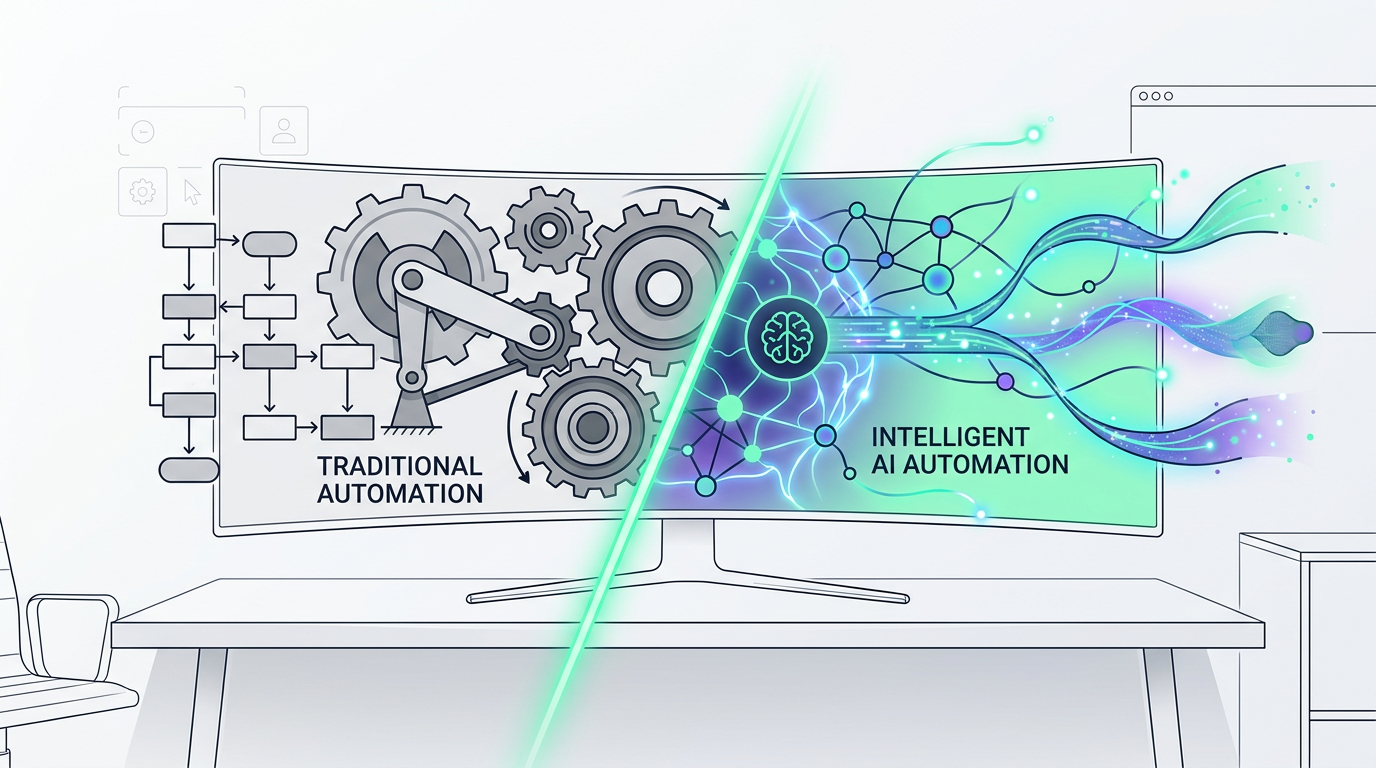
AI automation uses intelligent software to perform complex tasks that traditionally required human judgement and adaptation. Unlike older forms of automation, it can learn from new data, understand context, and make decisions. For a UK SME, this isn't about building self-aware robots; it's about deploying smart systems that handle ambiguity.
The key difference lies in intelligence. Consider traditional ai and robotic process automation. Robotic Process Automation (RPA), software technology that automates repetitive, rule-based digital tasks, is like a highly efficient macro. It can copy and paste data between spreadsheets at lightning speed, but only if the spreadsheet format rarely changes. If a column moves, the RPA bot breaks.
By contrast, AI automation is like a digital assistant that learns. It can read an invoice, understand that 'Inv #', 'Invoice No.', and 'Reference' all mean the same thing, extract the correct amount, and categorise the expense-even if the invoice layout is different every time. A report from The Royal Society explains that this is powered by machine learning, a core component of AI that enables systems to improve from experience. For SMEs, this means you can automate processes that were previously too variable or complex for simple tools, turning practical AI infrastructure into a competitive advantage.
Beyond the Hype: 7 Practical AI Automation Examples for UK SMEs
In our experience, the most successful AI projects solve specific, tangible problems. Instead of asking 'What can we do with AI?', a better question is 'What's our biggest operational bottleneck, and can AI help?'. This is a core part of our human-centred AI approach.
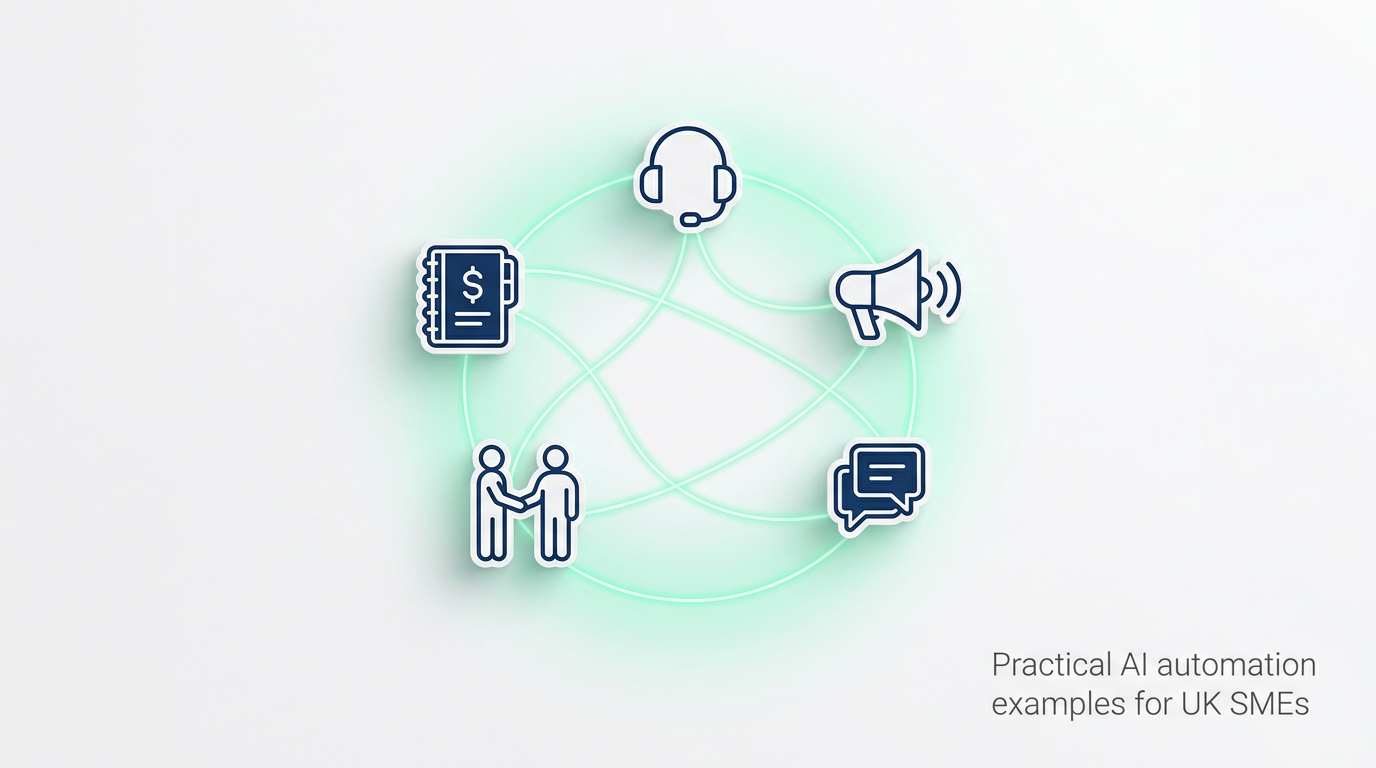
Here are seven practical examples of ai workflow automation that deliver measurable results for UK SMEs:
- Finance: Automatically process supplier invoices. An AI tool can read PDF invoices from an email inbox, extract key data (supplier, date, amount, VAT), and create a draft bill in your accounting software like Xero or QuickBooks. This reduces manual data entry by hours each week.
- Customer Service: Triage and route support tickets. An AI system using Natural Language Processing (NLP), a field of AI focused on understanding human language, can analyse incoming customer emails, determine if the query is about billing, a technical issue, or a sales enquiry, and assign it to the right team member with a suggested reply.
- Marketing: Analyse social media sentiment. Instead of manually reading hundreds of comments, an AI tool can scan mentions of your brand and classify them as positive, negative, or neutral. This gives you a real-time pulse on customer perception and helps you spot issues before they escalate.
- Sales: Qualify and enrich new leads. When a new lead comes in, an AI system can automatically research the person and their company online, pulling in data on company size, industry, and recent news. This provides your sales team with rich context before they even make the first call.
- Human Resources (HR): Screen candidate applications. For open roles that attract hundreds of applicants, AI can perform an initial screen of CVs against the key criteria of the job description, ranking the most suitable candidates for a human recruiter to review in detail.
- Operations: Monitor supply chain disruptions. An AI can track news, shipping data, and weather reports to predict potential delays in your supply chain, allowing you to proactively find alternative suppliers or manage customer expectations.
- Legal & Compliance: Review contracts for non-standard clauses. AI can quickly scan legal documents and flag clauses that deviate from your standard templates, drawing a lawyer's attention to the most critical areas for review.
Case Study: A Typical AI Consulting Scenario
- Challenge: A UK-based e-commerce business was spending over 20 hours per week manually responding to common customer queries like 'Where is my order?' and 'How do I make a return?'. This delayed responses to more complex issues and limited team capacity.
- Solution: We implemented a simple AI-powered chatbot integrated with their order management system. The bot was trained on their specific return policy and could access real-time shipping data via an API.
- Results: The bot successfully handled 65% of incoming queries automatically. This freed up 13 hours of staff time per week, reduced the average first-response time from 6 hours to 30 seconds, and increased customer satisfaction scores by 15% within three months.
- Key Insight: Automating high-volume, low-complexity tasks first delivers immediate ROI and builds team confidence in using AI tools.
Building the Business Case: How to Measure the ROI of AI Automation
A survey from the Confederation of British Industry (CBI) reveals that while over half of UK firms are using AI, an 'unclear ROI' is a major barrier to wider adoption. To secure buy-in and justify investment, you need to measure success beyond just initial cost savings.
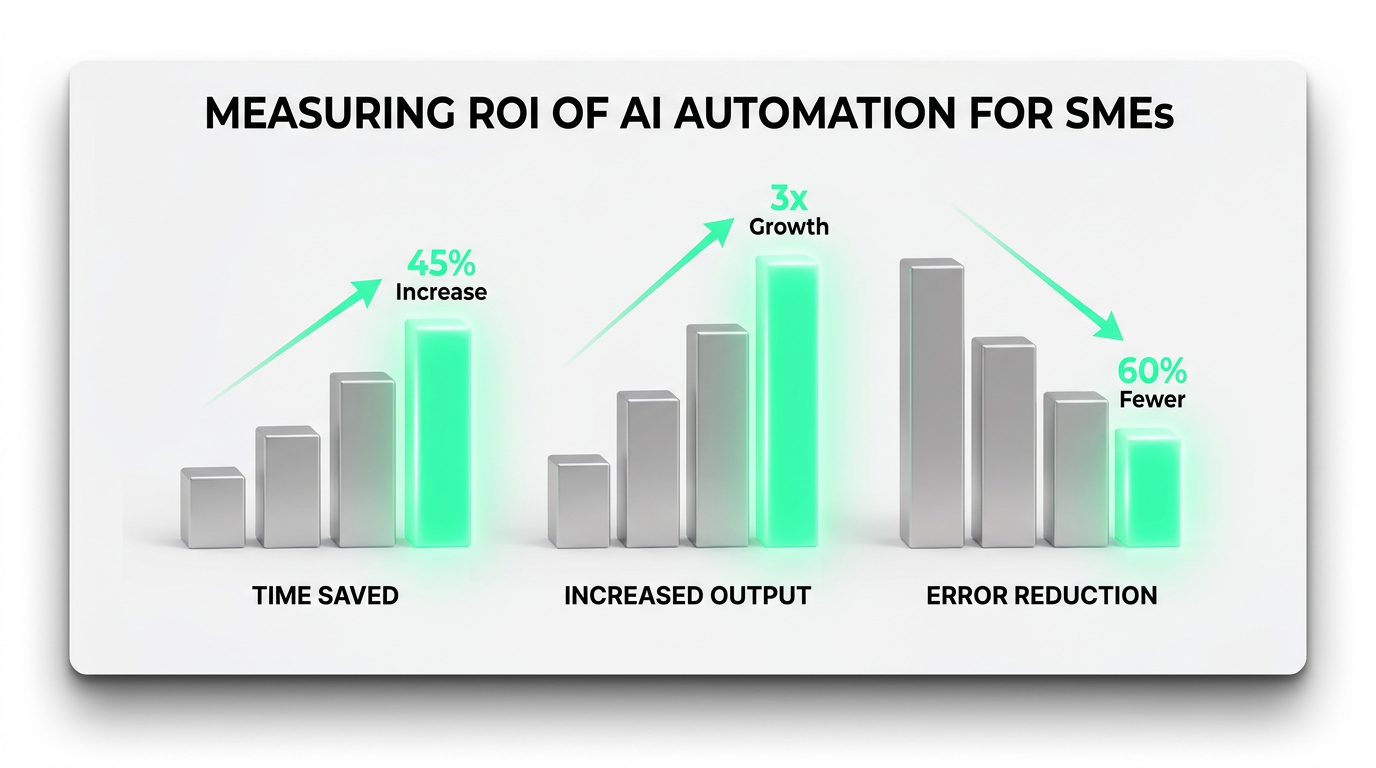
Calculating the Return on Investment (ROI), the ratio of net profit to the cost of an investment, for AI involves looking at both direct financial gains and operational improvements.
Here’s a simple framework:
- Time Saved: This is the most direct metric. Calculate the number of hours your team saves per week on a task. Multiply this by their hourly cost to get a direct labour saving. For example: 5 hours/week x £25/hour x 52 weeks = £6,500 saved annually.
- Increased Output: How much more can your team achieve with their freed-up time? If a sales team member can make 10 more prospecting calls a week instead of doing admin, what is the potential value of the new business they might generate?
- Error Reduction: Manual processes are prone to human error, which can be costly. If automating invoice processing reduces payment errors by 90%, what is the financial impact of avoiding late fees, overpayments, or damaged supplier relationships?
- Speed & Responsiveness: How does faster service impact customer retention? While harder to quantify directly, metrics like 'time to resolution' for support tickets or 'lead response time' are strong indicators of improved customer experience, which drives long-term value.
- Employee Morale: Automating tedious, repetitive work can significantly improve job satisfaction and reduce staff turnover. What is the cost of recruiting and training a replacement for a skilled employee who leaves out of frustration?
By combining these factors, you can build a comprehensive business case. For a deeper dive, explore our practical framework for measuring AI ROI.
Your 5-Step Framework for Implementing AI Automation
Successful ai workflow automation is a strategic process, not a one-off tech purchase. At Up-Stride, we guide our clients through a phased journey based on our Crawl, Walk, Run - AI Adoption Methodology. This approach prevents overwhelm and ensures you get measurable results at every stage.
Here is our recommended 5-step process for getting started:
- Identify Bottlenecks, Not Technologies: Start with a business problem. Where are the biggest time sinks, error rates, or sources of team frustration in your operations? Pick one specific, high-pain process to focus on first.
- Prioritise with an Impact/Effort Matrix: Map your potential automation projects on a simple four-quadrant grid. Label one axis 'Business Impact' (low to high) and the other 'Implementation Effort' (low to high). Start with a project in the 'High Impact, Low Effort' quadrant. This is your pilot.
- Start Small & Prove Value (The 'Crawl' Phase): Implement your pilot project for a single task or a small team. The goal is to get a quick win, learn from the process, and demonstrate tangible value. This builds momentum and internal confidence before you commit to larger investments.
- Choose Your Tools or Partner: Based on your pilot, decide on the right technology. You might use accessible no-code tools for simple workflows or partner with an agency for a more complex, bespoke solution. It's crucial to consider how the solution will handle your data and comply with the UK General Data Protection Regulation (UK GDPR), a legal framework for data privacy. The Information Commissioner's Office (ICO) provides clear guidance on this.
| Factor | Off-the-Shelf Tools (e.g., Zapier, Make) | Bespoke AI Solution (e.g., with an agency) |
|---|---|---|
| Speed to Implement | High (Hours to days) | Low (Weeks to months) |
| Initial Cost | Low (Monthly subscription, often under £100) | High (Project-based fees, typically £5,000+) |
| Customisation | Low (Limited to pre-built integrations) | High (Tailored exactly to your unique workflow) |
| Scalability | Medium (Can become complex and costly at scale) | High (Designed for long-term growth and adaptation) |
| Competitive Edge | Low (Available to all your competitors) | High (Creates a proprietary business asset) |
- Measure, Learn, and Scale (The 'Walk' and 'Run' Phases): Track the ROI of your pilot project against the metrics you defined. Use the learnings to refine your approach. Once successful, you can scale the solution to other teams ('Walk') and then identify new automation opportunities across the business ('Run'). For a full breakdown of this process, see our practical guide to AI implementation.
Choosing the Right Partner: How to Select a UK AI Automation Agency
For many SMEs, partnering with an expert is the fastest and most reliable path to success. But not all ai automation services are created equal. Choosing the right ai automation agency uk is critical. A good partner is a strategic guide, not just a coder.
Here is a checklist of questions to ask a potential partner:
- Do you understand my business goals? A great partner will start by asking about your business challenges and objectives, not by pitching a specific technology. They should be as comfortable talking about profit margins as they are about APIs.
- Can you show me relevant case studies with measurable ROI? Ask for examples of their work with businesses of a similar size and sector. They should be able to clearly articulate the business results they achieved, not just the technical features they built.
- How do you ensure compliance with UK GDPR? Given the UK's strict data protection laws, any partner must have a deep understanding of compliance. According to a UK Government report on the national AI strategy, effective governance is a cornerstone of trustworthy AI.
- Are you transparent about your process and costs? You should receive a clear proposal outlining the project phases, deliverables, timelines, and a full cost breakdown. Avoid partners who are vague about pricing or process.
- What does ongoing support look like? AI systems are not 'set and forget'. They require monitoring, maintenance, and optimisation. Ensure your partner offers ongoing support to help you adapt and scale the solution as your business evolves.
At Up-Stride, we build our strategic AI consulting services around these principles, acting as a long-term partner dedicated to bridging the AI advantage gap for UK SMEs.
Frequently Asked Questions About AI Automation
What is AI automation?
AI automation is the use of intelligent systems to perform complex business tasks that require adaptation and decision-making. Unlike simple automation that follows rigid rules, it uses technologies like machine learning to learn from data and handle variability. For a business, this means it can automate tasks like understanding customer emails or processing varied invoice formats, augmenting human capabilities rather than just mimicking keystrokes.
Is AI the same as automation?
No, they are related but distinct concepts. Think of automation as any technology that performs a task without human assistance. AI is a more advanced form of automation that can simulate human intelligence. A simple automated email responder is automation; an AI system that understands the user's intent and crafts a unique, relevant response is AI automation. All AI can automate, but not all automation is intelligent.
How can UK SMEs use AI automation to make money?
SMEs can generate financial returns through both cost reduction and revenue growth. Cost reduction comes from automating time-consuming administrative tasks in finance, HR, and operations, which lowers labour costs and reduces errors. Revenue growth is driven by using AI for intelligent lead scoring, personalised marketing campaigns that improve conversion rates, and enhanced customer service that boosts retention. The financial benefit is a direct result of improved operational efficiency.
Is AI automation difficult to learn?
The difficulty depends entirely on the type of tool you use. Using modern no-code AI automation platforms like Make.com or Zapier is designed for non-technical users and is not difficult to learn for specific tasks. However, building a custom AI model from scratch requires specialised skills in programming and data science. We recommend SMEs start with accessible tools to solve a clear problem before exploring more complex solutions.
Is AI automation a good career?
Yes, it is one of the fastest-growing career fields globally. The World Economic Forum's 2023 Future of Jobs Report identifies 'AI and Machine Learning Specialists' as the top-trending job role. Careers as an AI consultant, automation specialist, or implementation strategist are in high demand. The field requires continuous learning, but it offers significant opportunities for those who can bridge the gap between technology and business strategy.
What jobs will AI eliminate?
AI is far more likely to eliminate repetitive tasks rather than entire jobs. The work most susceptible to automation involves structured data processing, data entry, and generating routine reports. This frees employees from tedious work to focus on tasks requiring creativity, strategic thinking, and complex problem-solving. Roles are more likely to evolve and be augmented by AI tools than to be eliminated completely.
What jobs will survive AI?
Roles that rely on deep human skills like empathy, creativity, and complex negotiation will be the most resilient. This includes leaders, strategists, therapists, creative directors, and skilled tradespeople who perform complex physical tasks. These jobs require a level of critical thinking, originality, and emotional intelligence that current AI cannot replicate. Even so, most of these roles will likely use AI as a tool to enhance their capabilities.
How do I get into AI automation?
You can enter the field through both technical and non-technical paths. For a non-technical route, focus on business process analysis and master no-code automation platforms to learn how to design efficient workflows. For a technical path, pursue courses in Python, data science, and machine learning. In our view, a deep understanding of business problems is just as valuable as technical expertise in this field.
Is AI considered an automated system?
Yes, but it is a highly advanced and adaptive type of automated system. A traditional automated system follows a fixed set of pre-programmed rules. An AI-powered automated system, by contrast, can learn from new data, make predictions or decisions, and adapt its behaviour over time without needing a human to explicitly code every single possibility. It represents the shift from deterministic (rule-based) to probabilistic (learning-based) systems.
How long will it take to learn AI automation?
The timeline varies from a few weeks to several years depending on your goal. Mastering a no-code tool like Make.com to automate specific workflows can be achieved in a few weeks of focused effort. However, becoming a proficient AI developer or a strategic AI consultant who can design complex, bespoke systems is a multi-year journey of study and practical application. For business owners, the goal isn't expertise, but strategic understanding.
Important Considerations, Risks, and Alternatives
AI automation is a powerful tool, but it's not a magic bullet. Its success depends heavily on the quality, structure, and accessibility of your business data-the 'garbage in, garbage out' principle is more critical than ever. Research from organisations like The Alan Turing Institute highlights that AI models can reflect and even amplify biases present in their training data, requiring careful implementation and ongoing monitoring to ensure fairness and accuracy. Furthermore, ungoverned use of various AI apps by employees can introduce significant security vulnerabilities, a problem known as the risks of ungoverned 'Shadow AI'.
For some business challenges, there are more suitable alternatives. Simple, linear, and unchanging tasks might be better served by traditional Business Process Automation (BPA) or RPA, which can be more cost-effective and straightforward to implement. In other cases, the most efficient solution isn't technology at all; it might be redesigning a manual process, providing better team training, or clarifying responsibilities. The ultimate goal is operational efficiency, and AI is just one of many tools available to achieve it.
We recommend you seek professional guidance when a project is particularly complex or high-stakes. If you need to integrate AI with multiple legacy systems, handle large volumes of sensitive personal data under UK GDPR, or believe a bespoke solution could create a significant and defensible competitive advantage, partnering with an experienced AI consultancy is a wise investment. They can help handle the technical complexity and ensure the project delivers strategic value.
Your Next Step Towards an Optimised, Automated Business
The journey to effective AI automation begins not with complex technology, but with a clear understanding of your business's most pressing operational challenges. By focusing on practical applications that augment your team, measuring success with clear ROI metrics, and starting with small, manageable projects, any UK SME can use these powerful tools. This strategic approach transforms AI from a confusing buzzword into a tangible asset for growth and efficiency.
If you're ready to explore how a human-centred approach to AI can transform your operations, the team at Up-Stride is here to help. We specialise in providing ai automation services and creating practical AI strategies for UK SMEs. Book a free, no-obligation consultation to discuss your specific challenges and discover what's possible.
References
- Department for Science, Innovation and Technology (GOV.UK) - Government Report (2024). The UK AI market is valued at £106 billion, but a 'lack of skilled staff' is a primary barrier to adoption for businesses.
- UK Government - Government Strategy Paper. Details the UK's 10-year plan to support the AI ecosystem and ensure effective governance.
- Information Commissioner's Office (ICO) - Regulatory Guidance. Provides the official framework for ensuring AI usage complies with UK GDPR, covering accountability, fairness, and transparency.
- Stanford Institute for Human-Centered Artificial Intelligence (HAI) - Annual Academic Report. Tracks global trends in corporate AI investment, model costs, and public perception of AI.
- Organisation for Economic Co-operation and Development (OECD) - International Body Observatory Data. Defines international principles for trustworthy AI, including human-centred values and transparency.
- Innovate UK - Government Agency Report (2023). Highlights opportunities for UK service-sector businesses to improve productivity with AI and analyses adoption barriers for SMEs.
- The Alan Turing Institute - National Institute Research Paper. Identifies AI as a 'general-purpose technology' with major potential to boost the UK economy, noting challenges in skills and data access.
- World Economic Forum - Global Survey Report (2023). Projects that 75% of companies will adopt AI, with 'AI and machine learning specialists' being a top-trending job role.
- Confederation of British Industry (CBI) - Business Organisation Survey. Reveals that over half of UK firms use AI, driven by productivity goals, but 'unclear ROI' is a significant barrier.
- The Royal Society - Scientific Academy Report. Provides a foundational, credible explanation of machine learning and its applications for a non-technical audience.
- Make.com - Company Blog Post (2024). Explains AI automation For no-code platforms, outlining how visual workflows can connect different apps and AI models.
- Microsoft - Product Guide. Defines AI automation as the combination of AI and automation to create intelligent processes that can handle complex, dynamic tasks.
- Blue Prism - Industry Guide. Differentiates AI automation from traditional RPA, highlighting AI's ability to handle unstructured data and cognitive tasks.
Your Next Step Towards an Optimised, Automated Business
In summary, AI automation is a journey that begins not with complex technology, but with a clear understanding of your business's most pressing operational challenges. By focusing on practical applications that augment your team, measuring success with clear ROI metrics, and starting with small, manageable projects, any UK SME can leverage these powerful tools. This strategic approach transforms AI from a confusing buzzword into a tangible asset for growth and efficiency.
If you're ready to explore how a human-centred approach to AI can transform your operations, the team at Up-Stride is here to help. As a dedicated ai automation agency uk, we specialise in creating practical ai automation services tailored for UK SMEs. Book a free, no-obligation consultation to discuss your specific challenges and discover what's possible.
Frequently Asked Questions About AI Automation
What is AI automation?
AI automation is the use of artificial intelligence technologies to build systems that can execute complex business processes and learn from the outcomes. Unlike basic automation that follows rigid rules, it can handle unstructured data, make decisions, and adapt its behaviour. For a business, this means augmenting human capabilities by delegating dynamic, cognitive tasks to a smart system, freeing up your team for more strategic work.
Is AI the same as automation?
No, they are distinct concepts, though they are often used together. Think of standard automation as a calculator—it follows pre-programmed rules perfectly but can't learn. AI automation is more like a financial forecasting model; it uses data to learn patterns and make intelligent predictions. All AI can be used for automation, but most traditional automation (like Robotic Process Automation) does not use AI, representing a more advanced, intelligent evolution of the field.
How can UK SMEs use AI automation to make money?
UK SMEs primarily make money with AI automation through cost reduction and revenue growth. Cost reduction comes from automating time-consuming administrative tasks in finance, HR, and operations, lowering labour hours and error rates. Revenue growth is driven by using AI for intelligent lead scoring, creating personalised marketing campaigns at scale, and improving customer service with AI-powered support, which increases customer retention and lifetime value. The financial benefit is a direct result of improved operational efficiency.
Is AI automation difficult to learn?
It depends on the application; using modern no-code AI tools is not difficult, but building custom models is. Platforms like Make or Zapier are designed for non-technical business users to build powerful workflows with a visual interface. However, creating a bespoke AI solution from scratch requires specialised skills in programming and data science. We recommend SMEs start with accessible no-code tools to solve immediate problems before considering more complex, custom-built projects.
Is AI automation a good career?
Yes, it is one of the fastest-growing and most in-demand career fields. The World Economic Forum's 'Future of Jobs Report' consistently lists roles like 'AI and Machine Learning Specialists' as having the highest growth prospects (8). Emerging roles include AI consultant, automation specialist, and prompt engineer. It is a rewarding career path, but it requires a commitment to continuous learning to keep pace with the rapidly evolving technology.
What jobs will AI eliminate?
AI is more likely to eliminate repetitive tasks rather than entire jobs. The roles most affected involve highly repetitive, data-heavy work such as manual data entry, transcribing audio, generating simple template-based reports, and answering basic, recurring customer queries. This transformation allows employees to shift their focus from mundane execution to more strategic activities like analysis, client relationship management, and creative problem-solving, ultimately increasing their value to the business.
What jobs will survive AI?
Jobs that rely on uniquely human skills like deep empathy, complex strategy, and creativity will be the most resilient. This includes roles like therapists, senior leadership, creative directors, artists, and skilled tradespeople who require physical dexterity and on-the-fly problem-solving. These professions depend on nuanced social interaction, ethical judgment, and originality—qualities that AI cannot currently replicate. However, even these roles will likely be augmented and enhanced by AI tools.
How do I get into AI automation?
There are both technical and non-technical paths to entering the field. For a non-technical career, focus on becoming an expert in business process analysis and mastering no-code automation platforms. For a technical route, pursue education in Python, data science, and machine learning through online courses or formal degrees. For any path, a deep understanding of how to identify and solve business problems is just as valuable as the technical skill itself.
Is AI considered an automated system?
Yes, but it represents a highly advanced and intelligent type of automated system. A traditional automated system is deterministic; it follows a fixed set of "if-this, then-that" rules. An AI-powered automated system is probabilistic; it can learn from new data, make nuanced decisions in ambiguous situations, and adapt its actions over time without being explicitly reprogrammed for every possible scenario, making it far more powerful and flexible.
How long will it take to learn AI automation?
The learning curve varies dramatically with your goal. You can learn to build valuable workflows for specific business tasks using a no-code platform in just a few weeks of focused effort. However, becoming a proficient AI developer or consultant who can build custom solutions is a long-term commitment that takes years of study and hands-on experience. For an SME leader, the goal isn't mastery but understanding the principles well enough to lead a project effectively.
Important Considerations, Risks, and Alternatives
It is crucial to recognise that AI automation is not a magic bullet. Its effectiveness is fundamentally tied to the quality and structure of your business data—the "garbage in, garbage out" principle is amplified with AI. Models can inherit and scale biases present in the data they are trained on, requiring careful oversight and continuous monitoring to ensure fairness and accuracy. As The Alan Turing Institute notes, challenges around data access, privacy, and trust must be proactively managed (7). Without proper governance, teams may adopt unsanctioned tools, introducing significant risks of ungoverned 'Shadow AI'.
Furthermore, AI is not always the best or most cost-effective solution. For simple, highly repetitive, and linear digital tasks, traditional Business Process Automation (BPA) or Robotic Process Automation (RPA) may be entirely sufficient and more economical. In some cases, the most efficient solution isn't technological at all; a simple redesign of a manual workflow or clearer communication within a team can resolve a bottleneck more effectively than any software. The ultimate goal is operational efficiency, and AI is just one of many tools available to achieve it.
Given these complexities, it is wise to know when to seek professional guidance. You should consider consulting an expert or an AI automation agency when a project involves significant complexity, such as integrating with multiple legacy systems, handling large volumes of sensitive personal data that fall under UK GDPR, or when a potential bespoke solution offers a high ROI that could create a durable competitive advantage. An experienced partner can help navigate these challenges, ensure compliance, and maximise the return on your investment.
References
- Department for Science, Innovation and Technology (GOV.UK) - Government Report (2024). The UK AI market is valued at £106