
AI automation UK SMEs: AI Automation for UK SMEs: A Practical Guide to ROI and Implementation
AI automation for UK SMEs offers a strategic pathway to enhanced productivity and reduced operational costs by automating repetitive tasks and optimising workflows. By carefully assessing return on investment and implementing solutions that align with business objectives and UK compliance standards, small and medium-sized enterprises can unlock significant growth opportunities. This guide explores practical steps for adopting AI, ensuring a smooth transition and measurable benefits for your organisation.
🎯 Key Takeaway
For most businesses, AI automation for UK SMEs is worth the investment when implemented strategically, focusing first on high-impact, repetitive tasks to boost productivity and reduce operational costs. This approach allows organisations to reclaim valuable hours for strategic work and improve customer service. To succeed, start small with a well-defined problem to prove the concept before committing to larger projects. Finally, typically prioritise UK compliance, ensuring any Artificial Intelligence (AI) solution respects data sovereignty and adheres to Information Commissioner's Office (ICO) guidelines.
As of late 2026, the conversation around AI automation for UK Small and Medium-sized Enterprises (SMEs) is filled with both excitement and confusion. For many business owners, it's difficult to separate the genuine opportunities from the overwhelming hype. This article cuts through the noise. We've created it to be a pragmatic, business-focused guide for evaluating if AI is right for you. We'll cover the real benefits, the true costs, a framework for making a smart decision, and the critical UK-specific risks you can't afford to ignore. It’s a playbook for non-technical founders looking for practical AI infrastructure.
Written by: Up-Stride Content Team | Reviewed by: Mark Blake (Founder & CEO), Gabriel Imevbore (Client Experience & Sales), Thomas McElroy (Brand & Communications)
Our guidance is grounded in real C-suite and operational experience, ensuring you get advice that works in practice, not just in theory.
ℹ️ Transparency Disclosure: This article explores the viability of AI automation for UK SMEs based on industry reports, government guidance, and our team's direct experience with implementation. Some links may connect to our services. All information is verified by our editorial team to ensure accuracy and impartiality.
Why consider AI automation now?
Yes, UK SMEs should strongly be considering AI automation now. The primary reasons are to tackle persistent productivity challenges, close the AI advantage gap with larger competitors, and address national skills shortages. The UK's Department for Science, Innovation and Technology (2024) reports that a 'lack of skilled staff' is a major barrier to growth, a problem AI can directly help mitigate by automating tasks, not replacing people.So, how can AI help SMEs? It moves beyond simple automation. Instead of just following rigid rules, AI can handle dynamic, complex processes. Think of it as a digital team member that can:

- Boost Operational Efficiency: The Confederation of British Industry (CBI) (2023) finds that improving productivity is the number one driver for AI adoption among UK firms. AI tools can take over time-consuming administrative work like invoice processing, data entry, and scheduling, freeing up your team for high-value activities.
- Enhance Customer Service: AI-powered chatbots can provide instant, 24/7 support, while sentiment analysis tools can analyse customer feedback to identify service improvement opportunities. This leads to happier customers and a stronger brand reputation.
- Drive Informed Decisions: AI can analyse vast amounts of sales, marketing, and operational data to uncover trends and insights that would be impossible for a human to spot. This allows you to make smarter, data-driven strategic decisions.
Ultimately, embracing AI automation for small business UK operations isn't about chasing technology trends. It's a strategic move to build a more resilient, efficient, and competitive organisation. The World Economic Forum's (2023) Future of Jobs Report projects that 75% of companies plan to adopt AI, showing a clear direction of travel for the market.
Calculating the True Cost of AI for Your Small Business
Calculating the true AI cost for a small business in the UK requires looking beyond the monthly subscription fee. A successful implementation involves several cost layers that business leaders must anticipate to budget effectively and avoid a poor Return on Investment (ROI). ROI, which is the ratio of net profit to the cost of an investment, is a critical metric for any new technology project.
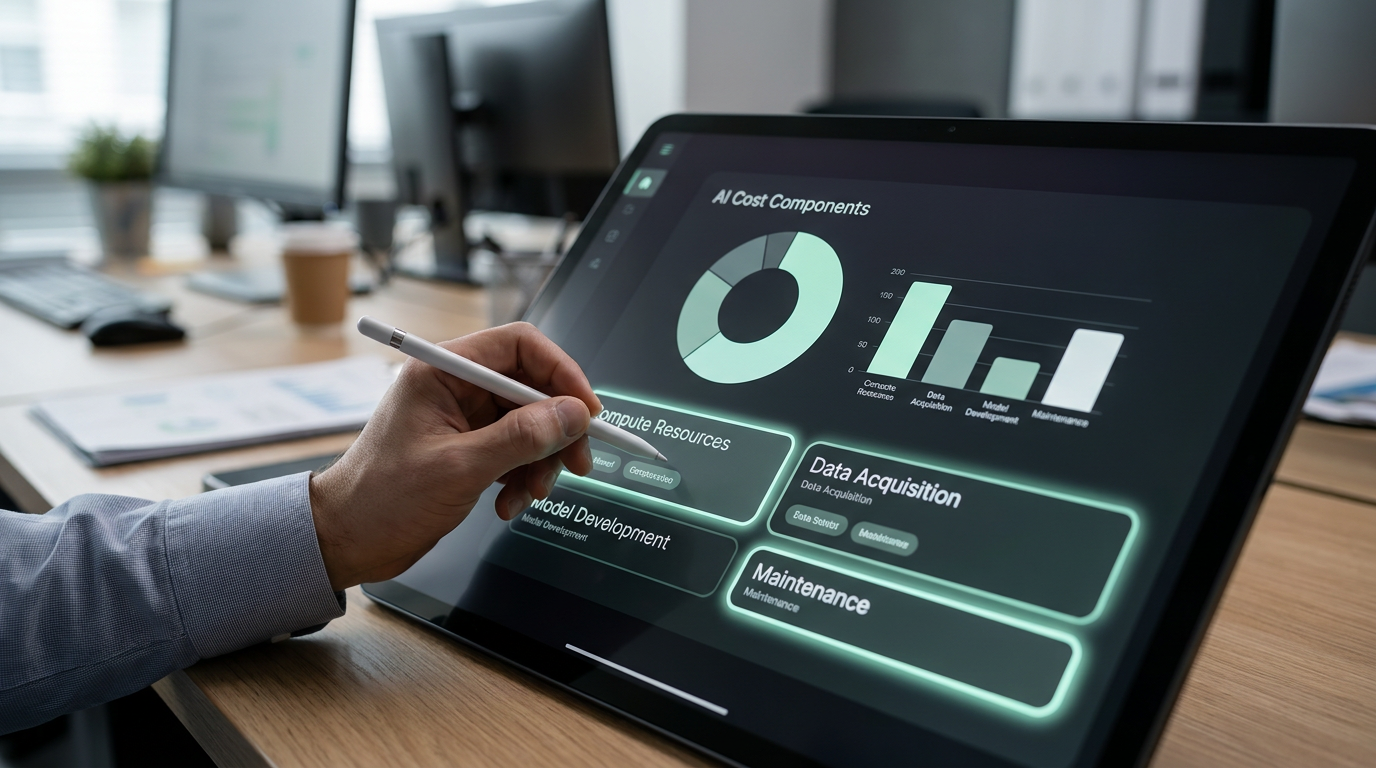
The initial software or platform licence is just the starting point. You must also account for:
- Consultancy and Strategy: Defining the right problem to solve is the most critical step. Expert guidance here prevents you from wasting money on the wrong solution.
- Implementation and Integration: This includes the technical work of connecting the AI tool to your existing systems, such as your Customer Relationship Management (CRM) or Enterprise Resource Planning (ERP) software.
- Data Preparation: AI is only as good as the data it's trained on. Costs may be incurred for cleaning, labelling, and structuring your data so the AI can use it effectively.
- Training and Change Management: Your team needs to understand how to use the new tools. Investing in training ensures you get the full benefit of the system.
- Ongoing Costs: Many AI services use consumption-based pricing (e.g., per API call or 'token'). It's vital to monitor this to avoid unexpected bills. You'll also have maintenance and support costs.
The table below breaks down these potential expenses. It's also worth noting that some AI-related development may be eligible for UK R&D tax credits, which can offset a portion of the investment.
| Cost Component | Typical Range (SME) | Key Considerations |
|---|---|---|
| Off-the-Shelf Software | £20 - £500 / month | Per-user pricing, feature limitations, data privacy terms. |
| Initial Strategy & Setup | £1,500 - £7,500 (one-off) | For custom projects or strategic guidance on tool selection. |
| Custom Development | £10,000 - £50,000+ | For bespoke solutions tailored to unique business processes. |
| Data & Integration Work | £1,000 - £10,000+ | Depends heavily on the state of your existing data and systems. |
| Ongoing Maintenance | 15-20% of initial cost / year | Essential for updates, security, and performance optimisation. |
Note: Ranges are estimates based on market analysis and project experience. Sources include data from the Stanford Institute for Human-Centered Artificial Intelligence (HAI) (2024) on model costs and an Innovate UK (2023) report on SME adoption.
A Practical Framework: Evaluating if AI is Worth It for Your Organisation
Before investing, you need a clear business case. At Up-Stride, we guide clients through a simple but powerful four-step framework to determine if a potential AI project will generate real value. This isn't just about cost savings; it's about understanding the total impact on your business. You can explore a more detailed version in our A Practical Framework for Measuring AI ROI.

Step 1: Identify High-Friction Pain Points
Look for tasks within your business that are:
- Repetitive and Time-Consuming: Think daily data entry, manual report generation, or sorting customer emails.
- Error-Prone: Where do human errors cause delays, rework, or financial loss?
- Scalability Blockers: What processes prevent you from taking on more customers or growing without hiring more staff?
Step 2: Quantify the 'Before' State
Put a number on the pain. How many hours per week does your team spend on this task? What is the average cost of an error? What is the opportunity cost-what could that team member be doing instead? This creates your baseline.
Step 3: Estimate the 'After' State with AI
Work with a potential partner or research a tool to project the efficiency gains. For example, could AI reduce the time spent on the task by 80%? Could it lower the error rate by 90%? Also, consider qualitative benefits like improved staff morale from removing tedious work.
Step 4: Calculate Value Generation
Now, you can calculate the value. This includes hard ROI (cost savings from reclaimed hours) and intangible benefits (faster customer response times, better decision-making). A project is a strong candidate if the value generated significantly outweighs the estimated cost from the previous section.
Hypothetical Case Study: Midlands Retail SME
- Challenge: The finance team spent a collective 20 hours per week manually processing supplier invoices, leading to a 5% error rate and frequent late payment fees.
- Solution: We implemented an AI-powered document processing tool that automatically extracts data from invoices, validates it against purchase orders, and inputs it into their accounting software.
- Results: The solution reduced manual processing time by 95%, saving 19 hours per week. The error rate dropped to less than 0.5%, eliminating late fees and improving supplier relationships.
- Key Insight: Focusing on a single, high-volume, and rule-based process provided a clear and measurable ROI, building internal confidence for future AI projects.
This structured approach helps identify an effective AI use cases for UK SMEs and ensures your investment is tied to a tangible business outcome.
A Practical Guide to AI Implementation and Governance for UK SMEs
A successful AI implementation for UK SMEs is as much about people as it is about technology. Without proper governance and a human-centred approach to change management, even an effective tool can fail. Our experience shows that framing AI as a 'digital colleague'-a tool that helps your team perform better-is key to adoption.
Here's a practical approach to implementation and governance:
- Involve Your Team Early: Don't spring a new tool on your employees. Involve them in the process of identifying pain points (as described in our framework). When they are part of the solution, they are far more likely to embrace it.
- Communicate the 'Why': Clearly explain how the AI tool will benefit them directly. Will it eliminate their most boring task? Will it free them up to focus on more creative work? Focus on augmentation, not replacement.
- Start Small with a Pilot: Use our Crawl, Walk, Run methodology. Begin with a single, low-risk pilot project. This allows you to prove the value, work out any issues, and build momentum before scaling across the organisation. You can learn more in our practical guide to AI implementation.
- Establish Clear Governance: This is non-negotiable in the UK. You must comply with the Data Protection Act 2018 and the UK General Data Protection Regulation (UK GDPR). The Information Commissioner's Office (ICO) (2024) provides clear guidance. Your policy should address:
- Data Sovereignty: Ensure customer data is processed and stored within the UK or an approved jurisdiction. Using US-based tools without the right safeguards can be a major compliance risk.
- Approved Tools: Create a list of approved AI tools. This prevents the use of 'Shadow AI'-unvetted tools that employees use without permission, which can lead to data leaks and intellectual property loss. Learn more about understanding the risks of Shadow AI.
- Accountability: Designate a person or team responsible for overseeing AI use and ensuring it aligns with your business ethics and legal obligations, as outlined in the UK Government's National AI Strategy (2021).
By taking a measured, human-centred, and compliant approach, you can de-risk your AI investment and turn it into a sustainable advantage.
Important Considerations
Before committing to a large-scale AI project, it's wise to weigh a few key factors. First, recognise the limitations of any research, including market reports. While statistics from sources like the OECD and Stanford HAI provide excellent benchmarks, your business's specific context, data maturity, and team readiness are the most important variables. An industry-wide trend doesn't guarantee success for your unique situation.
Second, consider alternative approaches. Sometimes, the problem you're trying to solve doesn't require complex AI. It might be better addressed through simpler process optimisation, traditional rules-based automation (which is less expensive), or better staff training. Robotic Process Automation (RPA), which automates repetitive, rule-based tasks without intelligence, can be a highly effective first step for many organisations. Typically ask: 'Is AI the simplest effective solution, or is there a better way?'
Finally, know when to seek professional guidance. If you lack in-house technical expertise, are dealing with sensitive customer data, or the project requires integration with multiple legacy systems, consulting with an AI specialist is a prudent investment. An expert partner can help you handle the complexities of vendor selection, data governance, and strategic implementation, significantly increasing your chances of achieving a positive ROI and avoiding costly missteps.
Frequently Asked Questions
What is AI automation for UK SMEs?
AI automation for UK SMEs involves using intelligent software to perform tasks that traditionally require human judgment and intervention. Unlike simple automation, it can handle complex processes, analyse data, and make decisions to improve efficiency, reduce costs, and drive growth. This is particularly valuable for gaining a competitive edge in the UK market.
How can AI help SMEs?
AI can help SMEs by automating repetitive administrative tasks, providing deep insights from customer data, personalising marketing efforts, and optimising supply chains. This frees up valuable team time to focus on strategic growth, innovation, and building customer relationships rather than on manual processes. It's about working smarter, not just harder.
How much does AI cost for a small business in the UK?
The cost of AI for a UK small business varies widely, from £20 per month for off-the-shelf tools to over £20,000 for bespoke solutions. According to industry analysis from firms like Wise Solutions, initial strategic projects often fall in the £1,500-£7,500 range. Costs depend on complexity, the level of customisation, and whether expert consultancy is required.
Will automation jobs be replaced by AI?
AI is more likely to augment human roles rather than replace them entirely, taking over repetitive and data-heavy tasks. This allows employees to focus on creative, strategic, and client-facing work that requires a human touch. The World Economic Forum's (2023) research predicts that whilst some roles will be displaced, AI will also create many new roles.
Which AI is best for small business owners?
The 'best' AI depends entirely on the specific business problem you want to solve. For marketing, tools like Jasper or Copy.ai are popular. For customer service, AI-powered chatbots can be effective. For operations, a custom AI agent might be needed. Our advice is typically to start by defining the problem, not by choosing a tool.
Is there a ChatGPT for business?
Yes, OpenAI offers 'ChatGPT Team' and 'ChatGPT Enterprise', which are designed for business use. These versions provide enhanced security, data privacy controls, and administrative features not available in the free version. They ensure your company's proprietary data is not used to train public models, a critical compliance feature for UK businesses.
What are the main risks of using AI?
The primary risks for SMEs include data security breaches, non-compliance with UK GDPR, and intellectual property loss, especially from unapproved 'Shadow AI' usage. There is also the financial risk of a poor return on investment if a project is not planned strategically. In our view, a clear governance policy is the most effective mitigation.
What is the difference between AI and traditional automation?
Traditional automation follows pre-programmed, fixed rules ('if this, then that'), while AI can learn, adapt, and make decisions. For example, traditional automation can send a standard email reply. AI can analyse the customer's query, understand its sentiment and intent, and then draft a personalised, context-aware response for review.
Do I need technical skills to implement AI?
Not necessarily for all solutions, as many modern AI tools are 'no-code' or 'low-code' and designed for non-technical users. However, for strategic or custom implementations, partnering with an AI consultant is highly recommended. This ensures the project aligns with business goals and is technically sound, secure, and compliant from the start.
How do I ensure AI use is GDPR compliant in the UK?
To ensure compliance, you must follow ICO guidance, have a lawful basis for processing data, be transparent with users, and conduct data protection impact assessments. You should use AI partners and tools that guarantee data is processed and stored within the UK or an approved jurisdiction to meet data sovereignty requirements.
Conclusion
Ultimately, the decision to invest in AI automation for UK SMEs hinges on a strategic evaluation of value, not just cost. By moving beyond the hype and focusing on solving specific business problems, you can transform AI from a daunting expense into a powerful engine for productivity and growth. A successful AI implementation for UK SMEs begins with a clear problem and a solid business case, ensuring your investment is directed where it can make the most impact.
If you've identified a challenge but are unsure of the next steps, a strategic partner can provide clarity. At Up-Stride, we specialise in creating human-centred AI solutions for UK businesses. We can help you build the business case, handle the complexities, and ensure your investment delivers real, measurable results. Book a free, no-obligation consultation today to discuss your specific needs.
References
- Department for Science, Innovation and Technology (GOV.UK) (2024) - Government Report. Estimates the UK AI market and identifies skills gaps as a key barrier to adoption.
- UK Government (2021) - Government Publication. Outlines the UK's 10-year plan to support and govern the AI ecosystem.
- Information Commissioner's Office (ICO) (2024) - Regulatory Guidance. Provides official guidance on applying UK data protection law to AI systems.
- Stanford Institute for Human-Centered Artificial Intelligence (HAI) (2024) - Annual Academic Report. Tracks global trends in AI investment, model costs, and ethics.
- Organisation for Economic Co-operation and Development (OECD) (2024) - International Body. Provides international principles for trustworthy AI and data on AI readiness.
- Innovate UK (2023) - Government Agency Report. Details AI opportunities and adoption barriers for UK service sector businesses.
- The Alan Turing Institute (2022) - National Institute Report. Analyses AI's potential to boost the UK economy.
- World Economic Forum (2023) - Global Survey Report. Projects that 75% of companies surveyed plan to adopt AI technologies.
- Confederation of British Industry (CBI) (2023) - Business Organisation Survey. Finds that improving productivity is the top driver for AI adoption among UK firms.
- British Business Bank (2024) - Guidance Article. Explores current AI trends and practical applications for small businesses.
- Wise Solutions UK (2024) - Industry Analysis. Provides a guide on initial AI automation steps for UK small businesses, including cost estimates.
- Crouch End Media (2024) - Practical Guide. Offers a UK-focused perspective on accessible AI tools and strategies for SMEs.