
AI for Small Business: A UK Guide to Costs, ROI, and Real-World Value
🎯 Key Takeaway
Adopting AI for small business is worth the investment when approached strategically, focusing on solving specific problems to generate a clear return on investment. The key is to start small, measure outcomes, and align technology with clear business goals rather than chasing hype. AI costs can range from free 'freemium' tools to over £50,000 for bespoke solutions, so a realistic starting budget is crucial. The most significant benefits for UK Small and Medium-sized Enterprises (SMEs) include increased productivity, operational cost savings, and enhanced customer service. However, compliance with the UK General Data Protection Regulation (UK GDPR), the data protection law governing personal data in the United Kingdom, and managing data security are non-negotiable risks that require a clear governance policy from day one.
As of September 2026, the conversation around Artificial Intelligence (AI), the simulation of human intelligence in machines, is impossible for any business leader to ignore. But for the owner of a UK SME, the hype often feels disconnected from the day-to-day reality of running a business. For AI for small business, the big question isn't about futuristic robots; it's about practical value. Is AI worth it for small business, or is it another expensive distraction?
We'll be honest - navigating the options can be overwhelming. That's why we've created this guide. It's not for data scientists; it's for business owners. We will cut through the jargon to give you a clear framework for deciding if AI is a worthwhile investment for you. We'll cover the real costs, show you how to calculate potential Return on Investment (ROI), explore practical AI use cases for SMEs, and outline the critical risks specific to operating in the UK. This is the non-tech founder’s practical playbook for making an informed decision.
Written by: Up-Stride Content Team | Reviewed by: Mark Blake (Founder & CEO), Gabriel Imevbore (Client Experience & Sales), Thomas McElroy (Brand & Communications)
Expertise: Enterprise-ready team with C-suite and operational experience, providing AI guidance grounded in real business challenges.
ℹ️ Transparency Disclosure: This article explores the viability of AI for UK small businesses based on government reports, industry analysis, and our own experience. We believe in empowering SMEs with clear, honest information. To achieve this, some links may connect to our own services and guides. All information has been verified by our editorial team to ensure it is accurate and actionable. Up-Stride is a specialised AI consultancy for UK SMEs.
How Much Does AI Cost for a Small Business in the UK?
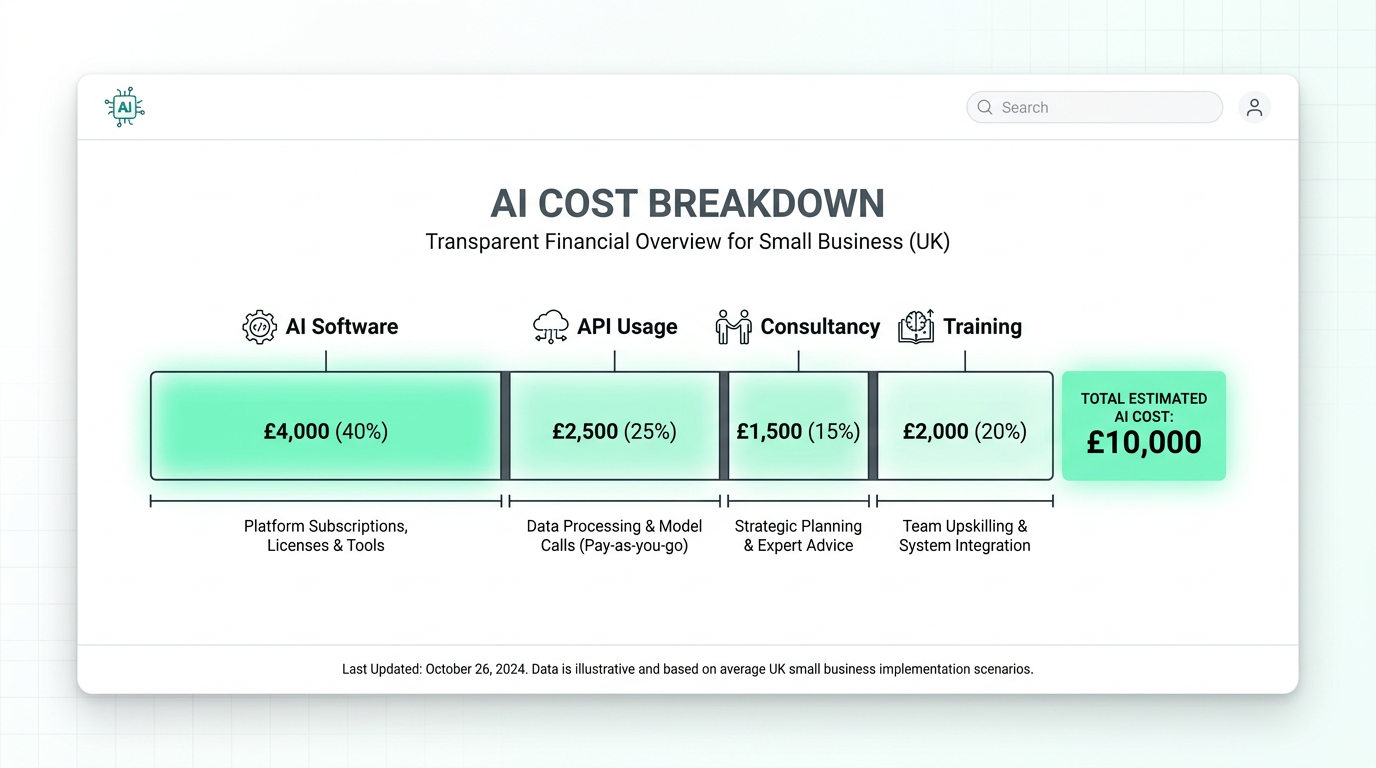
The cost of AI for a small business in the UK can range from £0 for basic 'freemium' tools to well over £50,000 for custom-developed solutions. There isn't a single price tag; instead, costs are broken down into distinct categories. Understanding these components is the first step to creating a realistic budget and answering the question of how much does AI cost for a small business.
The main cost drivers are software, people, and hidden operational expenses. Software costs include monthly subscriptions for off-the-shelf tools (like AI writers or customer service bots) and usage-based 'token' fees for powerful models. People costs cover consultancy for strategy, developer fees for implementation, and crucial team training. Finally, don't forget the hidden costs: preparing and cleaning your data, integrating the AI with existing systems like your Customer Relationship Management (CRM), and ongoing maintenance. According to a 2024 government report, the UK AI market is valued at £106 billion, but a 'lack of skilled staff' remains a key cost and barrier for SMEs, often necessitating external expertise Department for Science, Innovation and Technology (GOV.UK).
It’s also important for UK businesses to explore potential cost offsets. Government incentives like R&D tax credits or grants from Innovate UK, the UK's national innovation agency, can significantly reduce the financial burden of adopting new technology.
| AI Cost Component | Typical UK SME Cost Range | Key Considerations |
|---|---|---|
| Off-the-Shelf Software | £20 - £300 / month | Per-user subscriptions for tools like AI writers, marketing platforms, or chatbots. |
| API & 'Token' Usage | £50 - £1,000+ / month | Usage-based fees for integrating powerful AI models into your own applications. Can be volatile. |
| Consultancy & Strategy | £1,500 - £10,000+ (project-based) | Expert help to define a problem, choose the right tech, and create an implementation plan. |
| Custom Development | £10,000 - £50,000+ (project-based) | Building a bespoke AI solution tailored to a unique business process. |
| Team Training & Upskilling | £500 - £5,000 | Essential for adoption and ensuring your team can use the new tools effectively. |
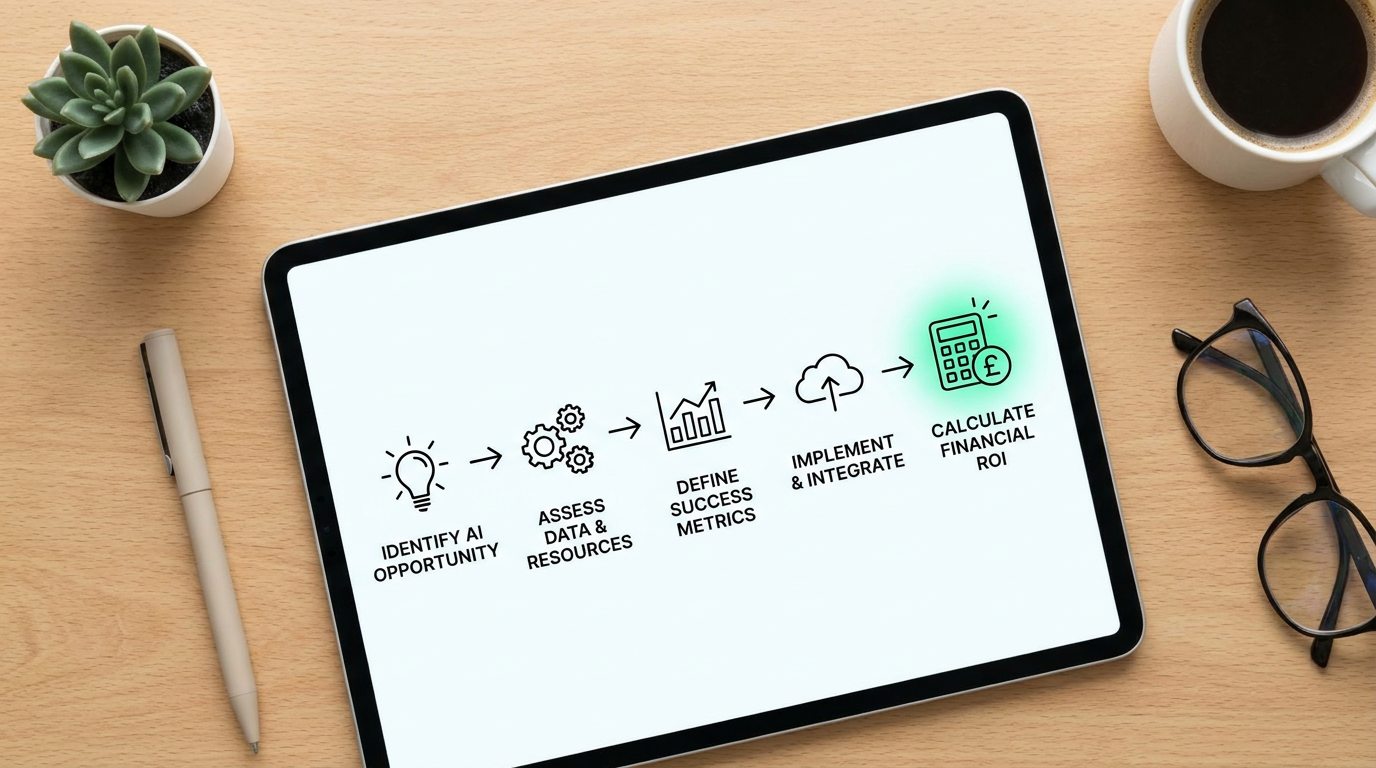
How to Calculate Your Potential AI ROI: A 5-Step Framework
To determine if is AI worth it for small business, you need a simple way to estimate the return on investment. Forget complex financial models; a practical, back-of-the-envelope calculation is often enough to see if an AI project makes sense. In our experience, the most successful AI adoptions start by targeting a specific, measurable pain point.
We guide our clients through a straightforward 5-step process to quantify potential value before spending a single pound. This approach turns a vague idea into a concrete business case.
- Identify a High-Pain, Low-Value Task: Find a repetitive, manual task that consumes significant staff time but doesn't require strategic thinking. A great example is manually processing supplier invoices.
- Quantify the 'Before' State: Calculate the current cost of this task. For instance, if an accounts administrator spends 8 hours per week on invoices at an hourly cost of £25 (including salary and overheads), the weekly cost is £200.
- Estimate the 'After' State with AI: Research an AI-powered invoice processing tool. Let's say it reduces the manual work to just 1 hour per week for verification. The new weekly cost is £25.
- Calculate the Gross Savings: The difference between the 'before' and 'after' state is your gross saving. In this scenario, it's £175 per week (£200 - £25), or £9,100 per year.
- Factor in the AI Cost for Net ROI: If the AI tool costs £100 per month (£1,200 per year), your net saving is £7,900 in the first year. The ROI is substantial and easy to justify.
This method provides tangible ROI. Plus, there are intangible benefits: the administrator is freed up for higher-value work, improving morale, and invoice processing becomes faster and less error-prone. A survey from the Confederation of British Industry (CBI) found that whilst productivity is a key driver, 'unclear ROI' is a major barrier; this framework directly addresses that concern. For a deeper dive, explore our practical framework for measuring AI ROI.
Beyond the Hype: Practical AI Use Cases for SMEs That Deliver Value
The key to successful AI adoption is to ignore science-fiction concepts and focus on practical applications that solve real-world business problems today. For SMEs, an effective AI use cases for SMEs are often those that automate repetitive tasks, enhance decision-making, and improve customer interactions. These aren't about replacing your team; they're about augmenting their capabilities.
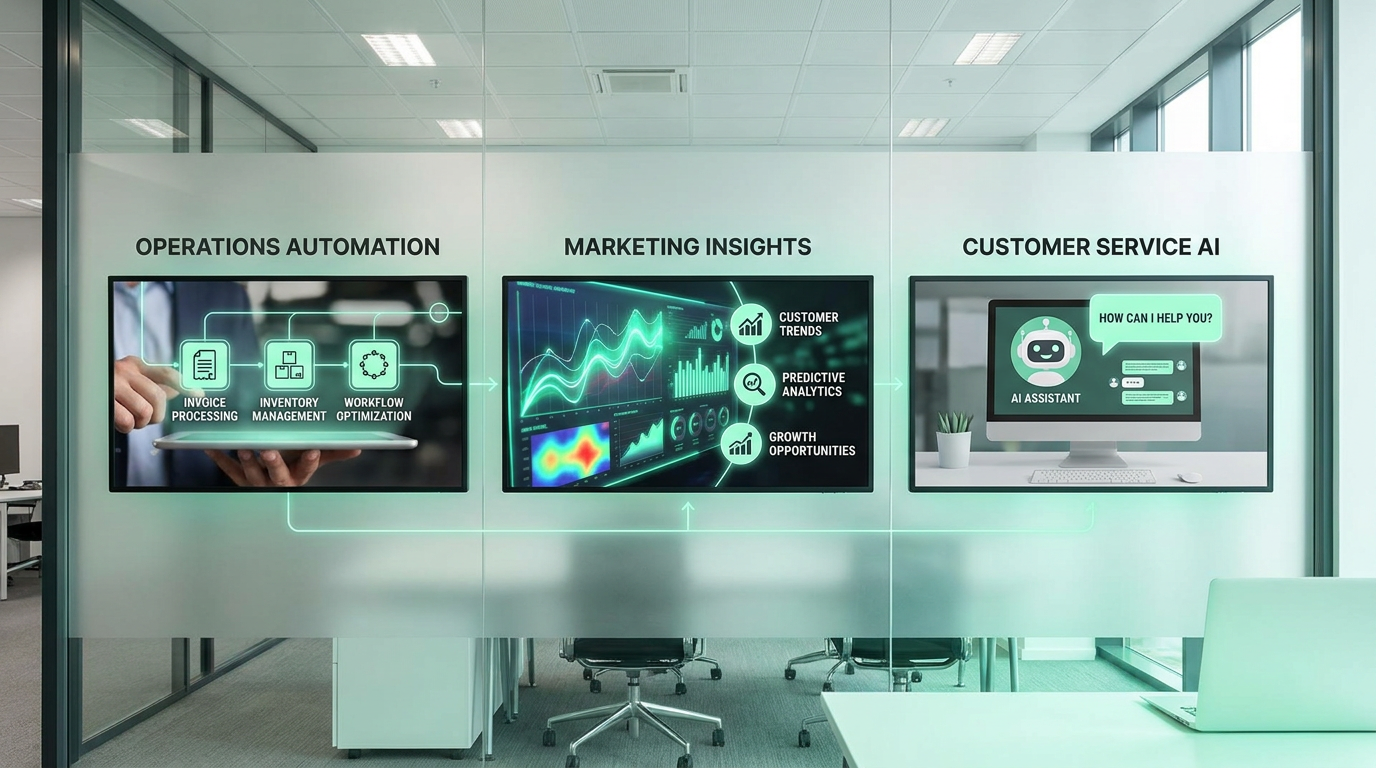
Here are some of the most effective, real-world applications we see delivering value for UK businesses right now, grouped by function:
- Operations & Administration: This is often an effective place to start. AI tools can automate invoice processing, schedule appointments, manage inventory by predicting demand, and transcribe meeting notes into actionable summaries. An Innovate UK report (2023) highlights these efficiency gains as a primary opportunity for the UK's service sector.
- Marketing & Sales: AI can act as a powerful assistant. It can generate first drafts of ad copy, social media posts, and email newsletters. It can analyse campaign data to identify what resonates with your audience, personalise website content for different visitors, and score leads to help your sales team focus on the most promising prospects.
- Customer Service: This is a major area for AI impact. AI-powered chatbots can handle common customer queries 24/7, freeing up your human agents to deal with more complex issues. AI can also analyse customer support tickets to identify recurring problems or summarise long customer conversations for agents, ensuring a smoother handover and better service.
The World Economic Forum notes in its 2023 Future of Jobs Report that 75% of companies are expected to adopt AI, making these use cases not just an advantage, but a future necessity.
What Are the Tangible AI Benefits for Small Business UK?
The tangible AI benefits for small business UK primarily revolve around boosting productivity, cutting operational costs, and gaining a competitive edge. When implemented correctly, AI stops being a cost centre and becomes a powerful engine for growth and efficiency.
The most significant benefits reported by UK firms include:
- Increased Productivity: This is the top driver for AI adoption. Over half of UK firms are already using AI, according to the Confederation of British Industry (CBI), with productivity goals being paramount. AI automates time-consuming tasks like data entry, report generation, and email sorting, freeing up your team to focus on strategic work that drives revenue.
- Reduced Operational Costs: By automating processes, as shown in our ROI calculation example, AI directly reduces labour costs. It also minimises costly human errors in areas like invoicing and inventory management, leading to further savings and improved cash flow.
- Enhanced Customer Experience: AI enables you to provide faster, more personalised service at scale. 24/7 chatbots answer questions instantly, and AI-driven analytics can help you understand customer behaviour better, allowing for more targeted and effective communication.
- Competitive Advantage: The UK Government's National AI Strategy explicitly aims to ensure the whole country benefits from AI. For SMEs, this means using AI as a leveller, providing access to capabilities that were once only available to large enterprises. It allows smaller firms to compete more effectively on service, efficiency, and innovation.
Managing AI Risks and GDPR Compliance in the UK
Adopting AI offers huge potential, but it also introduces new risks that must be managed proactively, especially concerning data protection. For any UK business, understanding and adhering to the UK General Data Protection Regulation (UK GDPR) is non-negotiable. The Information Commissioner's Office (ICO), the UK's independent data regulator, provides clear guidance that using AI does not change your fundamental data protection obligations.
One of the biggest risks we see is 'Shadow AI' - the use of unapproved AI tools by employees. An employee using a free online tool to summarise sensitive customer data could constitute a serious data breach. Therefore, creating a simple, clear AI Usage Policy is a critical first step for any business.
Key risks to address include:
- Data Privacy & UK GDPR: You must have a lawful basis for processing any personal data with AI. You must be transparent with customers about how their data is used and ensure the AI system doesn't make unfair, biased decisions. The ICO's AI and data protection risk toolkit is an essential resource here.
- Data Security & IP: Where is your data going? When you input information into a public AI model, you may lose control over it. For proprietary business information, it's vital to use enterprise-grade AI tools with explicit data privacy contracts.
- Accuracy and Bias: AI models can be wrong. They can 'hallucinate' facts or reflect biases present in their training data. All AI-generated output, whether it's a financial forecast or a marketing email, must be reviewed by a human before use.
Managing these risks is central to a human-centred AI approach. For a deeper look, see our guide to Shadow AI risks and governance.
Your AI-Readiness Checklist: Is Your Business Prepared for Implementation?
Jumping into an AI implementation for small business without proper preparation is a recipe for wasted time and money. Before you invest, it’s crucial to assess whether your business is truly ready to benefit from this technology. The success of AI depends less on the tech itself and more on the foundations you have in place.
Use this simple checklist to gauge your AI readiness. A 'no' doesn't mean you can't use AI; it just highlights an area you need to work on first.
- Problem Definition: Do you have a specific problem to solve? The most common mistake is adopting 'AI for AI's sake'. A successful project starts with a clear, well-defined business problem (e.g., 'our customer response time is too slow') not a vague goal ('we want to use AI').
- Data Readiness: Is your data accessible and clean? AI is powered by data. If the information needed for your chosen problem is messy, incomplete, or locked away in disconnected spreadsheets, your first step is a data-cleaning project, not an AI project. The Alan Turing Institute identifies data access as a key challenge for UK businesses.
- Team Readiness: Is your team prepared for change? Does your team have the basic digital skills to use new tools? More importantly, is there a willingness to adapt processes? As noted by GOV.UK, the 'lack of skilled staff' is a major barrier, so a plan for training and change management is essential.
- Technology Infrastructure: Can your systems connect? Can a new AI tool easily integrate with your existing CRM, accounting software, or website? Projects that require complex, custom integrations are significantly more expensive and risky.
- Leadership Buy-in: Is leadership committed? AI implementation requires investment and patience. The leadership team must be fully committed to the project, understand the goals, and champion the change within the organisation.
If you've ticked these boxes, you're in a strong position. For a more detailed walkthrough, see our practical, jargon-free 5-step framework for implementing AI.
Frequently Asked Questions
What is AI for small business?
Artificial Intelligence for small business is the practical application of smart software to automate tasks, analyse data for insights, and improve operational efficiency within smaller companies. It's not about building sentient robots but about using accessible, often low-cost, tools to solve real-world problems like managing customer service, creating marketing content, or streamlining administrative work. Ultimately, it helps SMEs save time, reduce costs, and compete more effectively against larger rivals.How much does AI cost for a small business?
The cost of AI for a small business varies dramatically, from free to tens of thousands of pounds. You can start for free with 'freemium' versions of popular tools. Paid off-the-shelf software, like AI writing assistants or chatbots, typically costs between £20 and £300 per month. A custom AI implementation project, however, can easily cost £10,000 or more. The key is to start with a clear budget and focus on solutions with a clear ROI.What are 5 disadvantages of AI?
The five main disadvantages of AI are cost, data security risks, potential for bias, the need for new skills, and the risk of over-reliance. The initial cost of software and implementation can be a barrier. Using AI with customer data creates significant data privacy and security responsibilities under UK GDPR. AI models can also produce biased or inaccurate results, and employees require training to use them effectively. Finally, over-relying on AI can erode critical human skills over time.Which AI is best for beginners?
an effective AI for beginners are user-friendly, off-the-shelf tools that solve one specific problem without requiring any coding. Good starting points include AI-powered writing assistants like Jasper or Copy.ai for marketing content, simple customer service chatbots like Tidio to handle common queries, or automation platforms like Zapier which now integrate AI steps into their workflows. We recommend choosing a tool that addresses your single most time-consuming manual task first.Can I use AI without paying?
Yes, you can strongly start using AI without paying, as many powerful tools offer 'freemium' models. Free versions of large language models like ChatGPT and Google's Gemini, along with various AI image generators, are widely available. These are excellent for learning, experimenting, and handling simple, non-sensitive tasks. However, for business use, a paid plan is almost typically necessary for better security, enhanced features, higher usage limits, and data privacy may help.What is the 30% rule in AI?
The '30% rule' is a popular guideline used to identify good opportunities for AI automation. It suggests that if an AI tool can automate a task to save at least 30% of the time it would normally take a human to complete, it's a strong candidate for implementation. This isn't a strict law but a practical benchmark that helps businesses prioritise AI projects that are likely to deliver a significant and measurable return on investment.Is my business data safe with AI?
Your data's safety entirely depends on the specific AI tool you use and your company's internal policies. Public, free-to-use models may use your input data to train their systems, which is a major risk for sensitive information. Reputable, business-grade AI tools, however, offer strict data privacy agreements and reliable security features. It's vital to read the terms of service and establish a clear AI governance policy to comply with UK GDPR.How do I start implementing AI in my business?
Our advice is to start small and prove the value with a simple three-step process. First, identify a single, highly repetitive, and time-consuming task within your business. Second, research and select a low-cost, user-friendly AI tool specifically designed to automate that task. Third, run a small, controlled pilot project to test the tool and carefully measure the time or cost savings before considering a wider rollout across the company.What AI is better than ChatGPT?
The term 'better' is subjective and depends entirely on the specific task you need to accomplish. While ChatGPT is an excellent general-purpose tool for a wide range of tasks, specialised AI tools often outperform it in their specific niches. For instance, an AI like Midjourney is vastly superior for image generation, while dedicated AI legal-tech tools are better for contract analysis. An effective tool is typically the one that solves your specific business problem most effectively.Which jobs will survive AI?
Jobs that rely heavily on uniquely human skills like creativity, complex strategic thinking, emotional intelligence, and intricate problem-solving are the most likely to survive and evolve alongside AI. Roles such as senior business strategists, therapists, creative directors, and expert tradespeople are often cited as resilient. The focus for most roles will be on augmentation, where AI handles the repetitive parts of a job, allowing humans to focus on the high-value, strategic elements.Important Considerations Before You Invest
It's important to acknowledge that AI is a rapidly evolving field. The cost and capability data cited in this article are based on trends as of late 2026 and are subject to change. Much of the available research focuses on larger enterprises, and while SME-specific data is growing, it is still emerging. The success of any AI tool is highly dependent on the unique context, processes, and goals of each individual business; what works for one may not work for another.
There are also effective alternatives to complex AI. For many common efficiency problems, simpler Business Process Automation (BPA) using no-code tools like Zapier or Make may be a more cost-effective first step. In some cases, simply optimising a manual workflow through process mapping and refinement can yield significant gains without any new technology. We believe AI should be considered as one of several tools in your efficiency toolkit, not the only solution.
Finally, before making a significant investment, we strongly advise that business owners consider a strategic consultation. An expert partner can help you handle the complex and often confusing vendor landscape, ensure your plans are fully compliant with UK GDPR from day one, and help you build a phased implementation roadmap that aligns with your specific business goals. This guidance helps prevent costly mistakes and ensures your first steps into AI are confident and value-driven.
Making the Right Decision: Is AI Worth It for Your SME?
Ultimately, deciding on AI for small business is less about the technology and more about strategic problem-solving. By focusing on a clear ROI, starting with manageable use cases, and establishing strong governance from the outset, UK SMEs can turn AI from a confusing buzzword into a powerful engine for productivity and growth. The key is to move beyond the hype and ask not 'Can we use AI?' but 'Where will AI deliver the most value for us?'.
If you're ready to explore how a human-centred AI strategy could transform your operations, the team at Up-Stride is here to help. We specialise in creating practical, compliant, and high-ROI AI solutions for UK SMEs. Book a free, no-obligation consultation to discuss your specific challenges and opportunities.
References
- Department for Science, Innovation and Technology (GOV.UK) - Government Report (2024). This study values the UK AI market at £106 billion and identifies 'lack of skilled staff' as a primary barrier to SME adoption.
- UK Government - Government Strategy Paper. Outlines a 10-year plan to ensure the UK benefits from AI through investment and effective governance.
- Information Commissioner's Office (ICO) - Regulatory Guidance. Provides official guidance and a risk toolkit for using AI in compliance with UK GDPR.
- Stanford Institute for Human-Centered Artificial Intelligence (HAI) - Annual Academic Report. Tracks global trends in AI investment, model costs, and public perception.
- Organisation for Economic Co-operation and Development (OECD) - International Body Principles. Establishes international principles for trustworthy AI, including human-centred values and accountability.
- Innovate UK - Government Agency Report (2023). Details AI opportunities and barriers for UK service-based businesses, including SMEs.
- The Alan Turing Institute - National Institute Report. Defines AI as a 'general-purpose technology' and discusses challenges like data access and trust for UK businesses.
- World Economic Forum - Global Report (2023). Projects that 75% of companies will adopt AI, with 'AI and machine learning specialists' being a top-trending role.
- Confederation of British Industry (CBI) - Business Organisation Survey. Reports that over half of UK firms are using AI, driven by productivity goals, but 'unclear ROI' remains a key barrier.
- Investopedia - Financial Media Analysis (2024). Provides analysis on how small businesses can use AI tools to improve efficiency and customer service.
- Spiceworks - IT Industry Publication. Discusses practical IT use cases for AI in small businesses and criteria for deciding when to adopt the technology.
- Computercentric - IT Service Provider Guide. Offers a plain-English guide to AI for small businesses, focusing on demystifying the technology.
Frequently Asked Questions About AI for Small Business
Q1: What is AI for small business?
AI for small business refers to the practical application of intelligent software to automate tasks, analyse data for insights, and improve operational efficiency within smaller companies. It is less about science-fiction robots and more about using accessible tools to solve specific, real-world problems like saving time on administrative work or enhancing customer service. Ultimately, AI for small business helps level the playing field, allowing SMEs to operate more effectively and compete with larger corporations.Q2: How much does AI cost for a small business?
The cost of AI for a small business can range from free to tens of thousands of pounds. Many powerful tools offer 'freemium' plans or low-cost monthlysubscriptions for specific tools like content generators or customer service bots. For more complex needs like custom software development or consultancy, costs can rise to several thousand pounds. The key is to start with a clear budget and focus on tools with a demonstrable ROI.
Q3: What are 5 disadvantages of AI?
The five main disadvantages of AI for a small business are initial cost, data security risks, potential for bias, the need for employee upskilling, and over-reliance. Implementation can be complex and expensive. Using customer data with AI tools carries significant privacy and UK GDPR compliance risks. AI models can produce biased or inaccurate results, and your team will need training to use them effectively. Finally, relying too heavily on AI can erode valuable human skills over time.Q4: Which AI is best for beginners?
The best AI for beginners are user-friendly, off-the-shelf tools that solve a single, specific problem without requiring any code. Good starting points include AI-powered writing assistants (like Jasper), simple customer service chatbots (like Tidio), or meeting transcription services (like Otter.ai). The key is to choose a tool that addresses a clear pain point in your daily operations, making the value immediately obvious and encouraging further adoption.Q5: Can I use AI without paying?
Yes, you can absolutely use many powerful AI tools without paying by using their 'freemium' versions. Services like ChatGPT, Gemini, and various image generators offer free tiers that are excellent for experimentation and simple tasks. However, these versions often have usage limits, fewer features, and may use your data for training. For secure, scalable business use, a paid plan is almost always the necessary and safer option.Q6: What is the 30% rule in AI?
The '30% rule' is a practical guideline suggesting that if AI can automate a task to save at least 30% of the time a human spends on it, it is a strong candidate for adoption. It is not a rigid law but a useful benchmark for business owners to quickly identify high-impact automation opportunities. This helps prioritise investments by focusing on tasks where AI can deliver the most significant and immediate productivity gains.Q7: Is my business data safe with AI?
The safety of your business data depends entirely on the specific AI tool and your company's usage policies. Public models like the free version of ChatGPT may use your inputs for model training, which is a major risk. Reputable business-grade AI tools, however, offer strict data privacy agreements. It is critical to read the terms of service and establish a clear data governance policy to ensure compliance with UK GDPR.Q8: How do I start implementing AI in my business?
The best way to start implementing AI is to begin small and prove the value quickly. First, identify a single, highly repetitive, and time-consuming task within your business, like manual data entry or drafting social media posts. Second, research a low-cost, user-friendly tool designed for that specific purpose. Third, run a small pilot test to measure the time and cost savings before considering a wider rollout.Q9: What AI is better than ChatGPT?
The concept of 'better' than ChatGPT depends entirely on the specific task you need to accomplish. While ChatGPT is an excellent general-purpose tool for text generation and brainstorming, specialised platforms often outperform it in specific domains. For instance, Midjourney is superior for high-quality image generation, and dedicated AI legal software is better for contract analysis. The best tool is the one that most effectively solves your unique business problem.Q10: Which jobs will survive AI?
Jobs that rely heavily on uniquely human skills like emotional intelligence, complex strategic thinking, creativity, and nuanced interpersonal relationships are the most likely to survive and evolve alongside AI. Roles such as senior strategists, therapists, creative directors, and skilled trade professionals require a level of judgment and empathy that AI cannot replicate. The focus for the future will be on augmenting human roles with AI, not simply replacing them.Important Considerations Before You Invest
Artificial Intelligence is a rapidly evolving field. The cost and capability data presented in this article are based on trends as of late 2026 and are subject to significant change. Much of the available research focuses on large enterprises, and robust, SME-specific data is still emerging. Therefore, the success of any AI implementation is highly dependent on the unique context, resources, and goals of your individual business.
It is also important to consider alternatives to complex AI. For many common business problems, simpler business process automation (BPA) using no-code tools like Zapier, or even just methodical process optimisation (improving the existing manual workflow), may be a more cost-effective and practical first step. AI should be viewed as one of several powerful tools in your arsenal for improving efficiency, not the only solution.
Finally, before making a significant financial commitment, business owners should strongly consider a strategic consultation. An impartial expert can help you navigate the complex and often confusing vendor landscape, ensure your proposed solution is fully compliant with UK GDPR, and create a phased implementation roadmap that aligns with your specific business goals. This initial guidance can prevent costly missteps and ensure your investment delivers real, measurable value.
Conclusion
Making the Right Decision: Is AI Worth It for Your SME?
In summary, AI for small business is less about adopting cutting-edge technology and more about strategic, practical problem-solving. By focusing on a clear ROI, starting with manageable use cases that address specific pain points, and establishing strong governance from the outset, UK SMEs can turn AI from a confusing buzzword into a powerful engine for productivity, growth, and competitive advantage. The key is to move beyond the hype and ask not 'Can we use AI?' but 'Where will AI deliver the most value for us?'.
If you're ready to explore how a human-centred AI strategy could transform your operations, the team at Up-Stride is here to help. We specialise in creating practical, compliant, and high-ROI AI solutions for UK SMEs. Book a free, no-obligation consultation to discuss your specific challenges and opportunities.