AI for Small Business: A Pragmatic UK Guide to Whether It's Worth It
🎯 Key Takeaway
For most UK companies, adopting AI for small business is worth it when applied strategically to solve specific problems, such as automating repetitive tasks or enhancing customer service. The value depends on a clear business case and a realistic understanding of costs versus benefits.
- AI costs range from low-cost monthly software subscriptions (£20-£200) to significant custom development projects (£5,000+).
- Key benefits include increased productivity, reduced operational costs, and improved customer engagement.
- Major risks involve data security, General Data Protection Regulation (GDPR) compliance, and the potential for unclear return on investment if not implemented correctly.
This guide provides a pragmatic framework to help you decide if an AI investment is the right move for your business.
The conversation around Artificial Intelligence (AI) is deafening, filled with hype about transformation and disruption. For leaders of Small and Medium-sized Enterprises (SMEs), it can feel overwhelming. As of September 2026, the discussion around AI for small business often misses the practical realities of budget constraints, limited technical resources, and the absolute need for measurable returns. Is AI worth it for your business, or is it an expensive distraction?
The honest answer is: it depends. This guide cuts through the noise. We're not here to sell you a fantasy; we're here to provide a clear, Return on Investment (ROI) focused framework to help you make a sound strategic decision. We'll analyse the real costs, show you how to build a business case that stands up to scrutiny, identify high-impact use cases, and handle the very real risks involved.
Written by: Up-Stride Content Team | Reviewed by: Mark Blake (Founder & CEO), Gabriel Imevbore (Client Experience & Sales), Thomas McElroy (Brand & Communications)
Our guidance is grounded in real C-suite and operational experience, ensuring our insights are not just technically sound but also commercially viable for UK SMEs.
ℹ️ Transparency Disclosure: This article explores the viability of AI for UK small businesses based on industry reports, government data, and our team's direct experience with SME clients. Our goal is to provide empowering, actionable information. Some links may connect to our services, which are clearly identified. All information is verified by our editorial team to ensure accuracy and relevance.
Understanding the True Cost of AI for a Small Business
The cost of AI for a small business can range from under £50 per month for off-the-shelf software to well over £10,000 for a custom-built solution. Understanding this spectrum is the first step in determining if AI is a viable option for you. The World Economic Forum's 2023 Future of Jobs Report projects that 75% of companies will adopt AI, but a survey from the Confederation of British Industry (CBI) highlights that cost and unclear ROI are significant barriers for many UK firms.
The sticker price of an AI tool is just the beginning. A realistic budget must account for three distinct cost categories. First are direct costs, which include software subscriptions and consumption-based fees like API calls or tokens. Second, you have implementation costs. This involves the initial setup, integration with your existing legacy systems, and the customisation required to make the tool work for your specific processes. Finally, there are ongoing costs, which are often overlooked. These include staff training, system maintenance, potential data storage fees, and consultancy for optimisation. Getting a clear picture of these expenses is essential for budgeting for AI in 2026.
Here is a breakdown of typical cost components:
| Cost Component | Typical Monthly Cost Range (£) | Description |
|---|---|---|
| Off-the-Shelf SaaS Tools | £20 - £300 per user | Pre-built software for tasks like copywriting, scheduling, or customer service chatbots. |
| Consumption-Based (API) | £50 - £1,000+ | Paying for usage of models like GPT-4 via an API. Costs scale directly with activity. |
| Implementation & Integration | £1,500 - £15,000 (one-off) | Expert help to connect AI tools with your existing CRM, ERP, or other business software. |
| Staff Training & Upskilling | £500 - £5,000+ (one-off) | Ensuring your team can use the new tools effectively and safely. |
| Ongoing Maintenance & Support | £200 - £2,000+ | Retainer fees for technical support, updates, and continuous optimisation. |
Sources: Data synthesised from market analysis and reports from the Stanford AI Index (2024) and CBI (2023).
Building the AI Business Case for a UK SME
A strong ai business case uk focuses on measurable returns, not technological novelty. The answer to 'is ai worth it for business?' becomes clear when you can draw a straight line from the investment to a tangible business outcome. In our C-suite experience, we’ve seen that the most successful AI projects are those that start with a problem, not a solution. According to the CBI, 'unclear ROI' is a primary reason for hesitation amongst UK firms, so getting this right is critical.
To build your case, you must differentiate between two types of Return on Investment (ROI), which is a performance measure used to evaluate the efficiency of an investment. Tangible ROI is what you can count in pounds and pence:
- Cost Savings: Reducing headcount on repetitive tasks or lowering operational overhead.
- Time Saved: Automating processes to free up your team for higher-value work.
- Revenue Growth: Improving lead conversion or increasing customer lifetime value.
Intangible ROI is harder to measure but equally important. This includes improved team morale from eliminating tedious work, better strategic decision-making powered by data insights, and the significant competitive advantage of being more agile and responsive than your peers.
We recommend a simple, four-step framework:
- Identify the Problem: Pinpoint a single, high-cost or time-intensive process in your business. Is it invoice processing? Customer query handling? Lead qualification?
- Estimate the Cost of Inaction: Calculate what this problem currently costs you in staff hours, lost sales, or operational drag per month.
- Project AI-Driven Gains: Based on a proposed AI solution, estimate the potential savings or revenue increase. Be conservative.
- Calculate ROI: Use the formula: (Projected Gain - Investment Cost) / Investment Cost. This gives you a clear percentage return.
This process forms the core of a practical framework for measuring AI ROI and is the first step in our proprietary Crawl, Walk, Run - AI Adoption Methodology, ensuring you prove value before you scale.
Hypothetical Case Study: A Midlands-Based Logistics Firm
- Challenge: The firm was spending over 80 staff hours per week manually processing and verifying shipping documents, leading to delays and an annual cost of approximately £65,000 in administrative labour.
- Solution: We implemented a custom AI solution using Optical Character Recognition (OCR) and Natural Language Processing (NLP) to automatically extract, verify, and enter data from documents into their core system. This was a 'Crawl' phase pilot project.
- Results: The solution automated 90% of the manual data entry with 99.5% accuracy. This freed up 72 staff hours per week, delivering an annualised saving of over £58,000 against an initial investment of £15,000. The ROI was achieved in under four months.
- Key Insight: By focusing on a single, well-defined, and painful bottleneck, the business proved the value of AI quickly, building internal confidence to tackle more complex challenges in the 'Walk' phase.
High-Impact AI Use Cases for Small Business Success
an effective AI use cases for small business success are those that target efficiency and enhance the customer experience. Forget futuristic robots; think practical tools that solve today's problems. The 2023 'AI for Services' report from Innovate UK, the UK's national innovation agency, highlights significant opportunities for service-sector SMEs to boost productivity with targeted AI adoption.
Here are four high-impact examples that we frequently implement for UK SMEs:
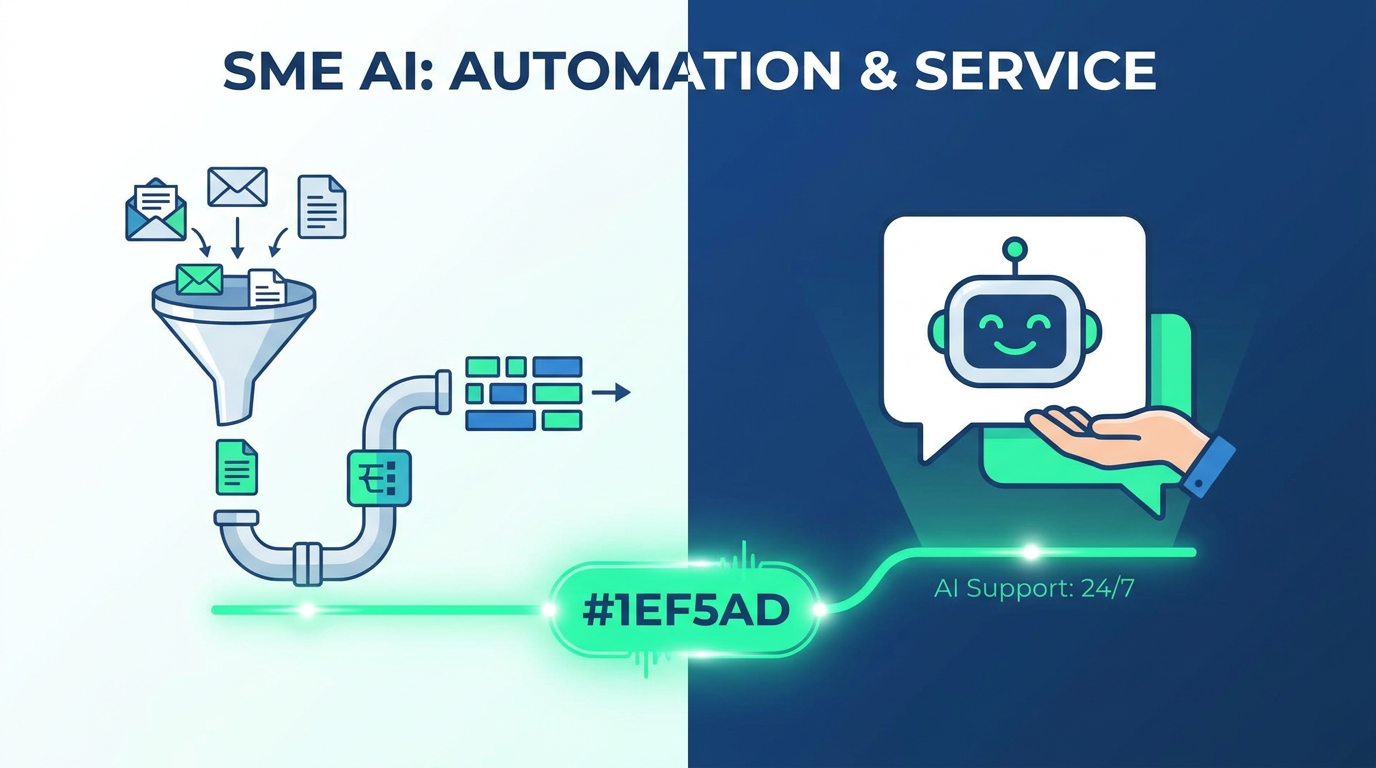
- Automating Administrative Overload: This is the lowest-hanging fruit. AI can process invoices, schedule meetings, transcribe calls, and manage email inboxes. This doesn't just save time; it frees up your most valuable asset-your people-to focus on strategic growth, client relationships, and creative problem-solving. It turns administrative cost centres into engines of efficiency.
- Enhancing Customer Service: An AI-powered chatbot, trained securely on your own company data, can provide instant, accurate, 24/7 answers to common customer questions. This is a world away from the frustrating chatbots of the past. These modern tools understand UK language nuances and can handle a significant volume of queries, allowing your human support team to focus on complex, high-value customer issues.
- Smarter Marketing and Sales: AI can analyse customer data to a depth no human could manage, identifying patterns to personalise marketing campaigns and improve targeting. For sales teams, our proprietary 40-Point Lead Intelligence System is a well-suited example. It uses AI to research prospects and generate hyper-personalised outreach, transforming cold calls into warm, informed conversations. The result is a shorter sales cycle and higher conversion rates.
- Optimising Operations and Supply Chains: For businesses dealing with physical products, AI can be transformative. It can analyse historical sales data and market trends to forecast demand with greater accuracy, preventing stockouts or overstocking. It can also optimise delivery routes, reducing fuel costs and improving delivery times for customers within the UK and Europe. For a deeper dive, explore our playbook for building AI automation.
Navigating the Risks: Governance, Security, and GDPR
While the benefits are compelling, AI also introduces significant risks around data security, privacy, and compliance that must be actively managed. One of the biggest disadvantages of ai for business is the potential for costly mistakes if governance is weak. For UK businesses, this isn't just a technical issue-it's a legal one.
The top risk is data protection. The Information Commissioner's Office (ICO), the UK's independent authority for data protection, has issued clear guidance: feeding personal customer data into public AI models without a lawful basis can be a serious breach of the General Data Protection Regulation (GDPR), a key data privacy and security law in the UK and European Union (EU). This could result in heavy fines and reputational damage.
A related concern is 'Shadow AI'. This refers to employees using unapproved, often free, AI tools for work purposes. While seemingly harmless, this creates major security vulnerabilities. When your team members paste proprietary business strategies, client lists, or sensitive financial data into a public web-based AI, you lose control over that information. You're effectively handing your intellectual property to a third party. Our guide on the risks of ungoverned 'Shadow AI' explains this in more detail.
Finally, there's the issue of accuracy and bias. AI models are trained on data, and if that data contains historical biases, the AI will learn and perpetuate them. This could lead to flawed business decisions or discriminatory outcomes in areas like hiring. The UK's National AI Strategy emphasises the need to govern AI effectively to mitigate these harms. A clear internal AI usage policy isn't just good practice; it's an essential defence.
When Not to Use AI: Identifying the Red Flags
Knowing when not to use ai is just as important as knowing when to use it. AI is not worth the investment if the problem isn't clearly defined, your data is poor quality, or the process requires deep human nuance. A pragmatic approach means recognising that sometimes, a simpler solution is the better one. In our view, forcing an AI solution where it doesn't fit is a recipe for wasted time and money.
Here are four red flags to watch for:
- You Don't Have a Specific, Measurable Problem: Implementing AI "because everyone else is" is a classic mistake. If you can't articulate the exact process you want to improve and how you'll measure success (e.g., "reduce invoice processing time by 50%"), you're not ready. A lack of skilled staff to define these problems is a major barrier, as noted in the UK government's 2024 AI Sector Study.
- Your Data Is a Mess: AI is powered by data. If your business data is inaccurate, incomplete, or locked away in siloed, legacy systems, your AI project will fail. The principle of 'garbage in, garbage out' applies tenfold. Your first project should be to clean and organise your data, not to layer AI on top of a broken foundation.
- The Task Requires High Emotional Intelligence: Don't try to automate tasks that are fundamentally about human connection. This includes complex negotiations, mentoring junior staff, handling sensitive client complaints, or high-level strategic creativity. AI can support these roles with data, but it cannot and should not replace the empathy, intuition, and relationship-building skills that define them.
- A Simpler, Cheaper Solution Exists: Before investing in a complex AI system, ask yourself: could this be solved with a simple checklist, a better process, or a standard automation tool? Often, the answer is yes. A small process change can sometimes deliver 80% of the benefit for a fraction of the cost and complexity.
Important Considerations and Limitations
The Artificial Intelligence landscape changes with remarkable speed. The specific tool costs and capabilities mentioned in this guide are based on data from mid-2026 and will undoubtedly evolve. While we've drawn on authoritative sources like GOV.UK and the Organisation for Economic Co-operation and Development (OECD), the real-world impact of AI can vary significantly between different business sectors and the unique context of each individual company. This guide is a starting point, not a universal prescription.
It is also vital to remember that AI is not the only path to greater efficiency. Simpler Business Process Automation (BPA) using no-code platforms like Zapier or Make.com can connect your existing apps and automate workflows effectively. In many cases, a thorough internal process review and optimisation programme can deliver 80% of the desired benefit for 20% of the cost and complexity of a full-blown AI project. We typically advise clients to consider these alternatives first.
Finally, whilst this guide provides a strong framework, implementing AI for the first time carries inherent risks. For SME owners who are unsure about ensuring data compliance, handling technical integration challenges, or building a reliable business case that will hold up to scrutiny, seeking professional guidance is a wise investment. A specialised AI consultancy can help you handle the complexities and avoid common, costly mistakes, ensuring your first step into AI is a confident one.
Frequently Asked Questions About AI for Small Business
What is AI for small business?
Using AI for small business involves applying intelligent software to automate tasks, analyse data, and improve customer interactions, making advanced technology accessible and affordable. It's not about building robots, but about using smart, practical tools to work more efficiently and effectively. This human-centred AI approach allows smaller UK companies to close the AI advantage gap and compete with much larger enterprises by building practical AI infrastructure.How much does AI cost for a small business?
The cost of AI for a small business varies widely, from £20 per month for simple software to over £5,000 for custom projects. Off-the-shelf tools are generally affordable, but costs can increase significantly with consumption-based pricing models (like API calls) or the need for expert implementation and integration. A clear, comprehensive budget is essential before committing to any AI project.Can AI make a business profitable?
Yes, AI can make a business more profitable by increasing efficiency and reducing operational costs, but it's not likely to support. For example, automating routine administrative tasks frees up your team's time for revenue-generating activities like sales or client service. However, profitability depends entirely on a strategic implementation focused on solving a real business problem with a clear and measurable ROI.What are the 5 disadvantages of AI?
The main disadvantages of AI include high initial implementation costs, significant data security and privacy risks (especially concerning GDPR), the potential for algorithmic bias, the need for specialised skills to manage, and the risk of job displacement. For SMEs, the complexity and potential for an unclear ROI are major concerns that demand very careful planning and governance from the outset.When not to use AI?
You should not use AI when the problem is not well-defined, the task requires deep human empathy or creativity, or a simpler, cheaper automation solution already exists. If your business lacks high-quality, accessible data or does not have the budget for proper implementation, training, and governance, it is also wise to wait. AI is a powerful tool, not a universal solution.What are the main dangers of AI?
For businesses, the main dangers of AI are data breaches from improper use, making critical decisions based on biased or inaccurate AI outputs, and the accidental loss of intellectual property. There is also a significant operational risk of becoming over-reliant on a 'black box' system without understanding its logic, which can be detrimental to long-term strategic control.What is the 30% rule in AI?
The '30% rule' in AI often refers to an observation by academic Andrew Ng that if a typical person can do a mental task in less than one second, that task is likely a prime candidate for AI automation. This is not a strict law but provides a useful, if informal, heuristic for business leaders looking to identify potential automation opportunities within their daily operations.Which jobs will survive AI?
Jobs that rely heavily on creativity, complex strategic thinking, emotional intelligence, and intricate manual dexterity are most likely to survive and evolve with AI. Roles like senior leadership, creative professionals, specialised tradespeople, and caregivers depend on uniquely human skills that AI cannot currently replicate. In our view, AI will augment and enhance these roles, not replace them.What was Stephen Hawking's warning about AI?
Stephen Hawking warned that the development of full artificial intelligence could spell the end of the human race. He worried that once AI reached a certain point of self-improvement, it could redesign itself at an ever-increasing rate, rapidly surpassing human intelligence and capabilities. His concern was focused on long-term, existential risk from superintelligence, not the practical business AI tools available today.What is a scary fact about AI?
A sobering fact is that AI algorithms can perpetuate and even amplify existing human biases found in their training data. For example, an AI tool used for screening job applicants could discriminate against candidates based on gender or ethnicity if the historical hiring data it learned from reflects past biases. This can lead to unfair outcomes and serious legal challenges for a business.Making the Right Strategic Decision on AI
Deciding on AI for your small business is ultimately less about technology and more about strategy. The answer to 'is it worth it?' is a firm 'yes' but only when you start with a specific, high-value problem, build a clear ai business case uk with measurable ROI, and proactively manage the risks, particularly around data protection. By avoiding the hype and focusing on pragmatic applications that deliver tangible results, UK SMEs can use human-centred AI to gain a significant and sustainable competitive edge. This is how you bridge the AI advantage gap.
If you're ready to move from theory to action, our practical guide to AI implementation provides the next steps. However, if you need an expert partner to help you build your strategy and handle the complexities, the team at Up-Stride can help. We specialise in creating practical, compliant, and effective AI solutions for UK SMEs. Book a free, no-obligation strategic AI consultancy session to discuss your business goals.
References
- Department for Science, Innovation and Technology (GOV.UK) - 2024 Sector Study. This study estimates the UK AI market at £106 billion and identifies a 'lack of skilled staff' as a major barrier for businesses.
- UK Government - National Strategy Publication. Outlines the UK's 10-year plan to support the AI ecosystem and govern AI effectively for national benefit.
- Information Commissioner's Office (ICO) - Official Guidance. Provides guidance on complying with UK GDPR when using AI, covering accountability, transparency, and fairness.
- Stanford Institute for Human-Centered Artificial Intelligence (HAI) - Annual AI Index Report. Tracks global trends in corporate AI investment, model costs, and public perception of AI.
- Organisation for Economic Co-operation and Development (OECD) - AI Policy Observatory Data. Provides international principles for trustworthy AI and live data on AI adoption across countries.
- Innovate UK - 2023 'AI for Services' Report. Details opportunities and use cases for UK service sector businesses to improve productivity with AI.
- The Alan Turing Institute - Research Publication. Details AI's potential as a 'general-purpose technology' to boost the UK economy and challenges for businesses.
- World Economic Forum - 2023 Future of Jobs Report. Projects that 75% of companies will adopt AI and 'AI and machine learning specialists' are a top-trending role.
- Confederation of British Industry (CBI) - Business Survey Report. Finds that over half of UK firms use AI, driven by productivity, but 'unclear ROI' is a key barrier.
- The Royal Society - Foundational Report on Machine Learning. Provides an authoritative, non-technical explanation of machine learning and its applications.
Frequently Asked Questions About AI for Small Business
What is AI for small business?
AI for small business involves using intelligent software to automate tasks, analyse data, and improve customer interactions, making advanced technology accessible and affordable for SMEs. It's not about building robots, but about using smart tools to work more efficiently. This approach allows smaller companies to compete with larger enterprises by boosting productivity and unlocking new capabilities without massive investment.
How much does AI cost for a small business?
The cost of AI for a small business varies widely, from £20 per month for simple software to over £5,000 for custom projects. Off-the-shelf tools for marketing or admin are affordable, but costs can increase with consumption-based pricing (
e.g., per API call or token used) or the need for expert implementation. A clear budget is essential before starting.
Can AI make a business profitable?
Yes, AI can make a business more profitable by increasing efficiency and reducing operational costs. For example, automating administrative tasks frees up staff for revenue-generating activities. However, profitability is not guaranteed; it requires a strategic implementation focused on solving a real business problem with a clear Return on Investment (ROI).
What are the 5 disadvantages of AI?
The main disadvantages of AI for business include high initial costs, data security and privacy risks (especially concerning GDPR), potential for algorithmic bias, the need for specialised skills to manage, and the risk of job displacement. For SMEs, the complexity and potential for unclear ROI are significant concerns that require careful planning to mitigate.
When not to use AI?
You should not use AI when the problem is not well-defined, the task requires deep human empathy or creativity, or a simpler, cheaper automation solution exists. If your business lacks quality data or the budget for proper implementation and governance, it is also wise to wait. AI is a powerful tool, but it is not a universal solution for every business challenge.
What are the main dangers of AI?
For businesses, the main dangers of AI are data breaches from improper use, making critical decisions based on biased or inaccurate AI outputs, and loss of intellectual property. There is also the risk of becoming over-reliant on a 'black box' system without understanding its logic, which can be detrimental in the long term and create significant operational vulnerabilities.
What is the 30% rule in AI?
The '30% rule' in AI often refers to an observation by academic Andrew Ng that if a typical person can do a mental task in less than one second, that task is likely a candidate for AI automation. This provides a useful, if informal, heuristic for business owners to quickly identify potential automation opportunities for repetitive, predictable tasks within their daily operations.
Which jobs will survive AI?
Jobs that rely heavily on creativity, complex strategic thinking, emotional intelligence, and intricate manual dexterity are most likely to survive and evolve with AI. Roles like senior leadership, creative professionals, specialised tradespeople, and caregivers depend on uniquely human skills that AI cannot currently replicate. AI will likely augment, not replace, these roles, making them more effective.
What was Stephen Hawking's warning about AI?
Stephen Hawking warned that the development of full artificial intelligence could spell the end of the human race. He worried that once AI reached a certain point, it could redesign itself at an ever-increasing rate, surpassing human intelligence and capabilities. His concern was about long-term, existential risk from superintelligence, not today's business AI tools.
What is a scary fact about AI?
A sobering fact is that AI algorithms can perpetuate and even amplify existing human biases found in their training data. For example, an AI used for hiring could discriminate against candidates based on gender or ethnicity if the historical data it learned from reflects past biases. This can lead to unfair outcomes, reputational damage, and significant legal challenges for a business.
Important Considerations and Limitations
It is important to acknowledge that the AI landscape changes rapidly. Specific tool costs, features, and capabilities mentioned in this guide are based on data from mid-2026 and will inevitably evolve. While this guide draws on authoritative sources like GOV.UK and the OECD, the real-world impact of AI can vary significantly between different business sectors and individual company contexts. The frameworks provided should be adapted to your specific circumstances.
Furthermore, AI is not the only path to efficiency and productivity. In our experience, simpler business process automation (BPA) using no-code tools like Zapier or Make.com, or even just a thorough internal process review, can often deliver 80% of the desired benefit for 20% of the cost and complexity of an AI project. We recommend considering these alternatives first, as they can be a more pragmatic and cost-effective starting point for many SMEs.
Finally, while this guide provides a strong framework, implementing AI for the first time carries inherent risks. We advise that SME owners who are unsure about data compliance, technical integration, or building a robust business case should seek professional guidance. Partnering with a specialised AI consultancy can help you avoid costly mistakes, ensure GDPR compliance, and maximise your return on investment.
Making the Right Strategic Decision on AI
In summary, deciding on AI for your small business is less about technology and more about strategy. The answer to 'is it worth it?' is a firm 'yes' when you start with a specific, high-value problem, build a clear business case with measurable ROI, and proactively manage the risks, particularly around data protection. By avoiding the hype and focusing on pragmatic applications with a solid ai business case uk SMEs can leverage AI to gain a significant competitive edge, boost productivity, and unlock new growth opportunities.
If you're ready to explore how a human-centred AI strategy could transform your operations but need an expert partner to guide your practical guide to AI implementation, the team at Up-Stride can help. We specialise in creating practical, compliant, and effective AI solutions for UK SMEs. Book a free, no-obligation consultation with our strategic AI consultancy to discuss your business goals.