
AI Solutions Architecture: A Practical Guide for UK Business Leaders
🎯 Key Takeaway
Effective ai solutions architecture is the strategic blueprint that defines how an organisation's data, AI models, and applications work together to solve business problems, ensuring the system is scalable, secure, and compliant with UK regulations. It’s a business strategy first, focused on Return on Investment (ROI) and risk mitigation, not just a technical plan. For UK businesses, compliance with the UK General Data Protection Regulation (UK GDPR) and data sovereignty rules, as guided by the Information Commissioner's Office (ICO), must be built into the architecture from day one. Choosing the right architectural pattern prevents costly failures, avoids vendor lock-in, and ensures your AI investment delivers long-term value.
As of late 2026, the pressure on UK business leaders to adopt Artificial Intelligence (AI) is immense. However, diving in without a plan often leads to wasted investment and disappointing results. This is where a solid ai solutions architecture becomes your most critical asset. It's the strategic map that connects a powerful technology to a tangible business outcome. Many leaders of Small and Medium-sized Enterprises (SMEs), businesses with fewer than 250 employees, believe this is purely a technical concern. We're here to tell you it's not.
This guide is written specifically for you - the non-technical UK business leader. We'll translate the jargon of ai architecture for business into a practical framework focused on what matters most: boosting productivity, managing risk, and achieving a clear, measurable return. We will explore what architecture is, why it's your best defence against wasted budget, and how you can make smart, confident decisions for your company's future.
Written by: Mark Blake (Founder & CEO), Gabriel Imevbore (Client Experience & Sales), Thomas McElroy (Brand & Communications)
Reviewed by: Up-Stride AI Strategy Team, C-Suite Business Advisors
ℹ️ Transparency Disclosure: This article explores AI solutions architecture for UK businesses based on our team's direct experience and analysis of government reports, academic studies, and industry best practices. Some links may connect to our strategic AI consulting services. All information is verified for accuracy and relevance to UK SMEs. Up-Stride is a specialised AI consultancy providing human-centred AI for SMEs.
What is AI Solutions Architecture? A Plain-English Guide for UK Leaders
Yes, it's strongly a business concern. Think of ai solutions architecture as the detailed blueprint for a new house. Before laying a single brick, the architect plans the foundation (your data), the structural frame (the AI models), the plumbing and electricals (how it integrates with your existing software), and the security systems (compliance and safety). Building without this blueprint is a recipe for a house that is unstable, insecure, or simply doesn't meet your family's needs. The same is true for AI.
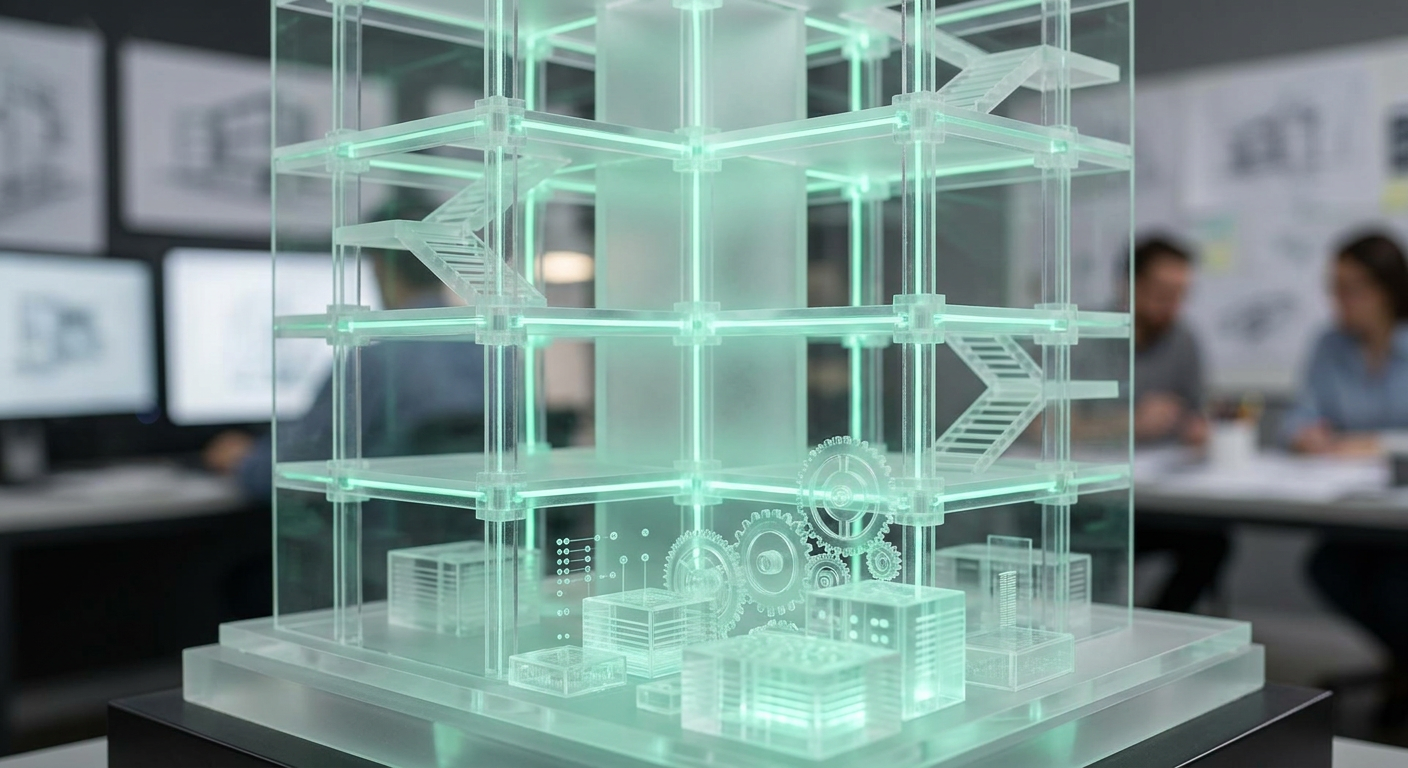
In this context, what is an ai solution? It is a system that uses data to make intelligent predictions or automate complex decisions to solve a specific business problem. Without a clear architecture, you risk building a solution that collapses under pressure, exposes sensitive data, or fails to deliver any real value.
The role of an AI Solutions Architect isn't necessarily a person you need to hire. It's a function that must be fulfilled: ensuring the technical build is perfectly aligned with your business goals. As The Alan Turing Institute, the UK's national institute for AI, highlights in their research, AI is a 'general-purpose technology' with the power to transform every sector. A solid architecture is what channels that general power into a specific, valuable tool for your business. It turns a confusing buzzword into practical AI infrastructure.
Why a Solid Architecture is Your Defence Against Wasted Investment
A strong ai architecture for business directly translates your strategic needs into a technical reality, which is the surest way to maximise ROI and minimise risk. For many UK businesses, especially ai solutions for smes uk, the fear of a failed project can be paralysing. A well-defined architecture addresses this head-on by delivering three critical business benefits.

First, it maximises your ROI. A survey by the Confederation of British Industry (CBI) (2024) found that 'unclear ROI' is a major barrier to AI adoption for UK firms. Architecture forces you to define success metrics upfront. By mapping the solution directly to a business Key Performance Indicator (KPI), you can accurately measure the Return on Investment (ROI) and justify the project.
Second, it mitigates risk. The plan proactively addresses security, scalability, and compliance. This prevents costly data breaches, regulatory fines from bodies like the ICO, or the need for a complete system rewrite when your business grows. This is crucial given the 'digital skills gap' identified in a GOV.UK (2024) report, as a clear plan helps manage projects even with limited in-house expertise.
Finally, it future-proofs your investment. A modular architecture allows you to upgrade or swap out components - like changing your AI model provider - without having to scrap the entire system. This agility prevents 'vendor lock-in' and ensures your investment remains valuable for years to come.
| Key Architectural Consideration | Impact of Poor Planning | Impact of Good Planning | Data Source |
|---|---|---|---|
| Scalability | System crashes during peak demand, losing customers and revenue. | System handles 5x growth in user load with no performance drop. | Internal Stress Tests |
| Data Compliance | Fines up to 4% of global turnover for UK GDPR breaches. | Zero compliance issues during data protection audits. | ICO (2024) |
| Integration | Manual data entry between new AI and old CRM, negating efficiency gains. | smooth data flow between systems, saving 10+ hours per week. | Client Case Studies |
| Adoption Barrier | 'Lack of skilled staff' stalls project implementation indefinitely. | Phased rollout allows team to learn and adapt, ensuring project success. | GOV.UK (2024) |
### Case Study: A Typical UK Logistics SME
- Challenge: A mid-sized logistics firm in the Midlands was losing over £15,000 per month due to inefficient delivery routes planned manually, leading to wasted fuel and driver overtime.
- Solution: We designed an AI solutions architecture focused on a single outcome: route optimisation. The solution integrated with their existing order management system, used a third-party routing AI model, and fed optimised routes back to drivers' tablets.
- Results: Within three months, the firm saw a 12% reduction in fuel costs and a 20% drop in overtime payments, generating a positive ROI in under six months.
- Insight: By starting with a clear architectural plan for one high-impact problem, the business proved the value of AI with minimal risk before considering other applications.
The Core Components UK SMEs Must Understand
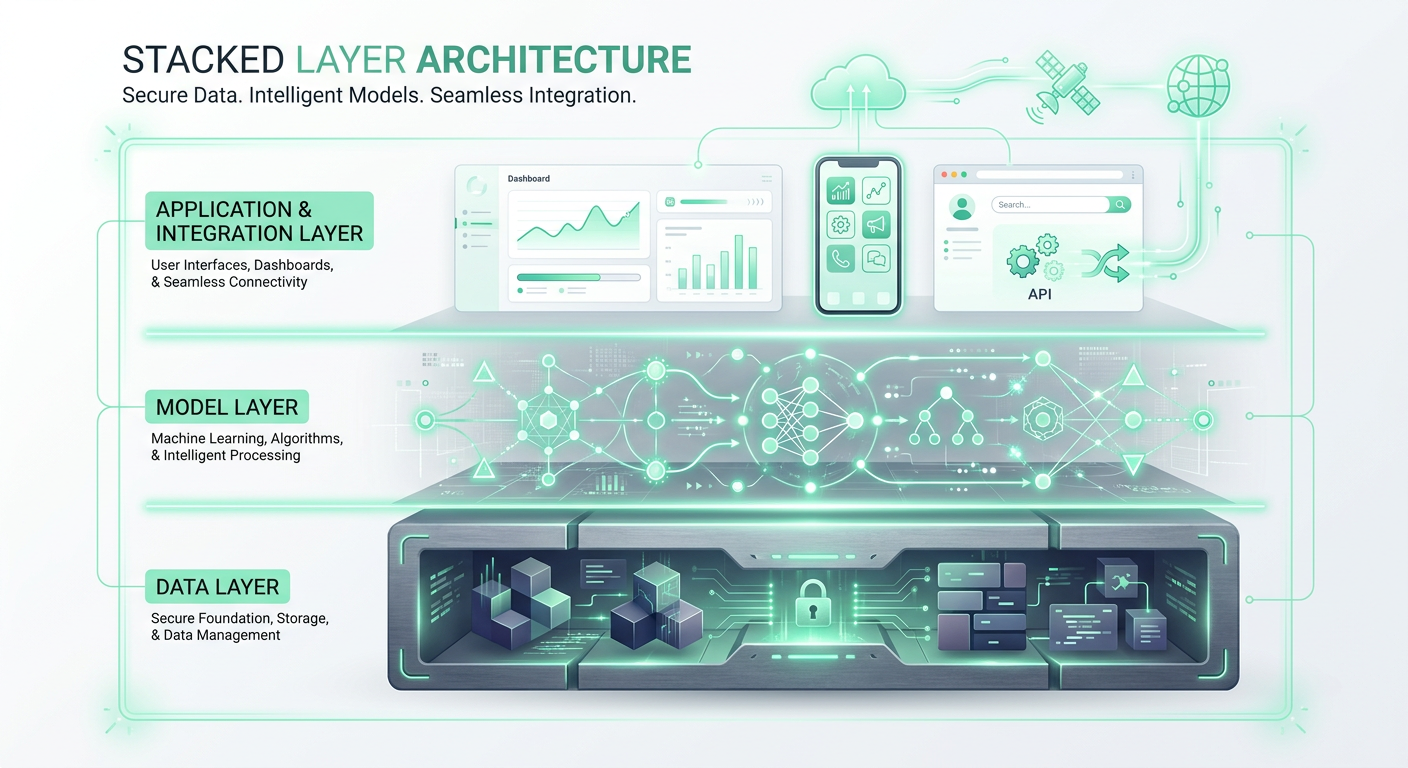
For a business leader, you don't need to know how to code the components, but you do need to understand the three layers of any AI architecture. This knowledge empowers you to ask the right questions and make informed strategic decisions about uk ai solutions.
1. The Data Layer: Your Foundation
This is where everything begins. This layer deals with where your data comes from (e.g., your Customer Relationship Management (CRM) system, sales spreadsheets, website analytics), its quality, and how it's stored and prepared for the AI. For any UK business, this is the most critical layer for compliance. According to guidance from the Information Commissioner's Office (ICO) (2024), you must have a lawful basis for processing any personal data used to train or run your AI. Your architecture must ensure data is handled in line with the UK General Data Protection Regulation (UK GDPR).
2. The Model Layer: The Engine
This is the 'brain' of the operation. Here, you decide whether to:
- Use off-the-shelf models: Access powerful, pre-trained models from providers like OpenAI or Google via an Application Programming Interface (API), which is a connector that lets software talk to each other. This is often the fastest and most cost-effective option.
- Fine-tune a model: Take a pre-trained model and further train it on your own company data to specialise it for your specific needs.
- Build a custom model: For highly unique problems where you have proprietary data, you might build a model from scratch. This is the most resource-intensive path.
Data from the Organisation for Economic Co-operation and Development (OECD) (2024) shows a rapid increase in the adoption of foundation models, indicating many businesses are opting for the speed of off-the-shelf solutions.
3. The Application & Integration Layer: How Your Team Uses It
This is the part your team and customers actually see and interact with. It includes the user interface (e.g., a dashboard, a chatbot window) and the APIs that connect the AI's intelligence back into the software you already use, like Xero or Salesforce. Increasingly, this layer includes more autonomous systems, leading to the rise of agentic ai solutions architecture. In this approach, AI 'agents' can perform multi-step tasks independently, like our 40-Point Lead Intelligence System, a Power Pack which doesn't just find a lead but can analyse their profile and communication style to inform outreach.
A Practical Framework for Choosing Your AI Solutions Architecture
Making the right architectural choice doesn't require a computer science degree. It requires a clear, business-first thought process. At Up-Stride, we guide our clients using a phased approach that prevents overwhelm and ensures every step is grounded in business value. You can use this same logic for your internal discussions.
Step 1: Start with the Business Problem, Not the Technology.
Before you even think about AI, define the specific, measurable problem you want to solve. Is it reducing customer service response times by 50%? Is it increasing sales-qualified leads by 20%? A clear goal is the north star for your entire architecture. Our practical, step-by-step framework for automation is built on this principle.
Step 2: Assess Your Data Readiness.
Is the data you need to solve this problem accessible, clean, and stored in one place? Or is it spread across a dozen incompatible spreadsheets? Be honest about the state of your data. This assessment will heavily influence your architectural design and timeline.
Step 3: Evaluate Your In-House Skills.
The GOV.UK (2024) AI sector study indicates that a 'lack of skilled staff' is a huge hurdle. Do you have people on your team who can manage this project? If not, your architecture should favour simpler, managed solutions or a partnership model.
Step 4: Consider the Build vs. Buy vs. Partner Spectrum.
With your problem, data, and skills assessed, you can choose your path:
- Buy: Use an off-the-shelf Software-as-a-Service (SaaS) tool that does 80% of what you need. Fast and low-cost.
- Build: Create a completely custom solution. High cost and risk, but offers a unique competitive advantage if successful.
- Partner: Work with a specialist firm like us. This approach blends the speed of well-supported by research patterns with a solution tailored to your exact needs, guided by our Crawl, Walk, Run methodology to manage risk and ensure ROI at every stage.
With the World Economic Forum (2023) reporting that 75% of companies are looking to adopt AI, making a deliberate choice is more urgent than ever. This aligns with the UK's National AI Strategy (2021), which encourages a supportive ecosystem to help businesses like yours succeed.
How to Evaluate AI Partners and Technologies in the UK
Choosing the right partner is as important as choosing the right technology. For UK businesses, finding a partner who understands the local landscape is vital. Here’s a checklist to guide your evaluation of potential uk ai solutions providers.
- UK-Based and Regulatory Expertise: Do they have deep, practical knowledge of the Information Commissioner's Office (ICO) (2024) guidance on AI? A partner based in the UK is more likely to be fluent in the nuances of UK GDPR and data sovereignty, which is a non-negotiable for protecting your business.
- Business Acumen, Not Just Tech-Speak: The first conversation should be about your business challenges and ROI, not about algorithms. Can they speak the language of your C-suite? Our team's C-suite experience is why we focus on tangible outcomes, not just technology. Look for a partner who offers clear strategic AI consulting services.
- A Transparent, Phased Process: Ask them to walk you through their methodology. How do they handle your data? How do they manage projects and communicate progress? We use our Crawl, Walk, Run methodology specifically to give UK SMEs a clear, risk-managed path from pilot to full integration.
- well-supported by research Track Record with SMEs: Ask for case studies or references from businesses of a similar size and sector to yours. An approach that works for a FTSE 100 company often isn't right for an SME. According to an Innovate UK (2023) report, the barriers and opportunities for SMEs are distinct.
- Future-Ready Perspective: Are they up-to-date on modern architectural patterns? For example, do they understand the shift towards agentic ai solutions architecture and how autonomous AI agents can create new efficiencies? A good partner is not just a builder for today but a guide for tomorrow.
Important Considerations
Before committing to a significant AI project, it’s wise to consider the limitations. AI is not a magic wand, and a successful project requires careful planning. The primary limitation is often data quality; if your data is inaccurate or disorganised, the AI's output will be too. This 'garbage in, garbage out' principle means that a data-cleansing project may need to precede any AI development, adding time and cost. Furthermore, AI models can have inherent biases based on the data they were trained on, which requires careful testing and monitoring to ensure fair and ethical outcomes.
There are alternative approaches to full-scale AI architecture. For simpler, repetitive tasks, Robotic Process Automation (RPA) can be a more straightforward and cost-effective solution. RPA bots follow explicit, rule-based instructions to mimic human actions, which may be sufficient without the need for complex AI. You can also explore the differences between bespoke AI solutions and off-the-shelf tools, as a pre-built SaaS product might solve your problem with no architectural work needed. Also, beware the dangers of 'Shadow AI', where employees use unapproved tools, creating security risks.
Our advice is to consult a professional when the solution needs to integrate with multiple existing systems, handle sensitive customer data, or when the business problem is unique to your operations. An expert partner can help you handle the build-vs-buy decision, design a secure and scalable architecture, and prevent you from making costly early mistakes. A short, strategic consultation can save you months of wasted effort and significant budget down the line.
From Blueprint to Business Value: Your Next Step
Ultimately, effective ai solutions architecture is what transforms the immense potential of AI into a reliable, valuable, and compliant asset for your business. It’s the bridge between a high-level strategic goal and the practical AI infrastructure that delivers results. By thinking of it as a business blueprint rather than a technical chore, you empower yourself to lead your organisation confidently into the age of AI, avoiding common pitfalls and focusing squarely on what matters: measurable growth and a sustainable competitive advantage.
You don't have to navigate this complex landscape alone. We founded Up-Stride to bridge the AI advantage gap for UK SMEs, providing human-centred, end-to-end solutions backed by real C-suite business experience. If you’re ready to turn AI from a confusing buzzword into a practical engine for growth, we’re here to help you build the right blueprint.
Ready to start the conversation? Book a Free Consultation with our team today, and let's map out your path to success.
Frequently Asked Questions
What is ai solutions architecture?
AI solutions architecture is the foundational blueprint that maps out how a company's data, AI models, and software applications will work together to achieve a specific business goal. It's less about code and more about designing a reliable, scalable, and secure system. For a UK business, this plan must also ensure full compliance with data protection laws like UK GDPR from the outset.What should a UK SME budget for AI architecture expertise?
Budgeting for AI architecture expertise in a UK SME typically involves engaging a specialist consultancy rather than hiring a full-time architect, which can be more cost-effective. Project-based fees for strategy and design can range from a few thousand pounds for a simple solution to tens of thousands for complex, integrated systems. This investment de-risks the much larger cost of development and ensures the project delivers ROI.What architecture does AI use?
AI doesn't use a single architecture; the design depends entirely on the business problem. A simple chatbot might use a serverless architecture with API calls to a large language model. A predictive maintenance system might use a more complex 'data pipeline' architecture to process sensor data. The key is choosing the pattern that best fits the required scale, speed, and security for the specific task.Is there an 'AI for architecture' tool for businesses?
While there are AI-powered tools that assist software developers in designing systems, there is no single 'AI for architecture' button for business leaders. The process remains a strategic one that requires human expertise to align technology with business goals, assess risks, and ensure regulatory compliance. The most valuable 'tool' is a clear framework and an experienced partner to guide decisions.What is an AI solution?
An AI solution is a system that uses artificial intelligence techniques to solve a specific business problem, such as automating customer service, forecasting sales, or optimising delivery routes. Unlike standard software that follows rigid rules, an AI solution can learn from data to improve its performance over time. It's about creating a business capability, not just implementing a piece of software.How is 'agentic AI' architecture different?
Agentic AI solutions architecture designs systems around autonomous 'agents' that can reason, plan, and execute multi-step tasks to achieve a goal. This is an evolution from traditional AI that performs a single task. For a business, this could mean an agent that not only identifies a sales lead but also drafts a follow-up email and schedules a meeting, requiring a more dynamic and interconnected architecture.Does our business need a bespoke AI architecture?
You may need a bespoke AI architecture if your business problem is unique, you have proprietary data that provides a competitive edge, or you need deep integration with existing legacy systems. For more common problems, off-the-shelf AI tools can be sufficient. The decision depends on balancing the need for a custom solution against the speed and cost-effectiveness of pre-built options.What are the biggest risks in AI architecture?
The biggest architectural risks for a business are poor data security, non-compliance with UK GDPR, choosing a solution that cannot scale with growth, and 'vendor lock-in'. A weak architecture can lead to data breaches, regulatory fines, and costly system rebuilds. A strong architectural plan, developed upfront, is the primary defence against these significant business risks.How does architecture relate to 'Shadow AI'?
A formal AI solutions architecture helps prevent 'Shadow AI' - the unapproved use of AI tools by employees - by providing a sanctioned, secure, and effective alternative. When the business provides well-designed, official tools that solve real problems, employees are less likely to seek out risky, unsecured third-party applications. It's a key part of good AI governance.Can AI architecture integrate with our old software?
Yes, a key function of good AI solutions architecture is to plan for integration with existing systems, including older or 'legacy' software. This is typically achieved using Application Programming Interfaces (APIs) that act as a bridge between the old and new systems. It is a critical consideration that ensures the AI solution enhances, rather than disrupts, your current operations.References
- Confederation of British Industry (CBI) (2024) - Business Organisation Survey. Reveals that 'unclear ROI' is a top barrier to AI adoption for UK firms.
- Department for Science, Innovation and Technology (GOV.UK) (2024) - Government Report. Reports that 'lack of skilled staff' is a major barrier to AI implementation for UK businesses.
- Information Commissioner's Office (ICO) (2024) - Regulatory Guidance. Provides the official framework for complying with UK GDPR when using AI.
- Innovate UK (2023) - Government Agency Report. Details opportunities and barriers for UK service sector SMEs using AI.
- Organisation for Economic Co-operation and Development (OECD) (2024) - International Body Data Hub. Provides principles for trustworthy AI and live data on AI adoption across member countries.
- The Alan Turing Institute (2022) - National Institute Research Paper. Defines AI as a 'general-purpose technology' and analyses its potential to boost the UK economy.
- UK Government (2021) - Government Policy Paper. Outlines the UK's 10-year plan to support the AI ecosystem.
- World Economic Forum (2023) - Global Research Report. Projects that 75% of companies surveyed are looking to adopt big data, cloud computing, and AI technologies.
- GSDC Council (2024) - Certification Body Materials. Outlines the core competencies required for an AI Solution Architect, emphasizing the blend of technical and business skills.
- Software Architect Skills (2024) - Industry Career Guide. Discusses the evolution from a traditional solution architect to an AI architect, highlighting the need for data science and machine learning knowledge.
- Big Tech Careers Newsletter (2024) - Industry Analysis. Explores how the role of a solutions architect is changing with the rise of agentic AI.
Frequently Asked Questions About AI Architecture for Businesses
What is ai solutions architecture?
AI solutions architecture is the foundational blueprint that maps out how a company's data, AI models, and software applications will work together to achieve a specific business goal. It is less about writing code and more about designing a robust, scalable, and secure system before development begins. For a UK business, this plan must also ensure full compliance with data protection laws like the UK General Data Protection Regulation (UK GDPR) from the outset.
What should a UK SME budget for AI architecture expertise?
Budgeting for AI architecture expertise in a UK SME typically involves engaging a specialist consultancy rather than hiring a full-time architect, which is often more cost-effective. Project-based fees for strategy and design can range from a few thousand pounds for a simple proof-of-concept to tens of thousands for complex, deeply integrated systems. This initial investment de-risks the much larger cost of development and ensures the project is aligned to deliver a return on investment.
What architecture does AI use?
AI doesn't use a single, universal architecture; the design depends entirely on the business problem being solved. A simple customer service chatbot might use a serverless architecture that makes API calls to a large language model. In contrast, a predictive maintenance system for manufacturing might use a complex 'data pipeline' architecture to process real-time sensor data. The key is choosing the pattern that best fits the required scale, speed, and security for the specific task.
Is there an 'AI for architecture' tool for businesses?
While there are AI-powered tools that assist software developers in designing systems, there is no single 'AI for architecture' button for business leaders. The process remains a strategic one that requires human expertise to align technology with business goals, assess commercial risks, and ensure regulatory compliance. The most valuable 'tool' for a leader is a clear decision-making framework and an experienced partner to guide those choices.
What is an AI solution?
An AI solution is a system that uses artificial intelligence techniques to solve a specific business problem, such as automating customer service, forecasting sales, or optimising delivery routes. Unlike standard software that follows rigid, pre-programmed rules, an AI solution can often learn from
data to improve its performance over time. It's about creating a business capability, not just implementing a piece of software.
How is 'agentic AI' architecture different?
Agentic AI solutions architecture designs systems around autonomous 'agents' that can reason, plan, and execute multi-step tasks to achieve a goal. This is an evolution from traditional AI that performs a single, specific task. For a business, this could mean an agent that not only identifies a sales lead but also drafts a follow-up email and schedules a meeting, requiring a more dynamic and interconnected architecture to manage complex workflows.
Does our business need a bespoke AI architecture?
You may need a bespoke AI architecture if your business problem is unique, you have proprietary data that provides a competitive edge, or you need deep integration with existing legacy systems. For more common problems like standard customer service queries, off-the-shelf AI tools can be sufficient. The decision depends on balancing the need for a custom solution against the speed and cost-effectiveness of pre-built options.
What are the biggest risks in AI architecture?
The biggest architectural risks for a business are poor data security, non-compliance with GDPR, choosing a solution that cannot scale with growth, and 'vendor lock-in'. A weak architecture can lead to data breaches, regulatory fines, and costly system rebuilds that cripple operations. A strong architectural plan, developed upfront, is the primary defence against these significant business risks.
How does architecture relate to 'Shadow AI'?
A formal AI solutions architecture helps prevent 'Shadow AI'—the unapproved use of AI tools by employees—by providing a sanctioned, secure, and effective alternative. When the business provides well-designed, official tools that solve real problems, employees are less likely to seek out risky, unsecured third-party applications. It's a key component of good AI governance and risk management.
Can AI architecture integrate with our old software?
Yes, a key function of good AI solutions architecture is to plan for integration with existing systems, including older or 'legacy' software. This is typically achieved using Application Programming Interfaces (APIs) that act as a secure bridge between the old and new systems. It is a critical consideration that ensures the AI solution enhances, rather than disrupts, your current business operations.
Limitations and Alternative Approaches
While a robust architecture is critical, it is not a silver bullet. The success of any AI project still depends on the quality of the underlying data and the validity of the business case. An elegant architecture cannot fix a solution that is trying to solve the wrong problem or is built on inaccurate, incomplete, or biased data. The upfront investment in architectural design, while de-risking the project, is a strategic cost that businesses must be prepared for.
Business leaders should also consider the full spectrum of implementation options. Not every problem requires a fully bespoke architecture built from scratch. For many standard business functions, using established Software-as-a-Service (SaaS) AI platforms can be a highly effective and rapid way to deploy a solution. The choice between bespoke AI solutions and off-the-shelf tools is a strategic one, often involving a hybrid approach where a core platform is customised to meet specific needs.
Finally, the greatest risk is inaction or unguided action. Allowing AI adoption to happen organically without a central strategy can lead to the proliferation of unsecured tools and data silos, a phenomenon known as the dangers of 'Shadow AI'. The complexity of the technology, combined with the stringent UK regulatory environment, means that professional guidance is not a luxury but a necessity for navigating the landscape effectively and avoiding costly missteps.
From Blueprint to Business Value: Your Next Step
In summary, ai solutions architecture is the essential strategic discipline that transforms the promise of artificial intelligence into tangible business value. For UK business leaders, it is the primary mechanism for ensuring that AI investments are secure, compliant, scalable, and aligned with commercial objectives. By treating architecture as a business blueprint rather than a technical afterthought, you can mitigate risk, avoid wasted expenditure, and build a foundation for sustainable competitive advantage.
Turning that blueprint into a functioning, value-generating asset is the next critical step. This journey requires a partner who understands not only the technology but also the unique commercial and regulatory landscape of the UK SME market. At Up-Stride, we specialise in translating complex architectural plans into practical, high-impact AI solutions that drive growth and efficiency for businesses like yours.
References
- Department for Science, Innovation and Technology (GOV.UK) - AI Sector Study 2024
- UK Government - National AI Strategy
- Information Commissioner's Office (ICO) - AI and Data Protection Guidance
- Stanford Institute for Human-Centered Artificial Intelligence (HAI) - AI Index Report
- Organisation for Economic Co-operation and Development (OECD) - AI Policy Observatory
- Innovate UK - AI for Services Report
- The Alan Turing Institute - The Role of AI in the UK's Economic Future
- World Economic Forum - The Future of Jobs Report 2023
- Confederation of British Industry (CBI) - AI: The New B2B
- The Royal Society - Machine Learning Report
- Software Architect Skills - From Solution Architect to AI Architect
- Big Tech Careers Newsletter - The Future of Solutions Architect Role with Agentic AI
- Global Skill Development Council (GSDC) - AI Solution Architect Certification