AI Strategy Consultant: A UK SME's Guide to Hiring the Right Partner
🎯 Key Takeaway
An AI strategy consultant is a specialist who helps businesses, particularly UK Small and Medium-sized Enterprises (SMEs), create and implement a roadmap for using artificial intelligence to achieve specific goals like increased productivity and growth. For SMEs, the effective consultant acts as a long-term partner, not just a short-term advisor.
• Focus on a partner, not just a consultant, who understands the unique financial and operational constraints of a UK SME.
• Prioritise consultants with well-supported by research experience in UK-specific governance, including General Data Protection Regulation (GDPR) and Information Commissioner's Office (ICO) guidelines, to mitigate legal risks.
• Evaluate candidates based on their ability to define clear Return on Investment (ROI) and deliver a phased, practical implementation plan, not just high-level theory.
This guide provides a comprehensive framework for UK business leaders to vet and select the well-suited AI strategy partner for sustainable growth.
The term Artificial Intelligence (AI) is everywhere. As of late 2026, it feels like every business leader should be using it, but the path forward is often foggy and filled with confusing jargon. For a UK SME, the pressure to keep up is immense, but the risk of a costly misstep is even greater. This is where finding the right AI strategy consultant becomes critical. They act as your expert guide, turning the abstract promise of AI into practical, profitable infrastructure for your business. This article will demystify the process, explaining what a true AI partner does, why a ‘Big Four’ firm might not be the right fit, and how to choose an expert who understands the unique landscape of an ambitious UK SME.
👤 Written by: Content Team
Reviewed by: Editorial Team, Industry Specialists
Last updated: 26 October 2026
ℹ️ Transparency Disclosure: This article explores how UK SMEs can effectively hire an AI strategy consultant, based on expert analysis and a review of government reports and academic studies. Some links may connect to our services. All information is verified by our editorial team. Up-Stride is a specialised AI consultancy for UK SMEs.
What is an AI Strategy Consultant (And Why UK SMEs Need a Partner)?
An AI strategy consultant is a specialist advisor who helps a business define its goals for AI and creates a practical, step-by-step plan to achieve them. Their job isn't to sell you a specific piece of software; it's to understand your unique business challenges and identify where AI can deliver the most significant impact on your bottom line. Research from The Alan Turing Institute (2022) highlights AI as a 'general-purpose technology', meaning its value comes from how it's applied to solve real-world problems, not from the technology itself.
However, we believe for UK SMEs, the term ‘consultant’ is misleading. You don't need someone who delivers a 100-page report and disappears. You need a long-term strategic partner. Here’s the difference:
- A Consultant Sells Advice: They analyse a problem, provide recommendations, and their engagement often ends there.
- A Partner Delivers Outcomes: They work alongside you through implementation, helping you navigate challenges, measure results, and adapt the strategy over time. They understand your cash flow, your team's capacity, and the need for phased, manageable projects.
This 'SME Empathy Gap' is where many engagements fail. A true partner bridges the gap between your business objectives and the technical possibilities of AI. According to a foundational report by The Royal Society (2017), successful machine learning adoption depends heavily on aligning it with clear business needs, a task for which a strategic partner is perfectly suited. They translate your ambition into a workable, human-centred AI solution.
The Core Responsibilities & Deliverables of a UK-Focused AI Partner
When you engage an AI partner, you're not just buying their time; you are investing in tangible outcomes that will shape your company's future. Vague promises won't cut it. A professional engagement should produce clear, actionable deliverables that form your practical AI infrastructure.
A key barrier to adoption for many firms is an 'unclear ROI', as found in a survey by the Confederation of British Industry (CBI) (2024). A good partner tackles this head-on. Here’s what you should expect:
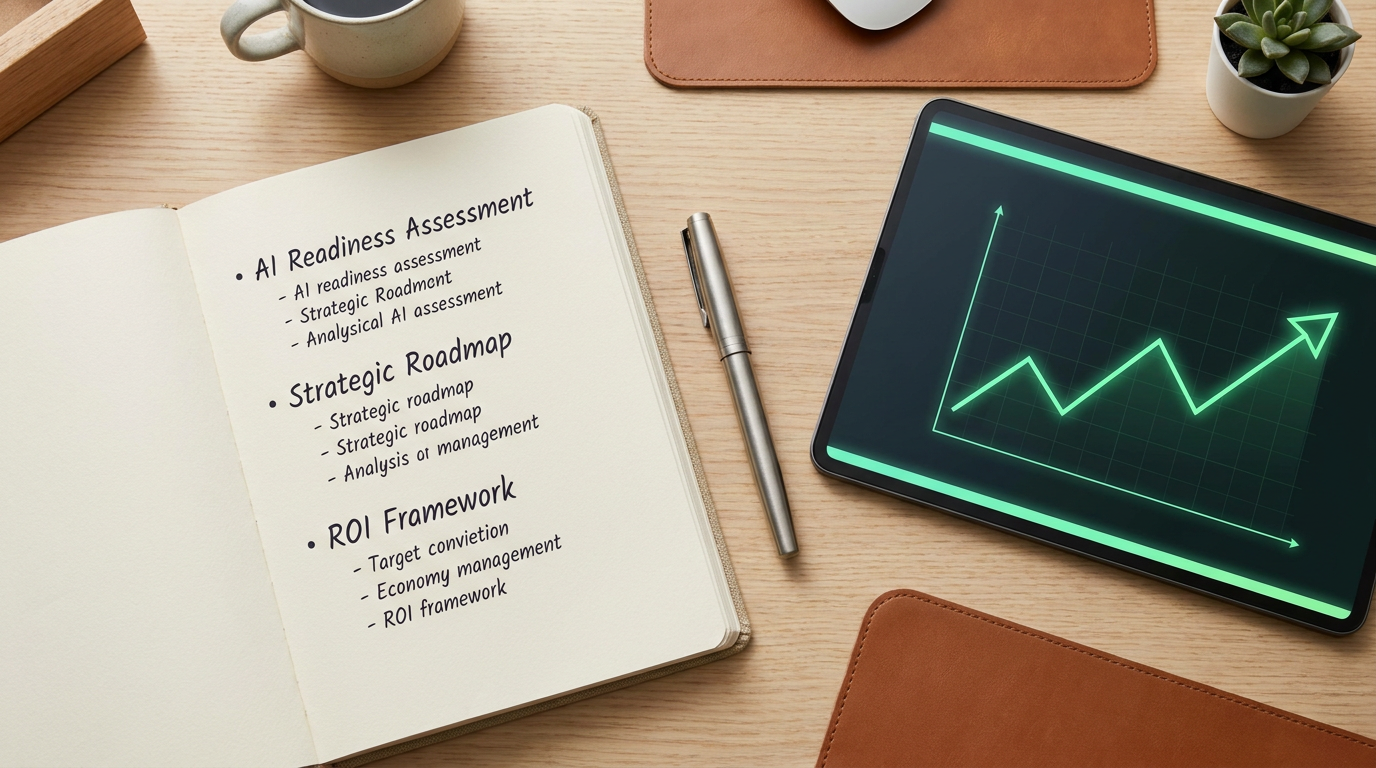
- AI Readiness Assessment: An audit of your current processes, data maturity, and technical systems to identify what’s possible today and what groundwork is needed for tomorrow.
- Strategic AI Roadmap: A prioritised list of AI initiatives, clearly linked to business goals (e.g., 'reduce customer service response time by 30%' or 'automate 50% of invoice processing'). This isn't a wish list; it's a phased plan.
- ROI and Budgeting Framework: A detailed financial model for each initiative. Our framework for measuring AI ROI helps you understand the expected costs, potential savings, and payback period before you commit significant capital.
- Technology and Vendor Selection: Unbiased recommendations on the right tools and vendors for the job, protecting you from sales pitches and ensuring you invest in technology that fits your needs and budget.
- Pilot Project Management: Hands-on management of the first high-impact, low-risk project to prove the concept, build internal confidence, and generate early momentum.
- Governance and Ethics Policy: A clear framework for using AI responsibly, ensuring compliance with UK regulations and building trust with your customers and team. This is a non-negotiable part of any credible ai strategy for smes.
Hypothetical Case Study: Midlands Logistics Ltd.
- Challenge: A regional logistics firm was struggling with rising fuel costs and unpredictable delivery times, impacting client satisfaction and eroding profit margins by an estimated £15,000 per month.
- Solution: We partnered with them to conduct a 2-week Discovery audit, identifying route planning as the highest-impact area for a pilot. We then helped them implement a specialised AI-powered route optimisation engine integrated with their existing dispatch software.
- Results: Within 90 days, the pilot project delivered a 12% reduction in fuel consumption and a 20% improvement in on-time delivery rates. The system paid for itself in under 7 months.
- Key Insight: By focusing on a single, measurable problem first, the company proved the value of AI to sceptical stakeholders and built a strong business case for further investment.
Why 'Big Four' Consultants Aren't the Answer for Most UK SMEs
When business leaders think of consulting, they often picture the ‘Big Four’ accountancy and advisory firms. While these global giants have extensive AI practices, our experience suggests they are often the wrong choice for a typical UK SME. It's a question of fit.
In our view, their model is built for the FTSE 100, not for the agile, resource-conscious SME that forms the backbone of the UK economy. Think of it this way: you don't hire an architect who designs skyscrapers to plan your house extension. The tools, timelines, and cost structures are fundamentally different.
Here are the key misalignments:
- Cost Structure: Big Four projects often come with six-figure price tags and teams of junior consultants, which is simply unfeasible for most SMEs. Their overheads demand high fees that don't align with SME budgets.
- Pace and Agility: Large consultancies are known for lengthy, multi-month diagnostic phases. An SME needs to move faster, testing ideas and seeing results in weeks, not quarters.
- Focus on Theory over Practice: Their deliverable is often a complex strategic document, leaving the difficult work of implementation to your already-stretched internal team. A specialised partner rolls up their sleeves and helps you build.
- Lack of SME Context: An enterprise consultant might recommend a solution requiring a dedicated data science team, which an SME doesn't have. A partner who understands the SME environment will recommend practical tools and processes that your existing team can manage.
A specialised partner offers a more nimble, cost-effective, and hands-on approach to developing an ai strategy for smes, ensuring the solution is built for your world, not for a global corporation.
How to Choose the Right AI Strategy Consultant for Your SME
Choosing the right partner is one of the most important decisions you'll make in your AI journey. The right choice accelerates your growth; the wrong one leads to wasted time, money, and enthusiasm. To find a great AI strategy consultant, you need to ask questions that go beyond their technical qualifications and dig into their business acumen and understanding of the UK market.
Our advice is to focus your vetting process on these key areas:
- Relevant Sector Experience: Have they worked with businesses of your size and in your industry? An expert in e-commerce AI may not understand the challenges of a manufacturing firm.
- Commercial Acumen: Do they speak your language? They should be more interested in your Profit and Loss (P&L) statement than in the latest algorithms. Ask them to explain how an AI project will directly impact revenue or costs.
- UK Compliance Expertise: Can they confidently discuss the implications of the UK's General Data Protection Regulation (GDPR) for your project? Ignorance here is a major red flag.
- A Phased, Practical Approach: Do they push for a massive, all-or-nothing project, or do they recommend a pilot-first approach? A good partner wants to prove value quickly with a small, manageable project. Our Crawl, Walk, Run methodology is built on this principle.
- Verifiable UK References: Can they connect you with other UK SME owners they've worked with? A portfolio of happy, local clients is an effective evidence of their ability to deliver.
The World Economic Forum's 2023 report projects that 75% of companies plan to adopt AI. Finding a partner with the right blend of skills is essential to be in that group successfully.
| Vetting Criteria | Green Flag (effective Partner) | Red Flag (Warning Sign) | Why it Matters for SMEs |
|---|---|---|---|
| Business Focus | Leads with questions about your business goals, customers, and pain points. | Leads with technical jargon and specific AI tools or models. | The goal is to solve business problems, not to use technology for its own sake. |
| ROI Discussion | Proactively introduces a framework for measuring ROI from day one. | Vague about costs and financial benefits, saying "it's hard to predict". | An unclear ROI is a top barrier to AI adoption. A partner must build a clear business case. (CBI, 2024) |
| Compliance Knowledge | Discusses GDPR, data privacy, and ethical AI as core project components. | Dismisses compliance as "something for the lawyers" or seems unaware of ICO guidance. | Non-compliance can lead to huge fines and reputational damage. It must be designed in. (ICO) |
| Implementation Plan | Proposes a phased "Crawl, Walk, Run" approach, starting with a small pilot. | Recommends a large, expensive, "big bang" transformation project from the start. | A pilot de-risks the investment, research suggests value quickly, and builds internal momentum. |
| Client History | Provides references from other UK SMEs who can speak to tangible results. | Only has testimonials from large enterprises or cannot provide relevant contacts. | Proof they understand the unique constraints and opportunities of the SME environment. |
Navigating UK Governance: AI, GDPR, and ICO Compliance
For any business operating in the UK, AI strategy and legal compliance are two sides of the same coin. You simply can't have one without the other. An ai strategy consultant uk businesses can trust must be an expert in navigating the complex web of regulations governing data and automated decision-making. Ignoring this can expose your business to significant financial and reputational risks.
The two key pillars of UK AI governance are:
- The UK GDPR and the Data Protection Act 2018: Managed by the Information Commissioner's Office (ICO), these laws dictate how you can legally collect, store, and process personal data. When an AI system uses customer or employee data, it falls squarely under this legislation. Key principles include data protection by design, fairness, and transparency.
- The UK's National AI Strategy: This government framework, detailed in a 2021 paper from the UK Government, aims to balance innovation with trust. It emphasises the need for clear rules to ensure AI is used safely and ethically.
A competent AI partner doesn't see compliance as a checkbox exercise; they see it as a foundational part of good strategy. They will help you answer critical questions from the very start: What is the lawful basis for using this data? How will we inform individuals that an automated decision has been made? How do we ensure the AI model isn't biased?
Building these principles in from the beginning is far more effective and less costly than trying to fix a non-compliant system later. It de-risks your investment and builds trust with your customers, which, in the long run, is a powerful competitive advantage. Don't underestimate the risks of ungoverned AI (Shadow AI) popping up in your organisation.
A Practical Framework: Your First 90 Days with an AI Strategy Partner
So, what does an engagement actually look like? The process shouldn't be a mystery. At Up-Stride, we use our proprietary Crawl, Walk, Run - AI Adoption Methodology to provide a clear, structured, and risk-managed journey. This phased approach prevents overwhelm and ensures every stage delivers tangible value. Here’s a typical 90-day timeline for an SME starting their AI journey.
Month 1: Discovery & Audit (The 'Crawl' Phase)
This is all about deep immersion. Your AI partner should spend this time not in their office, but in yours.
- Activities: Workshops with your key teams (sales, operations, finance), deep dives into your existing systems (CRM, ERP), and an audit of your data assets.
- Key Deliverable: An 'AI Readiness Report' that maps your current state and identifies 2-3 high-impact, low-risk "quick win" opportunities. This isn't about boiling the ocean; it's about finding the well-suited place to start.
Month 2: Strategy & Roadmap
With a deep understanding of your business, the partner now translates insights into a concrete plan.
- Activities: Collaborative sessions to prioritise the opportunities identified in Month 1. Financial modelling to build a clear ROI case for the top-priority pilot project.
- Key Deliverable: A formal Strategic AI Roadmap document. This includes the pilot project scope, budget, timeline, and the key metrics (KPIs) that will be used to measure its success.
Month 3: Pilot Launch & Governance (The 'Walk' Phase)
This is where the strategy becomes real. The first pilot project kicks off.
- Activities: Project management, vendor coordination (if needed), and the establishment of your AI Governance Committee. This group ensures the project stays on track and adheres to ethical and legal standards.
- Key Deliverable: A functioning pilot project delivering its first set of data. For example, an automated customer support chatbot handling its first 100 queries.
This structured 90-day sprint provides a tangible and exciting way to begin. For more details, explore our practical guide to AI implementation.
Important Considerations: Alternatives and Limitations
While an AI strategy partner offers a powerful path forward, it's essential to consider the full picture. The field of AI is evolving at an incredible pace. This article is based on the latest data and best practices as of October 2026, but specific tool recommendations or cost benchmarks can change. However, the core principles of aligning technology with clear business goals, prioritising ROI, and ensuring reliable governance will typically remain critical.
There are also alternative approaches to hiring a consultant. For very simple, task-based automation, a Do-It-Yourself (DIY) approach using no-code platforms like Zapier or Make.com can be highly effective. This is a great way to start automating simple workflows without a large initial investment. You can find more ideas in our SME's playbook for building AI automation. On the other end of the spectrum, if your business has a large, complex, and ongoing need for AI development, hiring a full-time, in-house specialist might be more cost-effective in the long run.
We believe professional guidance from a consultant becomes non-negotiable in certain situations. If your project involves processing sensitive personal data (triggering strict GDPR requirements), needs to integrate with complex legacy systems, or represents a significant capital investment for your business, a consultation is a vital risk-mitigation step. It ensures your high-stakes project is built on a solid, compliant, and strategically sound foundation from day one.
Your Next Step Towards a Practical and Profitable AI Strategy
Ultimately, finding the right AI strategy consultant is less about buying technology and more about gaining a strategic partner who can help you navigate change. For UK SMEs, the key is to look beyond the hype and focus on experts who demonstrate commercial acumen, a deep understanding of UK compliance, and a commitment to delivering measurable ROI. As a 2024 survey from the CBI shows over half of UK firms are now using AI, a well-chosen partner is the fastest way to close the AI advantage gap and build a lasting competitive advantage. Our Crawl, Walk, Run approach is designed specifically to make this journey manageable and successful.
If you're ready to move from being overwhelmed by AI to being optimised by it, the team at Up-Stride is here to help. We offer a human-centred AI strategy partnership for ambitious UK SMEs, translating complex technology into practical, profitable business outcomes. Book a free, no-obligation consultation to discuss your specific challenges and discover what's possible.
Frequently Asked Questions About Hiring an AI Consultant
What is an AI strategy consultant?
An AI strategy consultant helps a business plan how to use artificial intelligence to meet its goals. For a UK SME, they act as a strategic partner, creating a practical roadmap that balances innovation with budget, compliance, and clear return on investment. They bridge the gap between business needs and technical possibilities, ensuring your AI initiatives deliver real value.What does a strategy consultant do with AI?
A strategy consultant uses AI as a tool to solve business problems. Instead of just implementing tech, they analyse your operations to find opportunities for AI to increase efficiency, cut costs, or create new revenue streams. They focus on the 'why' and 'how' - aligning AI projects with your core business objectives for maximum impact and a strong return on investment.Why not just use off-the-shelf AI tools?
Off-the-shelf tools are excellent for specific tasks, but they don't form a strategy. A consultant helps you select the right tools, integrate them, and build a cohesive plan that avoids data silos and 'Shadow AI' risks. They ensure your technology investments work together to deliver on your wider business goals, preventing wasted spend and maximising overall impact.How much does an AI consultant cost in the UK?
Costs vary widely based on scope, from a few thousand pounds for a small audit to over £50,000 for a complex custom project. Specialised SME consultancies like ours often offer fixed-price 'Power Packs' for specific outcomes, providing more cost certainty than the open-ended hourly rates charged by larger firms. Typically prioritise a clear scope and defined ROI over the lowest price.Are AI consultants in high demand in the UK?
Yes, demand is extremely high as UK businesses accelerate AI adoption. Research from bodies like the CBI shows over half of firms are using AI, but a significant skills gap remains, as noted by the Department for Science, Innovation and Technology (2024). This demand means experienced, business-savvy consultants who can deliver tangible results are particularly sought after by SMEs needing expert guidance.What's the difference between an AI consultant and an AI developer?
An AI consultant defines the 'what' and 'why'; a developer builds the 'how'. The consultant is a strategist who aligns AI with business goals, creates the roadmap, and ensures ROI. The developer is a technical expert who writes the code and builds the solution defined by the strategist. You almost typically need the strategy before you start the development.Which AI tool is best for business strategy?
No single AI tool is 'best' for strategy; the right tool depends on the problem you're trying to solve. Strategy involves analysis and planning, not just automation. While tools like ChatGPT can help with research, a true AI strategy is about integrating specialised AI for marketing, finance, or operations into a cohesive plan. A consultant helps you choose the right technology stack for your specific needs.Do I need a lot of data to work with an AI consultant?
Not necessarily, but quality data is key to unlocking advanced capabilities. A good consultant's first step is an 'AI Readiness Assessment' to see what data you have. They can often identify valuable quick wins using existing data from your CRM or accounting software. They will also build a plan for improving data collection for more advanced future projects.Why is UK-specific experience so important?
UK-specific experience is crucial for legal compliance and market relevance. A consultant familiar with the UK understands GDPR and ICO regulations, preventing costly data breaches. They also grasp the nuances of the UK's economic climate, competitive landscape, and business culture, ensuring the strategy is practical and effective for your specific market, not a generic plan from another country.How long does it take to see results from an AI strategy?
You can see initial results from a pilot project within 90 days. A good strategy focuses on 'quick wins' to build momentum and prove ROI early on. While a full digital transformation takes longer, a well-designed pilot, such as automating a key administrative workflow or optimising a sales process, can deliver measurable efficiency gains in a single business quarter.References
- Department for Science, Innovation and Technology (GOV.UK) - 2024 Government Report. Reports that 'lack of skilled staff' is a major barrier to AI implementation for UK businesses.
- UK Government - 2021 Government Strategy Paper. Outlines the UK's 10-year plan to support the AI ecosystem and govern AI effectively.
- Information Commissioner's Office (ICO) - Regulatory Guidance. Provides official guidance on complying with UK data protection law (UK GDPR) when using AI.
- Stanford Institute for Human-Centered Artificial Intelligence (HAI) - 2024 Annual Academic Report. Tracks global trends in corporate AI investment, model costs, and public perception.
- Organisation for Economic Co-operation and Development (OECD) - International Policy Framework. Provides international principles for trustworthy AI, including transparency and accountability.
- Innovate UK - 2023 Sector Report. Details opportunities for UK service businesses to use AI to improve productivity and value.
- The Alan Turing Institute - 2022 Academic Research Report. Explains AI's potential to boost the UK economy and challenges for businesses like data access and trust.
- World Economic Forum - 2023 Global Survey. Projects that 75% of companies surveyed plan to adopt AI technologies.
- Confederation of British Industry (CBI) - 2024 Business Organisation Survey. Reveals that over half of UK firms are using AI, but 'unclear ROI' is a key barrier.
- The Royal Society - 2017 Foundational Scientific Report. Provides an authoritative explanation of machine learning and its applications.
- EY (ey.com) - 2024 Global AI Survey. Analysis of 1,500 C-suite leaders on AI strategy and implementation challenges.
- SIA Partners (sia-partners.com) - 2025 AI Transformation Report. A study of 500 European firms on the role of consultants in driving AI value.
- Aiimi (aiimi.com) - 2024 AI Readiness Whitepaper. A technical paper analysing data infrastructure requirements for successful AI strategy execution.
- Fast Data Science (fastdatascience.com) - 2024 Industry Analysis. Reviews the core competencies required for effective AI strategy consulting for mid-market companies.
Your Next Step Towards a Practical and Profitable AI Strategy
In summary, an AI strategy consultant provides the critical link between technological potential and tangible business value. For UK SMEs, the key is to look beyond the hype and focus on finding a partner who demonstrates commercial acumen, a deep understanding of UK compliance, and a commitment to delivering measurable ROI. With over half of UK firms now embracing AI, a well-chosen partner offering strategic ai consulting uk is the fastest way to close the capability gap and build a lasting competitive advantage.

If you are ready to move from being overwhelmed by AI to being optimised by it, the team at Up-Stride can help. We act as long-term AI partners for ambitious UK SMEs, translating complex technology into practical, profitable business outcomes. Book a free,
no-obligation consultation to discuss your specific challenges and discover what's possible.
Frequently Asked Questions About Hiring an AI Consultant
What is an AI strategy consultant?
An AI strategy consultant helps a business plan how to use artificial intelligence to meet its goals. For a UK SME, they act as a strategic partner, creating a practical roadmap that balances innovation with budget, compliance, and clear return on investment. They bridge the gap between business needs and technical possibilities, ensuring technology serves the business, not the other way around.
What does a strategy consultant do with AI?
A strategy consultant uses AI as a tool to solve business problems. Instead of just implementing technology, they first analyse your operations to find high-value opportunities where AI can increase efficiency