choose AI partner: How to Choose an AI Partner: A Strategic Guide for UK Business Leaders
To choose an AI partner effectively, UK businesses must prioritise strategic alignment, ensuring the vendor understands your specific business challenges and objectives. Evaluate their proven track record within the UK market, their adherence to local regulations like GDPR, and their capacity for seamless integration and change management. A successful partnership hinges on shared vision, technical expertise, and a clear path to measurable business value, not just technological prowess.
🎯 Key Takeaway
To choose an AI partner, UK businesses must prioritise a business-first strategy, verifying a potential partner's commercial acumen, UK-specific regulatory knowledge, and a well-supported by research human-centred approach to implementation. Define your business problem and desired outcomes before evaluating any technology or vendor. Verify their experience with UK Small and Medium-sized Enterprises (SMEs) and deep understanding of UK General Data Protection Regulation (GDPR) and data security standards. Assess their process for change management, team training, and ensuring user adoption for long-term success. This guide provides a comprehensive checklist and the critical questions you need to ask to make a confident and strategic choice.
For UK business leaders, the pressure to adopt Artificial Intelligence (AI) is immense. Research from the Confederation of British Industry (CBI) shows over half of UK firms are already using it. Yet, this urgency can lead to costly missteps. As of late 2026, the most critical decision isn't which AI to use, but how to choose an AI partner who can translate complex technology into tangible business growth. An effective partner is more than a vendor; they are a strategic guide who bridges the AI advantage gap for your business. This guide provides a clear, business-focused framework to help you, an ambitious leader of an AI partner for SMEs, make that choice with confidence.
👤 Written by: Up-Stride Content Team
Reviewed by: Up-Stride Editorial Team, Specialists in Human-Centred AI for UK SMEs
Last updated: 5 October 2026
ℹ️ Transparency: This article explores how to select a strategic AI partner based on extensive industry analysis and our experience with UK SMEs. Some links may connect to our services. All information is verified by our editorial team to ensure accuracy and relevance as of October 2026. Up-Stride is a specialised AI consultancy for UK businesses.
First, Define the Business Problem (Not the Tech Solution)
Yes, you must define the business problem before you even think about seeking a partner. In our experience, the most common reason AI projects fail is that they start with a solution in mind, like ‘we need a chatbot’, instead of a problem, like ‘our customer service team spends 40% of its time answering the same ten questions’. This tech-first approach almost typically leads to wasted investment and a solution that doesn't deliver value.
The correct first step is an internal audit. Where are the biggest bottlenecks in your operations? What repetitive, low-value tasks are consuming your team's time? Where are the untapped growth opportunities? A report from Innovate UK (2023) highlights how UK service firms can use AI to boost productivity, but this only works if you target the right areas. We recommend using a simple ‘impact vs. Effort’ matrix to prioritise. Plot your identified problems based on how much impact solving them would have and how much effort it would take. The high-impact, low-effort problems are your starting point.
This process gives you a clear problem statement. Instead of asking a potential AI consulting partner UK for a specific tool, you present them with a business challenge. This shifts the conversation from technical jargon to Return on Investment (ROI), demonstrates your strategic maturity, and forces the potential AI automation partner to prove they understand your business. It also lays the groundwork for building a practical AI strategy that aligns with your real-world commercial goals, whether the solution involves AI agents and automation tools or another approach entirely.
The Core Vetting Criteria: A 7-Point Checklist to Choose an AI Partner
Finding the right AI partner for business UK is less about their technical prowess and more about their strategic alignment with your goals. For UK SMEs, the needs are distinct from large enterprises; you require agility, cost-effectiveness, and a partner who understands your specific market pressures. This pragmatic checklist provides a framework to evaluate potential partners, ensuring they can deliver real-world results, not just impressive demos. A good AI partner for SMEs must score well across all these areas.
1. Business Acumen Over Technical Jargon
A potential partner should speak your language: revenue, costs, efficiency, and customer satisfaction. If their first conversation is about Python libraries and neural networks instead of your business objectives, that’s a red flag. A true strategic partner will seek to understand your commercial goals before ever proposing a technical solution.
2. A Human-Centred Approach to Adoption
A brilliant AI solution that your team doesn't use is worthless. Ask them directly: what is your process for change management and team training? A good partner has a plan to bring your people along on the journey, ensuring the technology empowers them rather than replaces them. This human-centred approach is the key to long-term success.
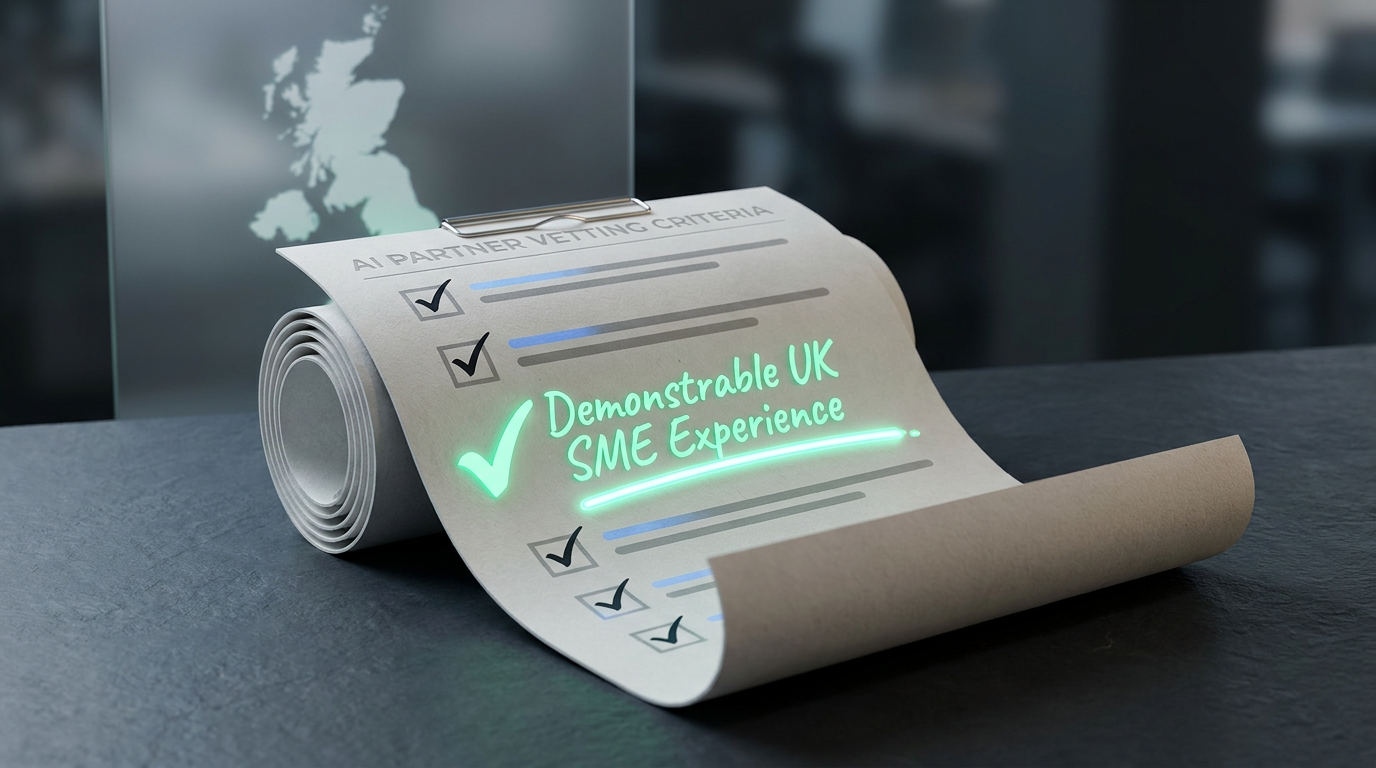
3. Demonstrable UK SME Experience
An AI solution for a global bank is vastly different from one for a 100-person manufacturing firm in the Midlands. Ask for case studies and references from businesses of your size and sector within the UK. They must understand the unique challenges and opportunities that UK SMEs face, from navigating local regulations to competing in a crowded market.
4. Ironclad Security and GDPR Expertise
This is completely non-negotiable. Your partner must demonstrate, in detail, how they will secure your company and customer data. They need a deep, practical understanding of the UK General Data Protection Regulation (UK GDPR) and guidance from the Information Commissioner's Office (ICO). Don't accept vague assurances; ask for specifics on their data handling protocols.
5. Transparent Pricing and Clear ROI Forecasting
Avoid partners who only offer vague hourly rates. Look for clear, project-based pricing or transparent retainers that align with your budget. More importantly, a great partner will work with you to build a solid business case and help you measure the Return on Investment (ROI) of the project.
6. Long-Term Strategy vs. Short-Term Project
Is this potential partner trying to sell you a single, one-off project, or are they interested in building a long-term strategic relationship? an effective AI partners grow with you, continuously identifying new opportunities for optimisation and innovation as your business evolves.
7. Cultural Fit and Communication Style
We'll be honest - this is a partnership. You are going to be working closely with these people. Do their communication style, response times, and core values align with your company culture? A strong cultural fit can be the difference between a smooth, successful project and a frustrating, drawn-out engagement.
Navigating UK Compliance: Why GDPR and Governance Matter
Yes, compliance is a critical and non-negotiable factor when selecting an AI partner for business UK. Ignoring it can lead to severe financial penalties and reputational damage. The UK's regulatory landscape, particularly the UK GDPR, imposes strict rules on how personal data is processed, and AI systems are no exception. According to the Information Commissioner's Office (ICO) (2024), any organisation using AI must ensure its processes are lawful, fair, and transparent.
A competent partner must act as your compliance guide. They should be able to explain exactly how their proposed solution adheres to UK GDPR principles, especially regarding automated decision-making and data minimisation. They need to provide a clear Data Processing Agreement (DPA) that outlines responsibilities and liabilities. The UK's National AI Strategy (2022) emphasizes the importance of effective governance, and your partner should be your first line of defence in implementing it. A good partner helps you prevent the rise of 'Shadow AI' - the unsanctioned use of AI tools by employees that exposes your business to huge vulnerabilities. By establishing a clear AI Governance framework, your partner helps you manage these risks of ungoverned AI, ensuring that all AI use is secure, compliant, and aligned with your business strategy. This proactive approach to governance, guided by international standards from bodies like the Organisation for Economic Co-operation and Development (OECD), turns a potential liability into a competitive advantage.
Key Questions to Ask a Potential AI Partner
Walking into a vetting meeting armed with the right questions can immediately separate the strategic partners from the mere tech vendors. This isn't about trying to catch them out with technical trivia; it's about understanding their process, their commercial mindset, and how they define success. Here are some essential questions to ask an AI partner to get the clarity you need.
Questions about Strategy and Business Impact:
- Can you walk me through a case study of a UK SME in a non-tech sector you've worked with? What was the business problem, and what was the measured outcome?
- How will you work with us to measure the success of this project and report on the ROI?
- Beyond this initial project, how do you see AI creating strategic value for our business in the next 2-3 years?
Questions about Process and Implementation:
- What is your process for training our team and ensuring high user adoption? What does your support look like post-launch?
- How do you manage project timelines and communication? What involvement will you need from my team?
- Who, specifically, will be working on our account, and what is their experience?
Questions about Commercials and Governance:
- Who owns the intellectual property (IP) and the data models developed during our engagement?
- Can you detail your data security measures and how you ensure compliance with UK GDPR?
- What is your pricing model, and what exactly is included? Are there any hidden or ongoing costs we should be aware of?
An experienced and confident AI implementation partner will welcome these questions and provide clear, direct answers. Vague responses or an over-reliance on jargon should be treated as a major warning sign.
Data Table: Comparing AI Partnership Models
Not all organisations that offer AI services are true partners. Understanding the differences between a simple vendor, a consultant, and a strategic partner is key to identifying what your business actually needs. This table breaks down the common models, helping you align your expectations with the right type of engagement. The Stanford AI Index Report (2024) notes a significant increase in corporate AI investment, making it crucial to ensure that investment is directed effectively.
| Criterion | One-Off Project Vendor | Retained AI Consultant | Strategic AI Partner |
|---|---|---|---|
| Primary Focus | Delivers a specific, pre-defined technical solution (e.g., a single software tool). | Provides high-level strategic advice, roadmaps, and analysis. | Combines strategy, implementation, and ongoing optimisation to drive business outcomes. |
| Scope of Work | Narrow and project-based. The engagement ends upon delivery. | Advisory. Often delivers reports or plans but may not execute them. | End-to-end. From problem definition through to deployment and long-term support. |
| Business Model | Fixed price per project or software licence. | Monthly or quarterly retainer for access to expertise. | A mix of project fees, retainers, and sometimes performance-based incentives. |
| Key Deliverable | A piece of functioning code or a software subscription. | A strategic document, audit report, or technology roadmap. | A fully integrated, adopted solution with measurable ROI and a long-term growth plan. |
| Success Metric | Project delivered on time and on budget. | Quality and clarity of the strategic advice provided. | Tangible business impact (e.g., cost savings, revenue growth, efficiency gains). |
Frequently Asked Questions About Choosing an AI Partner
What does it mean to choose an AI partner?
To choose an AI partner means selecting a strategic company to help you implement AI, focusing on business goals, not just technology. A true partner provides expertise in strategy, implementation, and governance. This decision should typically be based on a thorough vetting of their business acumen and alignment with your goals, ensuring they act as an extension of your team.
Which AI is best for small business owners?
There is no single 'best' AI; the right solution depends entirely on your specific business problem. For SMEs, an effective AI often starts with automating repetitive tasks in finance or customer service using accessible tools. A good partner will help you identify the highest-impact problem to solve first. This ensures a practical application rather than a purely technological one.
How do I set up AI for my business?
Start by identifying a specific, high-pain business process you want to improve, not by choosing a technology. Then, work with a consulting partner to conduct a small-scale proof of concept (PoC) to validate the solution's effectiveness. This approach minimises risk and builds a strong business case for further investment before you scale across the organisation.
What is the difference between an AI consulting and an implementation partner?
An AI consulting partner primarily provides strategic advice, helping you identify opportunities and create a roadmap. An AI implementation partner focuses on the technical build and deployment of the solution. A true strategic partner, like Up-Stride, combines both, guiding you from strategy through to successful, human-centred implementation and ensuring the solution delivers real business value.
How much should a UK SME budget for an AI partner?
Budgets vary widely based on scope, but you should look for partners who offer clear, predictable pricing. A simple automation project might start from £1,500-£5,000, while a custom AI agent could be £20,000+. Be wary of partners who can't provide clear costings and a projected ROI. When budgeting for AI in 2026, typically factor in ongoing support and potential consumption costs.
Is ChatGPT considered an AI partner?
No, ChatGPT is a powerful AI tool, but it is not a partner. An AI partner is a service-based business that provides strategic guidance, custom development, security, and accountability. Using tools like ChatGPT without proper governance can create significant risks, a problem a real partner helps you manage. A partner provides strategy and security, not just a tool.
What are the biggest risks of choosing the wrong partner?
The biggest risks include wasting significant budget on a solution that doesn't solve a real problem, creating major data security and GDPR compliance breaches, and low user adoption due to a poor implementation process. Choosing a partner with weak business acumen is the most common and costly mistake. This is precisely why thorough, business-first vetting is so essential.
How do I ensure data security with an external AI partner?
Ensure your partner has reliable data security credentials, is fully compliant with UK GDPR, and signs a comprehensive Data Processing Agreement (DPA). Ask them to detail their data handling, encryption, and access control policies. Their ability to answer these questions clearly and confidently is a key indicator of their professionalism and reliability. Typically confirm this before signing any contract.
What is the '30% rule' for AI?
The '30% rule' is a guideline suggesting that if AI can automate over 30% of a task, it's a good candidate for automation. However, this is a very simplistic metric. A better approach is to use an 'impact vs. Effort' matrix to prioritise projects based on their specific value to your business. A strategic partner can help you with this more nuanced analysis.
What results can I realistically expect from my first AI project?
For a well-chosen first project, you can realistically expect to see significant time savings in a specific process, a reduction in manual errors, and improved data quality. The goal is a clear, measurable win that builds momentum and provides a strong ROI. Avoid expecting a complete business transformation from a single project. Start small, prove the value, and build on that success.
Important Considerations
This guide provides a strategic framework, but the AI landscape evolves rapidly. Specific tools and platforms mentioned are illustrative, and new ones emerge constantly. The principles of vetting for business acumen, UK compliance, and a human-centred approach, however, remain constant. This research is based on publicly available data and our professional experience up to late 2026.
The primary alternative to engaging an AI partner is developing capabilities in-house. This can provide greater control but often involves higher upfront costs, longer timelines, and the significant challenge of hiring and retaining scarce AI talent in the UK market. For simpler needs, off-the-shelf Software-as-a-Service (SaaS) automation tools can be a good starting point before engaging a full partner.
We recommend seeking professional guidance when you have identified a clear business problem but are unsure of the potential AI solutions, or when you are concerned about the risks of data security and compliance. A brief consultation can often provide the clarity needed to decide on the right path forward, whether it's a small project or a long-term strategic partnership.
Making the Right Choice for Your Business's Future
Ultimately, the process to choose an AI partner is a defining strategic decision for any UK SME. By shifting the focus from technology to business problems, prioritising a human-centred approach to adoption, and rigorously vetting for UK-specific commercial and regulatory expertise, you can demystify the process. This ensures you select a partner who will deliver tangible ROI and become a genuine engine for your growth.
At Up-Stride, we specialise in being that strategic partner, providing human-centred AI solutions for UK SMEs. We turn AI from a confusing buzzword into practical infrastructure that delivers measurable results. If you're ready to move from AI hype to real-world business impact, we invite you to book a free, no-obligation consultation to discuss how we can help you thrive.
References
- Department for Science, Innovation and Technology (GOV.UK) - Government Report, 2024. Identifies 'lack of skilled staff' as a major barrier to AI adoption for UK businesses and estimates the UK AI market at £106 billion.
- UK Government - Government Strategy Paper, 2022. Outlines the UK's 10-year plan to support the AI ecosystem and ensure effective, fair governance of AI.
- Information Commissioner's Office (ICO) - Regulatory Guidance, 2024. Provides the official UK framework for ensuring AI systems comply with UK GDPR, covering accountability, lawfulness, and fairness.
- Stanford Institute for Human-Centered Artificial Intelligence (HAI) - Annual Academic Report, 2024. Tracks global trends in corporate investment in AI, model costs, and public perception of AI technologies.
- Organisation for Economic Co-operation and Development (OECD) - International Body Data Hub. Provides international principles for trustworthy AI and live data on AI readiness and adoption across member countries, including the UK.
- Innovate UK - Government Agency Report, 2023. Details opportunities and barriers for UK service sector SMEs using AI to improve productivity and create value.
- Confederation of British Industry (CBI) - Business Organisation Survey. Reveals that over half of UK firms are using AI, with top drivers being productivity, service enhancement, and cost reduction.
- World Economic Forum - Global Survey Report, 2023. Projects that 75% of companies will adopt AI and identifies 'AI and machine learning specialists' as a top-trending role.
- Resolve - Industry Guide. Highlights the importance of selecting a partner who understands business process automation and can deliver measurable efficiency gains.
- MSBC Group - Industry Analysis. Stresses the need to evaluate a partner's technical capabilities alongside their ability to provide ongoing support and strategic guidance.
- Centric Consulting - Best Practices Guide. Recommends focusing on a partner’s cultural fit and their demonstrated experience in your specific industry.
How to make the right choice for your business's future?
Ultimately, the process to choose an AI partner is a defining strategic decision for any UK SME. By shifting the focus from technology to business problems, prioritising a human-centred approach to adoption, and rigorously vetting for UK-specific commercial and regulatory expertise, you can demystify the process. This ensures you select a partner who will deliver tangible ROI and become a genuine engine for your growth.At Up-Stride, we specialise in being that strategic, human-centred AI partner for UK SMEs. If you're ready to move from AI hype to real-world business results, we invite you to book a free, no-obligation consultation to discuss how we can help you thrive.

Frequently Asked Questions About Choosing an AI Partner
What does it mean to choose an AI partner?
To choose an AI partner means selecting a strategic company to help you implement AI, focusing on business goals, not just technology. A true partner provides expertise in strategy, implementation, and governance. This decision should always be based on a thorough vetting of their business acumen, UK-specific experience, and alignment with your company's goals.
Which AI is best for small business owners?
There is no single 'best' AI; the right solution depends entirely on your specific business problem. For SMEs, the best AI often starts with automating repetitive tasks in finance, administration, or customer service using accessible tools. A good AI partner for SMEs will help