
The Complete Guide to Data and AI Consulting for UK SMEs
🎯 Key Takeaway
Strategic data and AI consulting provides UK Small and Medium-sized Enterprises (SMEs) with a clear roadmap to use artificial intelligence, moving from operational bottlenecks to data-driven growth. It translates complex technology into practical, profitable business solutions.
• Identifies high-impact opportunities for automation and efficiency gains within your specific business.
• Develops a clear data strategy that ensures compliance with UK General Data Protection Regulation (UK GDPR) and improves decision-making.
• Delivers a measurable Return on Investment (ROI) by reducing costs, improving productivity, and creating new value.
This guide provides a jargon-free playbook for choosing the right partner and making AI work for your business.
For many UK Small and Medium-sized Enterprises (SMEs), the constant buzz around Artificial Intelligence (AI) can feel like a mix of immense opportunity and overwhelming pressure. As of Q3 2026, with productivity and competition challenges mounting, the question isn't if you should adopt AI, but how. This is where strategic data and AI consulting becomes essential. It’s not about buying more software; it's about finding a partner to build practical AI infrastructure that solves real-world business problems.
This guide is a jargon-free playbook designed for non-technical leaders. We'll break down what this service is, explore the tangible benefits, outline how to choose the right partner, and explain how to measure success. Our goal is to demystify ai consulting for smes uk and give you the confidence to make informed decisions that drive real growth.
👤 Written by: Up-Stride Content Team
Reviewed by: Mark Blake (Founder & CEO), Gabriel Imevbore (Client Experience & Sales), Thomas McElroy (Brand & Communications) - Enterprise-ready team with real C-suite and operational experience.
ℹ️ Transparency Disclosure: This article explores data and AI consulting for UK SMEs based on our C-suite experience, industry analysis, and data from government and academic sources. Up-Stride is a specialised AI consultancy for UK businesses, and some links may connect to our services or further resources. Our editorial team has verified all information for accuracy and clarity.
What is Data and AI Consulting (in Plain English)?
At its core, data and AI consulting is a strategic service that helps businesses turn their data into a competitive advantage. It's about creating a clear plan to use AI effectively, rather than just experimenting with random tools. Think of it as having an expert guide who translates complex technology into practical, profitable business actions.
The service can be broken into two distinct but connected parts:
- Data Strategy Consulting: This is the foundational work of getting your 'data house' in order. Many SMEs have valuable data scattered across spreadsheets, emails, and various software. A consultant helps you organise, clean, and govern this information. This process, known as data strategy consulting uk, ensures your data is accurate, secure, and ready to be used. It also involves establishing policies to comply with regulations from bodies like the Information Commissioner's Office (ICO). We'll be honest - this part can be tedious, but it's strongly critical for success.
- AI Implementation: Once your data foundation is solid, the next step is to apply AI. This is where the consultant identifies high-impact opportunities within your business. It could be automating repetitive administrative tasks, predicting customer behaviour, or optimising your supply chain. The focus for SMEs is different from large enterprises; it’s about agility, affordability, and achieving a fast Return on Investment (ROI), a performance measure used to evaluate the profitability of an investment. According to a report from The Royal Society, machine learning, a subset of AI, excels at finding patterns in data, making it effective for these kinds of business challenges.
Essentially, data consulting is like preparing a detailed architectural blueprint and laying a solid foundation for a house. AI consulting is the process of actually building the intelligent, functional structure on top of it.
Why Should UK SMEs Consider AI? Tangible Benefits & ROI
For a business owner, the only reason to invest in new technology is if it delivers a clear return. The conversation around ai consulting for smes uk must move beyond buzzwords and focus on measurable outcomes. AI isn't just a tool for large corporations; it's a powerful engine for SME productivity and growth, particularly in a landscape where labour shortages and efficiency are key concerns.
The tangible benefits typically fall into three main categories:
- Boosting Productivity: The World Economic Forum's 2023 Future of Jobs Report projects that 75% of companies will adopt AI, largely driven by the need for automation. For an SME, this means freeing up your talented team from repetitive, low-value tasks. Imagine an e-commerce business where AI automatically handles inventory updates, answers common customer queries, and generates personalised marketing emails. This allows your staff to focus on strategic growth activities instead of manual admin. It's about augmenting your team, not replacing them.
- Reducing Costs: AI excels at optimising processes and minimising expensive errors. For a manufacturing firm, an AI-powered visual inspection system can spot defects on a production line far more accurately than the human eye, reducing waste and recall costs. For a service-based business, AI can analyse historical data to forecast demand more accurately, preventing overstaffing or resource shortages. A 2023 report from Innovate UK highlights these opportunities, noting AI's potential to create significant value in the UK's service sector.
- Enhancing Services and Driving Revenue: Understanding your customers is the key to growth. AI can analyse sales data, customer feedback, and market trends to provide deep insights that would be impossible to find manually. This allows you to create highly personalised offers, improve customer satisfaction, and identify new revenue streams. By implementing the right business ai solutions uk, you can build a smarter, more responsive business. If you're looking for a starting point, our playbook for building AI automation offers practical steps.
How to Choose the Right AI Consulting Partner
Selecting the right partner is the single most important factor in the success of your AI initiatives. A good consultant acts as a strategic guide, not just a technical vendor. When you start your search on how to choose an ai consultant, you should focus on business value and partnership fit, not just technical jargon.
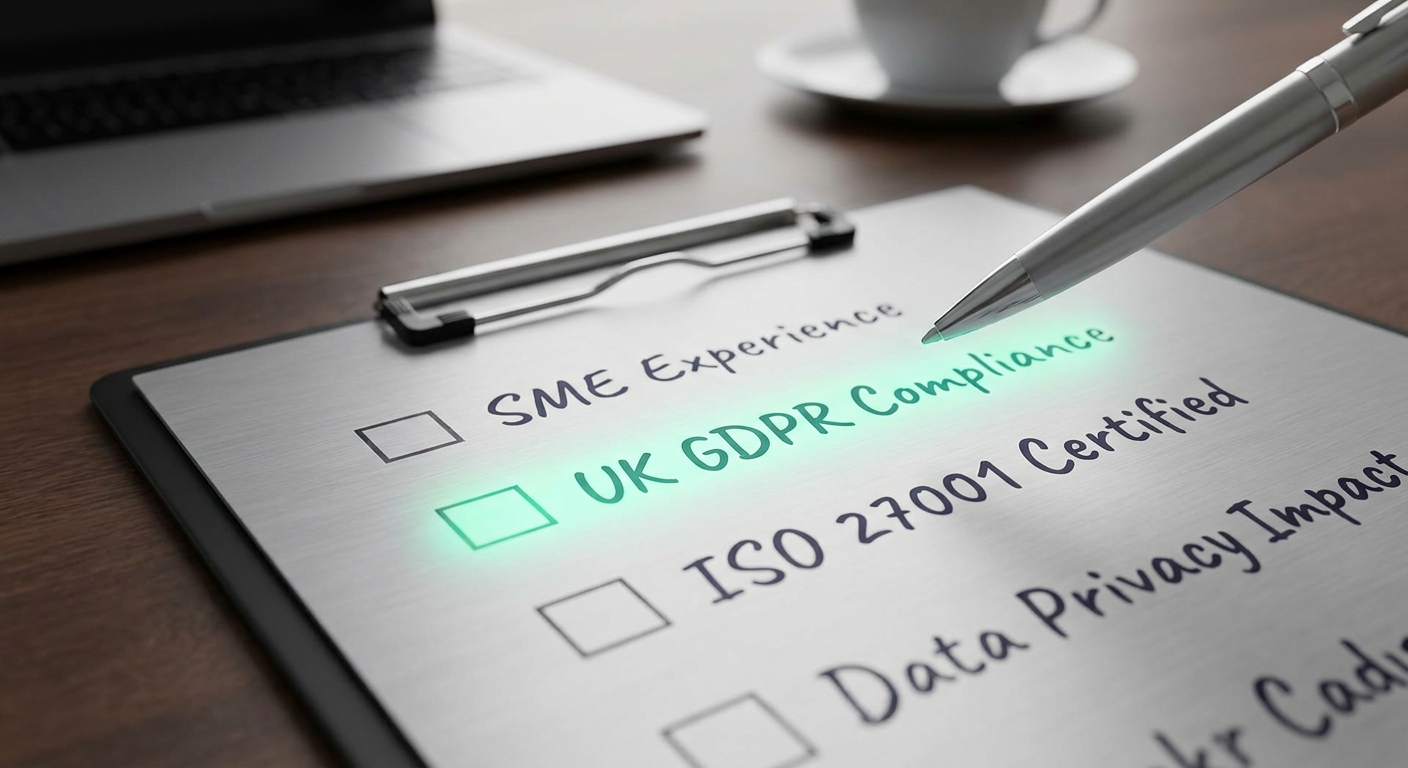
Here are five key criteria to build your evaluation checklist:
- SME-Specific Experience: Has the consultant worked with businesses of your size and in your industry? Ask for case studies or references. An approach that works for a multinational bank is rarely suitable for a 50-person engineering firm. Their solutions should be pragmatic and budget-conscious.
- Business Acumen Over Tech-Speak: Can they discuss ROI, operational efficiency, and customer value as fluently as they discuss algorithms? A true partner first seeks to understand your business challenges. If a potential consultant's pitch is full of technical terms without connecting them back to your bottom line, that's a red flag.
- UK GDPR & Data Security Expertise: Data is your most valuable asset. Any potential partner must demonstrate a deep understanding of UK data protection law. Ask them directly about their approach to data governance and compliance with the Information Commissioner's Office (ICO) guidelines. This is non-negotiable.
- Transparent Pricing & Phased Approach: Avoid open-ended hourly contracts that can lead to budget overruns. Look for partners who offer fixed-price projects or a phased methodology. Our Crawl, Walk, Run - AI Adoption Methodology is designed for this, ensuring you see value at each stage before committing further investment. A clear Practical Guide to AI Implementation can also help set expectations.
- A Human-Centred Focus: Does their process involve training and empowering your team? an effective business ai solutions uk are those that your employees will actually use and embrace. A consultant who only talks about technology but ignores change management and user adoption is setting you up for failure.
To help with budgeting, here are some typical project scopes for SMEs:
| Project Type for SME | Typical Cost Range (UK) | Typical Timeline | Key Deliverable |
|---|---|---|---|
| AI Strategy & Roadmap Workshop | £3,000 - £7,500 | 1-2 Weeks | A prioritised list of AI use cases with estimated ROI and an implementation plan. |
| Data Audit & Governance Setup | £5,000 - £15,000 | 2-4 Weeks | A clean, centralised data source and a clear data governance policy (UK GDPR compliant). |
| Process Automation Pilot (e.g., RPA) | £8,000 - £20,000 | 4-8 Weeks | Automation of 1-2 key administrative or operational processes, saving measurable staff hours. |
| Custom AI Model Pilot (e.g., Sales Forecaster) | £15,000 - £40,000+ | 8-16 Weeks | A working pilot model that provides predictive insights to improve a core business function. |
Note: Costs are illustrative and vary based on complexity and scope.
The Up-Stride Difference: A Human-Centred Approach
There is a significant gap between tech-first AI implementation and human-centred solutions. A tech-first approach focuses on the algorithm; a human-centred AI approach focuses on the person who will use it and the business problem it will solve. At Up-Stride, we firmly believe this is the only way to successfully bridge the AI advantage gap for UK SMEs.
So, what does this mean in practice?
It means designing human-centred AI solutions that augment and empower your team, not just aim to replace them. This philosophy directly addresses a key barrier to AI adoption identified in a 2024 report from the Department for Science, Innovation and Technology (GOV.UK): a 'lack of skilled staff'. Instead of seeing this as a problem, we see it as an opportunity to upskill your existing team, making their jobs more engaging and valuable. The OECD also champions this approach in its principles on trustworthy AI, emphasizing human-centric values.
Our process is built around this philosophy:
- Discover: We don't start with technology. We start with your business. Our initial focus is on understanding your unique challenges, operational bottlenecks, and strategic goals.
- Design: We work alongside your team to co-create a solution. This ensures the final product is intuitive, practical, and solves the problem they actually face every day.
- Deliver: We manage the implementation from end-to-end and provide ongoing support. This isn't about handing over a piece of software; it's about delivering a complete, working system and ensuring your team is confident in using it. This is the core of effective data strategy consulting uk.
Frequently Asked Questions
What is data and ai consulting?
It is a strategic service that helps businesses create a plan to use their data and implement intelligent systems. This involves organising your data effectively (data consulting) and then applying Artificial Intelligence to automate processes, gain insights, and improve decision-making (AI consulting). Ultimately, data and ai consulting turns technology into a measurable business asset.What does an AI consultant actually do for a small business?
An AI consultant first identifies a specific, high-impact business problem that AI can solve. They then help you choose the right tools (or design a custom solution), manage the implementation project, and ensure your team is trained to use the new system. Their job is to act as your expert guide, translating your business needs into a working technical solution.How much does AI consulting cost for SMEs in the UK?
Costs can range from a few thousand pounds for a strategy workshop to over £25,000 for a custom solution. The final price depends entirely on the complexity of the problem you're solving. Reputable consultants often offer fixed-price packages or phased projects, which provides the cost predictability that is crucial for SME budgeting and financial planning.How can AI help my SME save money?
AI primarily saves money by automating repetitive tasks, which reduces labour costs and minimises expensive human errors. It can also optimise inventory to cut waste, predict maintenance needs to prevent costly downtime, and improve the return on your marketing spend. These efficiencies directly contribute to your bottom line by lowering operational expenses.Is my business ready for AI?
You are likely ready for AI if you have repetitive, rule-based tasks that consume significant staff time. If you have digital data about your customers, sales, or operations (even in spreadsheets), you have the raw material for AI. A consultant can help perform a readiness assessment to identify the most promising starting point for your specific situation.What are the risks of using AI in my business?
The primary risks involve data privacy issues and ensuring compliance with UK GDPR. This is especially true with the unapproved use of AI tools by employees, often called 'Shadow AI'. There is also the risk of a poor implementation leading to a low ROI. A strong governance policy and working with an experienced partner are an effective ways to mitigate these challenges.How do I measure the ROI of an AI project?
You measure AI Return on Investment by tracking 'hard' metrics like hours saved, direct cost reductions, and increased revenue. However, you should also consider 'soft' benefits like improved employee morale from less tedious work and higher customer satisfaction scores. A practical framework for measuring the Return on Investment can help you track both short-term gains and long-term value.Do I need a bespoke AI solution or an off-the-shelf tool?
Off-the-shelf tools are excellent for standard business problems and offer a quick, affordable start. A bespoke solution, while a larger initial investment, is better when you have a unique process that provides a competitive advantage. A custom solution is tailored exactly to your needs and can deliver a much higher long-term ROI by enhancing what makes your business unique.What is the difference between data consulting and AI consulting?
Data consulting is like organising your kitchen and stocking the pantry with high-quality ingredients. AI consulting is then using those ingredients to cook a gourmet meal. You must have clean, organised, and reliable data (the 'ingredients') before you can effectively apply AI (the 'cooking') to create something valuable for your business.How long does it take to implement an AI solution?
A simple automation project using existing tools can often be live within a few weeks. A more complex, custom-built AI solution for a core business process might take three to six months to develop a pilot version. The timeline depends entirely on the complexity of the business problem you are solving and the quality of your existing data.Important Considerations
The success of any AI project depends heavily on the quality of the underlying data and the clarity of the business objective. This guide is based on industry data and trends as of late 2026; the technology, capabilities, and associated costs are evolving at a rapid pace. The ROI figures and timelines mentioned are illustrative and will vary based on the unique circumstances of each individual business.
Whilst this guide focuses on consulting as a path to AI adoption, alternative approaches exist. Many businesses can achieve early wins by using off-the-shelf Software-as-a-Service (SaaS) tools that have AI features already built-in. For simpler workflow connections, no-code automation platforms can be effective. Some organisations may also consider hiring an in-house data specialist, although this represents a significant fixed cost and talent challenge for most SMEs.
For any project involving personal customer data or automated decision-making that significantly impacts people, professional guidance is essential. An experienced partner ensures your solution is not only effective but also compliant with UK GDPR and ethically sound. We typically recommend seeking expert advice before implementing AI in sensitive areas of your business to avoid legal and reputational risks.
Your Next Step Towards a Smarter Business
Navigating the world of data and AI consulting doesn't have to be overwhelming. For UK SMEs, the key is to move past the hype and focus on practical applications that solve real business problems. By prioritising a clear data strategy, choosing a partner with well-supported by research business acumen, and focusing on human-centred solutions, you can unlock significant gains in productivity and competitiveness.
At Up-Stride, we specialise in translating complex AI capabilities into measurable results for businesses like yours. We combine C-suite experience with technical expertise to act as your long-term AI partner. If you’re ready to explore our approach to bridging the AI gap and discover how AI can work for your business, book a free, no-obligation consultation with our team today.
References
- Department for Science, Innovation and Technology (GOV.UK) - Government Report (2024). Identifies the UK AI market size and notes 'lack of skilled staff' as a primary barrier to AI adoption.
- UK Government - Government Strategy Paper. Outlines the UK's 10-year national plan to support the AI ecosystem.
- Information Commissioner's Office (ICO) - Regulatory Guidance. Provides official guidance on applying UK data protection law (UK GDPR) to AI systems.
- Stanford Institute for Human-Centered Artificial Intelligence (HAI) - Annual Academic Report. Tracks global trends in corporate AI investment and model costs.
- Organisation for Economic Co-operation and Development (OECD) - International Body Principles. Defines international standards for trustworthy AI, including human-centred values and accountability.
- Innovate UK - Government Agency Report (2023). Details opportunities and barriers for UK service sector SMEs using AI.
- The Alan Turing Institute - National Institute Report. Explains AI's potential to boost the UK economy.
- World Economic Forum - Global Survey Report (2023). Projects that 75% of companies will adopt AI for automation.
- Deloitte UK - Consultancy Overview. Outlines service offerings in AI and data, showing the scope of enterprise-level consulting.
- The Royal Society - Scientific Academy Report. Provides a foundational explanation of machine learning for a non-technical audience.
- PA Consulting - Consultancy Service Page. Details approaches to AI, analytics, and data strategy for large organisations.
- The Dot Collective - Consultancy Service Page. Describes data and AI strategy services, highlighting the importance of a clear roadmap.
Frequently Asked Questions About Data and AI Consulting
Q1: What is data and AI consulting?
Strategic data and AI consulting is a service that helps businesses transform their raw data into intelligent systems that drive growth and efficiency. It moves beyond pure technology to focus on business outcomes. This involves creating a clear data strategy, identifying high-value AI opportunities, and managing the implementation of solutions that solve specific operational problems, from automating tasks to improving customer insights.
Q2: What does an AI consultant actually do for a small business?
An AI consultant for an SME acts as a strategic partner, translating business needs into technical solutions. They begin by auditing your current processes to find the best opportunities for AI. They then help you select the right tools (or design a custom solution), manage the project from start to finish, and ensure your team is trained and ready to use the new system effectively for a clear return on investment.
Q3: How much does AI consulting cost for SMEs in the UK?
Costs for AI consulting vary based on project scope, from a few thousand pounds for a strategic workshop to over £25,000 for a custom solution. Many consultancies focused on SMEs offer fixed-price packages for defined outcomes, such as an automation pilot or a data strategy roadmap. This approach provides the cost predictability that is essential for SME budgeting, avoiding the open-ended hourly billing common in enterprise projects.
Q4: How can AI help my SME save money?
AI primarily saves money by automating repetitive, time-consuming manual tasks, which reduces labour costs and minimises expensive human errors. For example, it can automate invoice processing, optimise delivery routes to save fuel, predict stock needs to reduce waste and storage costs, and improve the targeting of marketing campaigns to increase return on ad spend. These efficiencies directly impact your bottom line.
Q5: Is my business ready for AI?
Your business is likely ready for AI if you have rule-based, repetitive processes that consume significant staff time or if you collect digital data on your operations. This data doesn't need to be perfect; even information in spreadsheets about sales, customers, or inventory can be a starting point. A consultant can perform a readiness assessment to confirm where the most valuable opportunities lie.
Q6: What are the risks of using AI in my business?
The primary risks involve data security, privacy, and compliance with UK GDPR, especially with the unapproved use of AI tools by staff. Other risks include poor implementation leading to a low ROI and potential bias in AI decision-making. These can be mitigated with a strong governance policy, transparent AI models, and working with an experienced partner who understands UK regulations.
**Q7: How do I measure the ROI of an
AI project?
Return on Investment is measured by tracking quantitative metrics like cost reductions and revenue increases, alongside qualitative benefits such as improved employee morale. You should establish baseline metrics before the project begins. Track 'hard' returns like hours saved on a task, reduced material waste, or increased sales conversions. Also, consider 'soft' returns like higher customer satisfaction scores. A practical framework for measuring the Return on Investment is crucial for justifying the initial spend.
Q8: Do I need a bespoke AI solution or an off-the-shelf tool?
The choice depends on whether your business process is standard or a unique source of competitive advantage. Off-the-shelf AI tools are excellent for common problems like accounting automation or CRM data entry, offering a fast and cost-effective start. A bespoke solution is justified when automating a proprietary process that differentiates you in the market, as it can deliver a significantly higher long-term ROI despite the larger upfront investment.
Q9: What is the difference between data consulting and AI consulting?
Data consulting prepares your ingredients, while AI consulting cooks the meal. Think of it this way: data consulting focuses on getting your data 'house' in order - organising, cleaning, and structuring it into a usable format (the ingredients). AI consulting then uses that high-quality data to build intelligent systems that automate tasks or provide insights (cooking the meal). You need the first to succeed at the second.
Q10: How long does it take to implement an AI solution?
Timelines range from a few weeks for a simple automation pilot to over six months for a complex, bespoke system. A project using an existing tool to automate a single, well-defined process can be live very quickly. In contrast, developing a custom predictive model for a core business function requires more time for data preparation, model training, and integration. A good consultant will provide a phased timeline with clear milestones.
Limitations and Important Considerations
AI is not a magic bullet. The success of any AI project is highly dependent on the quality of the underlying data and the clarity of the business objective. This guide is based on current data as of late 2026; the technology and costs are evolving rapidly. The ROI figures are illustrative and depend on individual business circumstances.
While this guide focuses on consulting, alternative approaches exist. Businesses can start with off-the-shelf SaaS tools with built-in AI features or use no-code automation platforms like Zapier or Make.com for simple tasks. Some may also choose to hire an in-house data specialist, though this can be a significant cost for an SME.
For any project involving personal data or complex decision-making, professional guidance is essential. An experienced consultant ensures your solution is not only effective but also compliant with UK GDPR and ethically sound. Always seek expert advice before implementing AI that significantly impacts customers or employees.
Your Next Step Towards a Smarter Business
In summary, data and ai consulting provides a structured path for UK SMEs to move past the hype and focus on practical applications that solve real business problems. By prioritising a clear data strategy, choosing a partner with proven business acumen, and focusing on human-centred solutions, you can unlock significant gains in productivity and competitiveness. The journey starts not with complex algorithms, but with a clear understanding of your most pressing operational challenges.
At Up-Stride, we specialise in translating complex AI capabilities into measurable results for businesses like yours. We combine C-suite experience with technical expertise to act as your long-term AI partner, focusing on our approach to bridging the AI gap for SMEs. If you’re ready to explore how AI can work for your business, book a free, no-obligation consultation with our team today.


References
- [[1] Department for Science, Innovation and Technology (GOV.UK)](https://www.gov.uk/government/publications/ai-sector-study-2024) - Government Report (2024). Identifies the UK AI market size and notes 'lack of skilled staff' as a primary barrier to AI adoption for businesses.
- [[2] UK Government](https://www.gov.uk/government/publications/national-ai-strategy) - Government Strategy Paper. Outlines the UK's 10-year national plan to support the AI ecosystem and ensure benefits are realised across all regions.
- [[3] Information Commissioner's Office (ICO)](https://ico.org.uk/for-organisations/uk-gdpr-guidance-and-resources/artificial-intelligence-ai/) - Regulatory Guidance. Provides official guidance on applying UK data protection law (UK GDPR) to AI systems, covering accountability and fairness.
- [[4] Stanford Institute for Human-Centered Artificial Intelligence (HAI)](https://aiindex.stanford.edu/) - Annual Academic Report. Tracks global trends in corporate AI investment, model costs, and public perception of AI technology.
- [[5] Organisation for Economic Co-operation and Development (OECD)](https://oecd.ai/) - International Body Principles. Defines international standards for trustworthy AI, including human-centred values, transparency, and accountability.
- [[6] Innovate UK](https://iuk.ktn-uk.org/wp-content/uploads/2023/11/AI-for-Services-report-digital_final.pdf) - Government Agency Report (2023). Details opportunities and barriers for UK service sector SMEs using AI to improve productivity, with specific use cases.
- [[7] The Alan Turing Institute](https://www.turing.ac.uk/research/publications/role-ai-uks-economic-future) - National Institute Report. Explains AI's role as a 'general-purpose technology' and its potential to boost the UK economy.
- [[8] World Economic Forum](https://www.weforum.org/publications/the-future-of-jobs-report-2023/) - Global Survey Report (2023). Projects that 75% of companies will adopt AI and identifies 'AI and machine learning specialists' as a top-trending job.
- [[9] Confederation of British Industry (CBI)](https://www.cbi.org.uk/articles/ai-the-new-b2b/) - Business Organisation Survey. Reveals that over half of UK firms use AI, driven by productivity goals, but 'unclear ROI' remains a barrier.
- [[10] The Royal Society](https://royalsociety.org/topics-policy/projects/machine-learning/) - Scientific Academy Report. Provides a foundational, credible explanation of machine learning and its applications for a non-technical audience.
- [[11] Deloitte UK](https://www.deloitte.com/uk/en/services/consulting/services/artificial-intelligence-and-data.html) - "Artificial Intelligence & Data". Provides an overview of enterprise-level AI consulting services and strategic frameworks.
- [[12] PA Consulting](https://www.paconsulting.com/services/reimagine-ai-digital-and-data/ai-analytics-data) - "AI, analytics, and data". Details strategic consulting offerings in AI for large organizations, highlighting a focus on transformation.
- [[13] The Dot Collective](https://www.thedotcollective.co.uk/what-we-do/data-and-ai-strategy) - "Data and AI Strategy Consulting Services". Showcases strategy services for businesses looking to build a foundation for leveraging data and AI.