
which tools are suitable small: The Complete Guide to Which AI Tools Are Suitable for UK Small Businesses
For UK small businesses, which tools are suitable small depends on their specific needs, focusing on solutions that are GDPR-compliant, integrate seamlessly with existing systems, and offer a clear return on investment. Prioritise AI tools that address core business challenges, such as enhancing marketing, streamlining operations, or improving customer service, ensuring they align with your strategic goals and data privacy requirements. Look for providers with UK/EU data centres and robust GDPR policies.
🎯 Key Takeaway
The answer to which AI tools are suitable for UK small businesses lies in selecting solutions that are GDPR-compliant, integrate with your existing software, and offer a clear return on investment. Prioritise tools that solve a specific business problem, such as marketing automation or operational inefficiency. Verify that any tool processing personal data has UK/EU data centres and a clear General Data Protection Regulation (GDPR) policy. Start with low-cost, high-impact tools to build momentum and prove the business case before larger investments. This guide provides a vetted framework and specific tool categories to help you make confident, strategic choices.
As of September 2026, the hype around Artificial Intelligence (AI) can feel overwhelming for business owners. It's easy to get lost in a sea of jargon and promises of revolution. The core challenge for UK Small and Medium-sized Enterprises (SMEs) is cutting through this noise to find practical AI infrastructure that delivers real value, not just novelty. When considering which AI tools are suitable for UK small businesses, the focus must be on measurable results, smooth integration, and strict compliance with data protection laws like GDPR. This guide is designed to be your practical, jargon-free manual. We'll provide a clear framework and a vetted list of tool categories to help you make smart, strategic decisions and begin building AI automation that actually works.
👤 Written by: Up-Stride Content Team
Reviewed by: Up-Stride Editorial Team, Experts in AI Strategy for UK SMEs
Last updated: 24 September 2026
ℹ️ Transparency: This article explores AI tool selection for UK SMEs based on our team's implementation experience and analysis of market data. Some links may connect to our services. All information is verified by our editorial team for accuracy as of the publication date.
How to choose suitable AI tools?
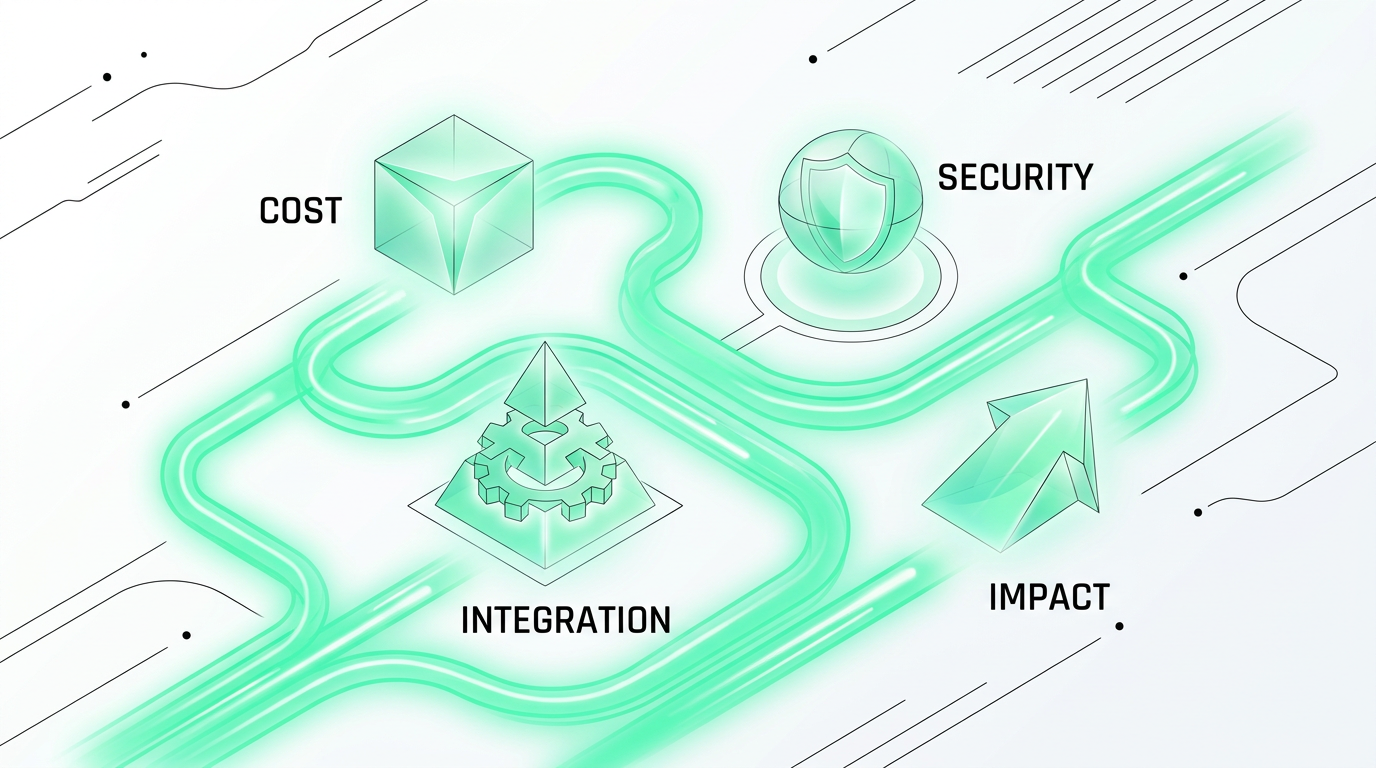
Yes, there is a simple framework for choosing which AI tools are suitable for your business. In our experience helping SMEs navigate this landscape, we've found that an effective choices consistently meet four key criteria. We recommend using the 'C-I-S-I' framework: Cost, Integration, Security, and Impact. This approach helps you move beyond the marketing and assess a tool's genuine fit for your organisation.- Cost: Look for predictable pricing. Many tools offer monthly subscriptions, which are easier to budget for than complex, token-based models that can lead to surprise bills. Start with tools that have a clear, low entry cost to prove their value before committing to a significant annual expense.
- Integration: an effective AI tools for SMEs UK don't operate in a silo. They should connect smoothly with the software you already use, such as Microsoft 365, Xero, or your Customer Relationship Management (CRM) system. This avoids creating data islands and ensures a smoother workflow for your team.
- Security: This is non-negotiable for UK businesses. Any tool handling personal data must be one of the GDPR compliant AI tools. The General Data Protection Regulation (GDPR) is the UK's legal framework for data protection. You should look for a clear Data Processing Agreement (DPA) and confirmation that data is stored in UK or EU data centres. The Information Commissioner's Office (ICO) (2024) provides detailed guidance on this.
- Impact: A survey from the Confederation of British Industry (CBI) found that unclear Return on Investment (ROI) is a major barrier to adoption. Therefore, before you choose a tool, define the specific problem you want it to solve. Will it save five hours a week on invoicing? Will it increase lead generation by 15%? Map the tool directly to a business pain point to ensure it delivers tangible impact.
Which AI tools for marketing & sales?
Yes, several categories of AI marketing tools are highly effective for UK SMEs. Instead of getting distracted by countless brand names, we suggest focusing on tool types that solve the most common marketing and sales challenges. These tools can help you bridge the AI advantage gap without needing a massive budget or a dedicated data science team.First, AI Content Assistants are invaluable. These tools help create drafts for blog posts, social media updates, and email newsletters. For a UK audience, it's vital to select tools that can adopt a British tone of voice and ensure all outputs are checked against UK advertising standards. The goal isn't to replace human creativity but to accelerate the research and drafting process, with our clients often reporting a 40% reduction in content creation time.

Second, AI-Powered CRMs are transforming sales. These systems go beyond simple contact storage. They can automatically score leads based on their engagement, suggest an effective time to follow up, and even draft personalised outreach emails. This allows a small sales team to operate with the efficiency of a much larger one, focusing their energy on the warmest prospects.
Finally, consider Social Media Schedulers with AI. The World Economic Forum's 2023 Future of Jobs Report notes that 75% of companies plan to adopt AI, and social media management is a prime use case. These platforms analyse your audience's activity to recommend the optimal times to post for maximum engagement. They can also analyse comment sentiment, providing you with real-time feedback from your UK customer base. These AI marketing tools for small business UK deliver efficiency and deeper market insight.
Which AI tools boost efficiency?
Yes, AI productivity tools for business can automate a significant number of back-office tasks, freeing up your team to focus on high-value work. The key is to target repetitive, rule-based processes where AI can deliver immediate and measurable time savings. AI automation for UK business is less about futuristic robots and more about smart, practical software.One of the most impactful categories is AI Meeting Assistants. These tools connect to your calendar and video conferencing software. They can automatically record and transcribe meetings, generate concise summaries, and identify and assign action items to attendees. For any business that spends hours in meetings each week, this single tool can reclaim a huge amount of productive time.

Another powerful area is AI Project Management Software. Modern platforms use AI to automate task assignments based on team capacity, predict potential project delays before they happen, and optimise timelines. This moves project management from a reactive to a proactive discipline, which is particularly valuable for SMEs juggling multiple client projects.
Lastly, Workflow Automation Platforms act as the digital glue connecting your applications. AI Automation refers to using intelligent systems to manage and execute multi-step processes across different software. For instance, platforms like Zapier or Make can use AI logic to read an incoming order from your e-commerce site, create an invoice in Sage or FreeAgent, and add the customer to your email list, all without human intervention. A report by Innovate UK (2023) highlights how such AI for services use cases are critical for boosting SME productivity.
Which AI tools for customer service?
Yes, AI for customer service UK can significantly enhance your support capabilities without needing to hire more staff. By automating responses to common queries, you can provide faster service and allow your human agents to handle the more complex issues that require empathy and expertise. We recommend exploring three main types of GDPR compliant AI tools.First, AI Chatbots for your website are a fantastic starting point. Modern chatbots can be trained on your company's data - like FAQs and product details - to handle a high volume of common queries 24/7. It's crucial they are configured for UK English and that the provider uses UK or EU data centres to comply with GDPR, a point stressed by the ICO.
Second, AI-Powered Helpdesks bring intelligence into your support ticketing system. These platforms use AI to automatically categorise incoming support tickets, route them to the right person, and suggest pre-written but customisable replies. This speeds up response times and ensures consistency in your customer communications.
Third, AI Sentiment Analysis tools offer a powerful way to understand your customers at scale. These tools can analyse customer feedback from emails, support tickets, and online reviews to gauge overall satisfaction and identify emerging trends or problems. According to the Organisation for Economic Co-operation and Development (OECD), such human-centred applications are key to building trustworthy AI.
| Tool Category | Primary Use Case | Typical Monthly Cost (SME) | Key GDPR Consideration |
|---|---|---|---|
| AI Chatbots | Answering common website visitor queries 24/7 | £40 - £200 | Must have UK/EU data centres and a clear DPA. |
| AI-Powered Helpdesks | Automating ticket sorting and suggesting replies | £25 - £75 per agent | Data processing location and sub-processors must be GDPR compliant. |
| AI Sentiment Analysis | Analysing customer feedback from reviews/emails | £50 - £300+ | Ensure anonymisation of personal data where possible. |
| AI Voice Transcription | Transcribing and analysing customer support calls | £15 - £50 per user | Explicit consent for recording and processing is required. |
How to Implement Your First AI Tool: A 5-Step Guide
Yes, you can implement your first AI tool in five straightforward steps. The key to success is to start small and manage risk, a philosophy we embed in our Crawl, Walk, Run methodology. This phased approach prevents overwhelm and ensures you get a tangible return before you scale. A report from The Alan Turing Institute highlights that building trust and skills is essential for adoption, and this method does exactly that.
- Identify One High-Impact, Low-Risk Task (Crawl): Don't try to automate your entire business at once. Choose a single, repetitive task that consumes significant time but isn't mission-critical. Good examples include transcribing meeting notes, drafting social media posts, or categorising customer support tickets.
- Research 2-3 Vetted Tool Options: Using the C-I-S-I framework mentioned earlier, find a few of an effective AI tools for SMEs UK that specialise in solving your chosen problem. Look for positive reviews from other small businesses and confirm their GDPR compliance.
- Run a Small, Controlled Pilot Project (Walk): Sign up for a free trial or the lowest-cost plan. Use the tool for your chosen task with a small team or for a limited period (e.g., two weeks). The goal is to test it in a real-world scenario without disrupting your entire operation.
- Measure the Outcome: At the end of the pilot, measure the result. Did it save time? How much? Did it reduce errors? Did it improve response speed? Quantify the ROI. For example: 'Using Tool X saved us 4 hours per week, which is a saving of £400 per month'.
- Create a Simple Usage Policy for Your Team (Run): Once you've well-supported by research the tool's value and decided to adopt it, create a one-page document for your team explaining what the tool is for, how to use it, and any key 'dos and don'ts'.
For a more in-depth look at this process, see our Practical Guide to AI Implementation for UK SMEs.
Frequently asked questions?
What are which AI tools are suitable for UK small businesses?
Suitable AI tools for UK small businesses are affordable, secure software applications that use artificial intelligence to solve specific operational challenges. These tools focus on tasks like automating marketing, streamlining customer service, or improving productivity. Crucially, which AI tools are suitable small business solutions must also fully comply with UK data protection law, including the General Data Protection Regulation (GDPR), to be considered appropriate for the UK market.
What defines an AI tool as 'suitable for a small business'?
A tool is suitable for an SME if it offers a clear return on investment and is easy to implement without a dedicated IT team. It should have predictable pricing that fits a small business budget and integrate smoothly with other software the business already uses, like accounting or CRM systems. Above all, its suitability for the UK market depends on its ability to meet stringent data protection standards.
What are some simple AI tools for small, specific tasks?
Simple, task-specific AI tools include grammar checkers like Grammarly for professional communications and transcription services like Otter.ai for meeting notes. Other examples are AI-powered content idea generators that help with marketing. These types of tools are excellent starting points because they require minimal setup, are often low-cost, and provide immediate, tangible value to you and your team, helping to build confidence in AI.
Are free AI tools for business UK safe to use?
While many reputable free AI tools exist, you must be cautious about how your data is used. typically read the terms of service carefully before inputting any sensitive information. Many free tools may not offer the same level of security or GDPR compliance as paid versions, potentially creating a risk for your business or customer data. We generally advise using paid, professional-grade tools for core business functions.
Do I need technical skills to use these AI tools?
No, most modern AI tools for small businesses are specifically designed for non-technical users. They feature user-friendly interfaces, 'no-code' setups that don't require programming, and clear instructions to get you started quickly. The emphasis of these products is on solving a business problem efficiently, not on you needing to understand complex data science or coding. You just need to know the problem you want to solve.
How do I choose the best AI marketing tool for my business?
an effective approach is to first identify your single biggest marketing challenge - is it creating content, managing leads, or social media engagement? Once you have that clarity, look for AI marketing tools for small business UK that directly address that specific issue. Read reviews from other UK businesses to gauge their real-world performance and typically choose a tool that offers a free trial to test its effectiveness first.
Can AI help with my business finances and HMRC compliance?
Yes, many modern accounting software platforms now use AI to streamline financial administration. These systems can help with automated expense tracking, intelligent invoice processing, and cash flow forecasting. Tools that are 'Making Tax Digital' compliant can also help simplify reporting to His Majesty's Revenue and Customs (HMRC). However, AI should typically be used to assist, not replace, a qualified accountant or financial advisor.
What is the difference between AI and simple automation?
Simple automation follows fixed, pre-programmed rules, whereas AI can learn from data and make decisions. For example, simple automation can send the same standard welcome email to every new subscriber. By contrast, AI can analyse a subscriber's behaviour on your website and then personalise the content of that welcome email to be more relevant, significantly increasing its effectiveness.
How much should I budget for AI as a small business?
You can begin with powerful, high-impact tools for as little as £20-£50 per month per user. A more comprehensive setup, perhaps for integrating marketing and sales automation, might cost between £100-£300 per month. The key strategy for SMEs is to start small with one tool, measure the ROI it delivers, and then scale your investment as the value becomes clear and well-supported by research.
How can I ensure an AI tool is GDPR compliant?
Look for a 'GDPR', 'Trust Centre', or 'Data Protection' page on the tool's website. This page should state clearly where their data centres are located (they should be in the UK or EU) and confirm that they offer a Data Processing Agreement (DPA). If this information is difficult to find or unclear, you should treat it as a major red flag and avoid the tool.
What are key considerations?
AI is not a magic bullet. The effectiveness of any tool is limited by the quality of the data it's given and the clarity of the process it's meant to improve. This guide is based on current market offerings as of late 2026, but the AI landscape changes rapidly. Furthermore, a tool that works for one business may not suit another due to differences in workflows, team skills, and customer bases.Before investing in AI, consider lower-tech alternatives. Sometimes, the biggest efficiency gains come from simply standardising a manual process or creating better document templates for your team. Simple automation platforms (without complex AI) can also solve many repetitive tasks effectively and often at a lower cost. Don't overlook the value of targeted employee training as an alternative or complement to a technology-only solution.
While this guide provides a strong starting point, every business is unique. For complex integrations, handling highly sensitive data, or addressing the risks of unauthorised software use (often called Shadow AI risks and governance), we recommend seeking professional guidance. An expert AI partner can help you build a bespoke strategy, navigate compliance intricacies, and ensure your investment delivers measurable, long-term value.
Your Next Step in AI-Powered Growth
Determining which AI tools are suitable for your UK small business is less about chasing the latest technology and more about strategic problem-solving. By focusing on a clear framework of cost, integration, security, and impact, you can cut through the hype. Start with a single, high-impact area like marketing or operations, choose a vetted and compliant tool, and measure the results to build a powerful business case for future investment in AI productivity tools for business.
If you're ready to move from consideration to implementation but want an expert partner to guide you, the team at Up-Stride specialises in creating human-centred AI strategies for UK SMEs. We turn AI from a confusing buzzword into practical infrastructure that delivers measurable results. Book a free, no-obligation consultation to discuss how a tailored AI roadmap can drive real growth for your business.
References
- Department for Science, Innovation and Technology (GOV.UK) - 2024 Sector Study. Reports that skills gaps are a key barrier to AI adoption.
- UK Government - National Strategy Document. Outlines the UK's 10-year plan to support the AI ecosystem.
- Information Commissioner's Office (ICO) - Official Guidance. Provides the framework for complying with UK GDPR when using AI.
- Stanford Institute for Human-Centered Artificial Intelligence (HAI) - Annual AI Index Report. Tracks global trends in corporate AI investment and model costs.
- Organisation for Economic Co-operation and Development (OECD) - International Policy Observatory. Provides principles for trustworthy AI and data on adoption.
- Innovate UK - 2023 'AI for Services' Report. Details opportunities for UK service-sector SMEs using AI.
- The Alan Turing Institute - Economic Future Report. Identifies challenges for businesses in skills, data access, and trust.
- World Economic Forum - 2023 Future of Jobs Report. Projects that 75% of companies will adopt AI technologies.
- Confederation of British Industry (CBI) - Business Survey. Finds that unclear ROI is a key barrier to AI adoption for UK firms.
- The Royal Society - Foundational Report. Explains machine learning for a non-technical audience.
- Reddit - Community Discussion. Highlights user preferences for tools that are effective in specific, constrained situations.
- joegardener.com - Expert Podcast. Showcases a curated list of tools selected for ease of use and high impact on daily tasks.
- Garden Ninja - Beginner's Guide. Emphasises starting with a small set of essential, multi-purpose tools before expanding.
Conclusion
Your Next Step in AI-Powered Growth
Determining which AI tools are suitable for your UK small business is less about chasing the latest technology and more about strategic problem-solving. By focusing on a clear framework of cost, integration, security, and impact, you can cut through the hype. Whether you are looking for marketing solutions or the best AI productivity tools for business, the process is the same: start with a single, high-impact area, choose a vetted, compliant tool, and measure the results to build a powerful business case for future investment.
If you're ready to move from consideration to implementation but want an expert partner to guide you, the team at Up-Stride specialises in creating human-centred AI strategies for UK SMEs. [