AI Strategy & Implementation
What Is Human-centred AI and Why Is It Important? A Complete Guide for UK SMEs
Discover human-centred AI for UK SMEs. Prioritise people to de-risk investment, boost adoption, and drive growth.
15 October 202616 min read

🎯 Key Takeaway
Human-centred AI is an approach to developing artificial intelligence systems that prioritises human well-being, values, and experience throughout the entire design, development, and deployment process. It ensures technology serves people, not the other way around.
• It shifts the focus from what Artificial Intelligence (AI) can do, to what it should do to solve real problems for your customers and employees.
• For UK Small and Medium-sized Enterprises (SMEs), it de-risks AI investment by improving user adoption, ensuring compliance with Information Commissioner's Office (ICO) guidelines, and delivering tangible Return on Investment (ROI).
• Adopting this approach enhances productivity, boosts team morale, and creates a sustainable competitive advantage in the market.
This guide provides a pragmatic playbook for implementing a human-centred AI strategy that drives real business growth.
As of October 2026, the buzz around AI can feel overwhelming for UK SME leaders. There’s a constant pressure to adopt new technology to avoid being left behind, yet the risk of making a poor investment is very real. Many business owners we speak to are confused by the jargon and unsure where to start. This is where human-centred AI provides a clear path forward. It’s not just another buzzword; it's a strategic framework for making AI work effectively and profitably for your business. The importance of human-centred AI lies in its power to turn technology from a potential cost centre into a genuine driver of growth. This guide is our playbook for leveraging this human-first AI approach for tangible results.
Written by: Content Team | Reviewed by: Editorial Team, Industry Specialists
Last updated: 15 October 2026
ℹ️ Transparency Disclosure: This article explores human-centred AI based on our analysis of government reports, academic research, and international body guidelines. We believe in transparency; some links may connect to our services. All information is verified by our editorial team. Up-Stride is a specialised AI consultancy for UK SMEs.
What Exactly Is Human-Centred AI (and What Is It Not)?
Human-centred AI is a strategic choice to design and build intelligent systems around the needs, behaviours, and goals of the people who will use them. Instead of starting with a piece of technology and forcing your team to adapt to it, you start with a human problem and build a solution that fits smoothly into their workflow. This is a direct contrast to the common 'tech-first' approach, where a company might buy a complex AI platform because it's powerful, only to find that no one uses it because it’s too complicated or doesn’t solve a real problem.
This approach is an extension of well-established human-centred design principles, applied specifically to intelligent systems. According to the Organisation for Economic Co-operation and Development (OECD), one of the core principles for trustworthy AI is a focus on human-centred values. This isn't about sacrificing profit for ethics. In our experience, it's about achieving superior business outcomes because you focus on people.
A human-first AI strategy leads to tools that are more intuitive, more likely to be adopted by your team, and ultimately, more effective at delivering a positive ROI. It is not, as some believe, a less powerful or 'softer' version of AI. It is a smarter, more sustainable way to deploy it. As The Royal Society's foundational reports on machine learning explain, the societal impact of these technologies depends entirely on how they are implemented.
The Core Principles of Human-Centred AI
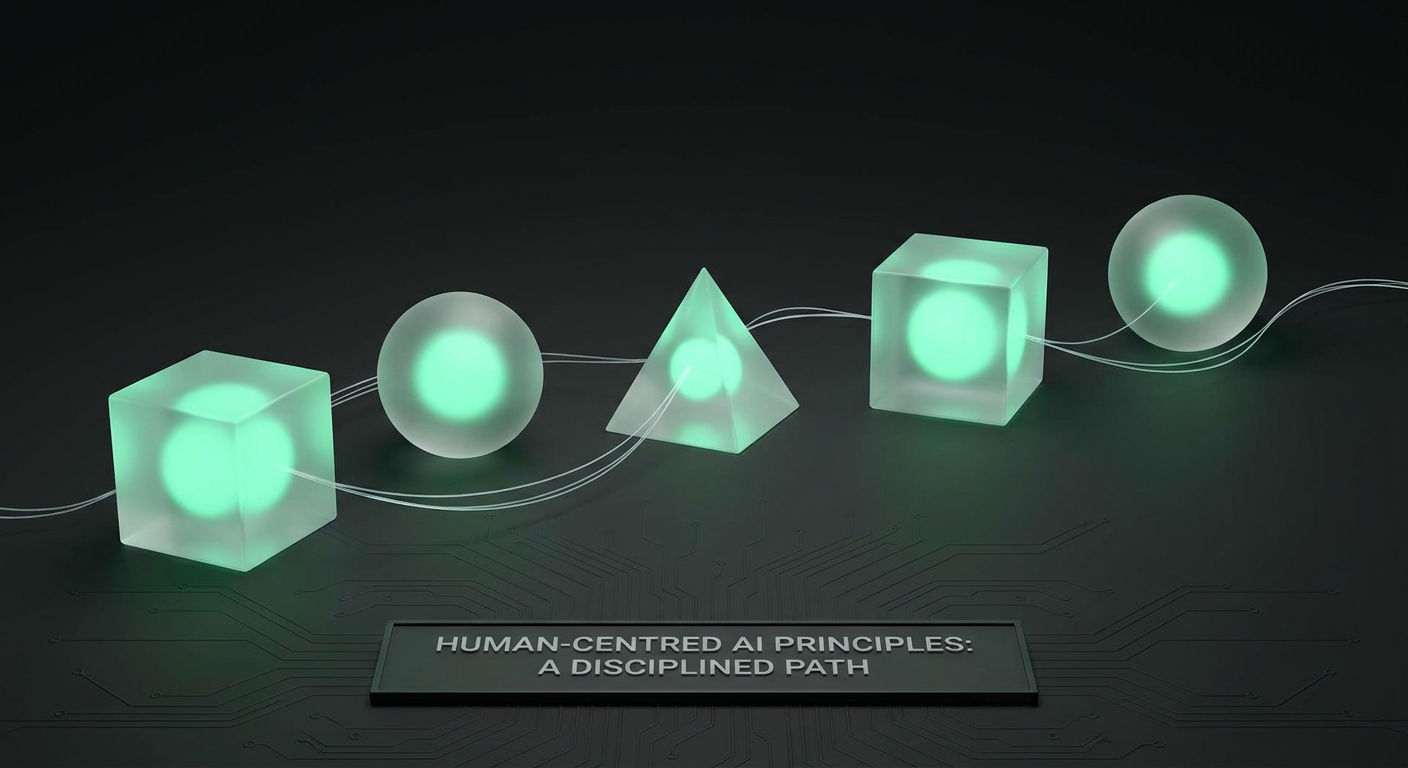
At its heart, human-centred AI is a disciplined process. It’s not a vague philosophy but a practical methodology rooted in established design thinking. By following these principles, you ensure your AI investment solves real-world problems and empowers your team.
- Empathise: The journey begins with a deep, genuine understanding of your users, whether they're your employees or your customers. This means moving beyond assumptions and observing their daily challenges. What tasks are repetitive and frustrating? Where are the bottlenecks in their workflow? This isn't about what you think they need; it's about what their actions show they need.
- Define: With insights from the empathy stage, you can clearly define the problem from a human perspective. A tech-first problem definition might be 'We need to automate invoicing'. A human-centred definition would be 'Our finance assistant, Sarah, spends 10 hours a week manually matching purchase orders to invoices, which leads to errors and delays her from doing higher-value credit control work'. This reframing is critical.
- Ideate: Now, you can brainstorm solutions that directly address Sarah's problem. Instead of just looking for an 'AI invoicing tool', you might explore solutions that can read purchase orders, suggest matches for her to approve with one click, and flag any discrepancies for human review. The goal is to generate a wide range of ideas focused on the human need.
- Prototype & Test: Don't build the entire system at once. Create a small-scale, low-cost prototype (a pilot project) and get it into the hands of the end-users. Let them test it in a real-world context. Their feedback is invaluable for refining the solution before you commit significant resources. This iterative cycle of feedback and improvement is central to human-centred design principles.
- Implement & Augment: Finally, deploy the AI with the explicit goal of augmenting human capabilities, not just replacing them. The World Economic Forum's (2023) Future of Jobs Report highlights that while AI will automate tasks, it also creates new roles and enhances existing ones. A successful AI tool acts as a co-pilot, handling the tedious work and freeing up your team's time for strategic thinking, creativity, and customer interaction.
Why It's a Strategic Imperative for UK SMEs
For a UK SME, adopting a human-centred approach to AI isn't just a 'nice-to-have'; it's a strategic necessity that provides a distinct competitive advantage. It directly addresses the biggest barriers to successful AI adoption that small and mid-sized businesses face.
First, it de-risks your financial investment. According to a survey from the Confederation of British Industry (CBI), one of the most significant barriers to AI adoption is an 'unclear ROI'. A human-centred approach tackles this head-on. By starting with a clearly defined human problem, you ensure you're building something that creates demonstrable value from day one. You're not gambling on a complex technology; you're investing in a solution to a known, costly inefficiency.
Second, it ensures compliance by design. The UK's regulatory landscape, governed by the Information Commissioner's Office (ICO) (2024), places a strong emphasis on fairness, transparency, and accountability in AI systems. A human-centred process, which involves users and prioritises clarity, naturally aligns with these principles. This helps you build a reliable AI governance framework and significantly reduces your legal and reputational risk under the UK General Data Protection Regulation (UK GDPR).
Third, it helps you overcome the skills gap. A 2024 report from the Department for Science, Innovation and Technology (GOV.UK) identifies a 'lack of skilled staff' as a major hurdle for UK businesses. Human-centred AI tools are, by definition, intuitive and easy to use. They require less specialised training, which means your existing team can adopt them faster and become more productive without the need for expensive new hires.
Finally, in a tight labour market, providing tools that empower rather than frustrate your staff is a powerful tool for employee retention. When your team sees AI as a helpful assistant that removes the worst parts of their job, morale and engagement improve. The importance of human-centred AI is that it makes your business a better place to work.
Real-World Examples: Human-Centred AI in Action for UK SMEs
The theory is great, but what does this look like in practice for a typical UK SME? Let's move beyond enterprise-level examples and look at some relatable, practical applications. These human-centred AI examples show how the focus is typically on supporting the person doing the job.
- A Midlands Logistics Firm: The company faces pressure to optimise delivery routes to save fuel and time. A tech-first approach might be to buy a rigid, complex optimisation engine that dictates every turn. A human-centred solution, however, provides drivers with simple, AI-powered route suggestions on a familiar app. Crucially, it allows drivers to use their local knowledge to override the system if they spot a temporary road closure or know a better shortcut. The result? Routes are more efficient, but driver autonomy and morale are preserved, leading to better outcomes.
- A Manchester Creative Agency: The creative team is bogged down with administrative tasks. Instead of a generative AI that attempts to create final designs (often missing the client's nuanced brief), the agency implements a human-centred AI assistant. This tool automates mood board creation from a brief, sources first-draft stock imagery, and organises project files. This frees up the designers' time to focus on high-value creative strategy and client relationships, which is where their real talent lies.
- A UK-based E-commerce Retailer: The customer service team is swamped with repetitive queries. A generic chatbot might frustrate customers by failing to understand their questions. A human-centred AI chatbot, however, is trained not just on product data but on solving common customer problems (e.g., 'What's an effective gift for a new mum?'). Most importantly, it's designed to recognise its own limitations and can smoothly hand over the entire conversation context to a human agent at the first sign of customer frustration.
In each scenario, the AI is a powerful assistant, not an autonomous replacement. This is a core part of the SME's playbook for building AI automation that works.
The Business Case: Tangible Benefits of Human-Centred AI
Adopting a human-centred approach isn't just about creating a better user experience; it's about delivering measurable business results. When you prioritise people in your AI strategy, you unlock tangible benefits that directly impact your bottom line. The benefits of human-centred AI are clear, quantifiable, and strategically vital for growth.
One of the most immediate benefits is increased productivity. A report from Innovate UK (2023) highlights AI's significant potential to boost productivity in the UK's service sector. This is amplified when the tools are intuitive and require minimal training. When your team can use an AI tool effectively from day one, you see efficiency gains almost immediately.
This leads directly to reduced operational costs. Lower training expenses are just the beginning. Well-designed AI reduces costly human errors, streamlines workflows, and cuts down the time wasted on inefficient manual processes. By automating the right tasks, you free up your most valuable resource – your team's time – to focus on revenue-generating activities. Properly measuring the Return on Investment (ROI) of these time savings is key. This approach drives higher customer satisfaction and loyalty. When AI helps your team solve customer problems faster and more accurately, or provides customers with a more helpful self-service experience, their satisfaction increases. Happy customers are more likely to return and recommend your business.
Finally, and perhaps most importantly, it improves employee adoption and morale. The CBI has noted that successful AI implementation depends on workforce buy-in. When your team sees AI as a helpful co-pilot rather than a threat to their job, they embrace the technology. This positive attitude is crucial for realising the full potential of your AI investment.
| Metric | Traditional 'Tech-First' AI Approach | Human-Centred AI Approach | Supporting Evidence |
|---|---|---|---|
| User Adoption Rate | Low (often below 30%) due to complexity and poor workflow fit. | High (typically above 70%) as it's designed around user needs. | World Economic Forum (2023) |
| Time to ROI | Long (12-24+ months) due to training, integration issues, and low adoption. | Short (3-9 months) as it solves a specific, high-value problem quickly. | Confederation of British Industry (CBI) |
| Training Costs | High, requiring specialised skills and extensive change management. | Low, as the tools are intuitive and fit existing workflows. | Innovate UK (2023) |
| Regulatory Risk | Higher risk of non-compliance with ICO fairness/transparency rules. | Lower risk, as transparency and user control are built-in. | Stanford HAI (2024) |
How to Implement a Human-Centred AI Strategy (Without an Army of Data Scientists)
You don't need a massive budget or a team of PhDs to get started. For an SME, a pragmatic, step-by-step approach works best. We'll be honest - this part can be tedious, but getting it right saves huge headaches later. Here is a simple, four-step framework for any non-technical business leader.
- Start with Pains, Not Platforms. Forget the technology for a moment. The most important first step is to talk to your team. Ask them: 'What is the most repetitive, frustrating, or time-consuming part of your job?' Listen carefully and list out the specific operational bottlenecks they face every day. Your first AI project is hidden in those answers.
- Use the 'Impact vs. Effort' Matrix. Don't try to solve everything at once. Take the list of pain points and map them on a simple two-by-two grid: one axis for 'Business Impact' (from low to high) and the other for 'Implementation Effort' (from low to high). Your well-suited starting point is a problem in the 'High Impact, Low Effort' quadrant. It’s a quick win that delivers visible value.
- Co-design the Solution. Involve the people who will actually use the tool in the design process. If you're building a tool for the sales team, they need to be in the room. Ask them how it should work. What information do they need to see? At what point should they be able to override the AI's suggestion? This collaborative process is the secret to building something people will love to use.
- Pilot, Measure, and Scale. Start small. Implement a pilot project for a single user or a small team. Before you begin, measure the current state (e.g., time taken for the task, error rate). After the pilot, measure again. This before-and-after data creates a powerful success story that builds momentum and gets buy-in from the rest of the organisation for the next project.
This structured process is the foundation of a practical guide to AI implementation.
Frequently Asked Questions About Human-Centred AI
What is human-centred AI?
Human-centred AI is a strategic approach that places human needs, values, and experience at the core of AI system design and deployment. It ensures technology is developed to serve and augment people, leading to more effective, ethical, and profitable outcomes. This approach is critical for ensuring high user adoption and a positive impact on your business.
What are the 5 steps of human-centred design?
The five commonly recognised steps are Empathise, Define, Ideate, Prototype, and Test. You start by understanding your users (Empathise) and framing their problem (Define). Then you brainstorm solutions (Ideate), build a testable version (Prototype), and get user feedback (Test). This iterative cycle ensures the final product genuinely meets user needs and is directly applicable to AI development.
Why is a human-centred approach important for AI?
A human-centred approach is vital because it prevents the creation of technology that is powerful but unusable or has negative consequences. It de-risks investment by ensuring the AI solves a real-world business problem, which dramatically improves user adoption. It also helps align the system with ethical standards and regulations like those from the ICO, making AI work for the business, not against it.
What is an example of human-centred design in AI?
A great example is a navigation app that allows the user to choose options like 'avoid motorways' or 'most scenic route'. The AI is powerful enough to find the fastest route, but it is designed around human preferences and control, not just pure data optimisation. This flexibility makes the tool more useful and trusted by the person using it.
What is a human-centred mindset?
A human-centred mindset is a culture of curiosity and empathy that consistently prioritises understanding people's needs before developing solutions. It's about asking 'why' and 'for whom' before asking 'what' or 'how'. In a business context, it means viewing technology primarily as a tool to serve employees and customers better, which is a powerful cultural shift.
What are some examples of human-centred skills?
Key human-centred skills include empathy, active listening, observation, collaborative brainstorming, rapid prototyping, and the ability to synthesise qualitative feedback. These are not just 'soft skills'; they are critical commercial skills for designing effective technology solutions that people will actually want to use. These abilities are essential for modern product development and successful AI implementation.
What's another way of saying human-centred?
Other common terms you'll hear are 'user-centric', 'people-first', or 'human-first'. For AI, you may also encounter 'responsible AI' or 'ethical AI', though human-centred AI is more focused on the design process itself. The core idea is typically to prioritise the human element over the purely technological one in any business solution.
How is this different from 'Ethical AI'?
'Ethical AI' is a broad framework of principles to ensure AI does no harm, while human-centred AI is the practical process used to put those principles into action. Think of it as the 'how-to' guide for building ethical and effective AI by involving humans at every stage of development. A human-centred process is one of the most reliable ways to achieve an ethical outcome.
Is human-centred AI only for large companies?
No, it is arguably more important for SMEs. With more limited resources, SMEs cannot afford failed AI projects that deliver no ROI. A human-centred approach de-risks that investment by focusing on solving the most pressing, high-impact problems first. This ensures a faster and more reliable return, making it a smarter use of capital.
What is an example of human-centred leadership?
Human-centred leadership involves leading with empathy, actively listening to team members' challenges, and empowering them with the right tools. When implementing AI, a human-centred leader involves their team in the selection and design process to ensure the technology serves them effectively. This collaborative approach builds trust, encourages adoption, and leads to better business results.
Important Considerations and Next Steps
This guide is based on the latest research as of October 2026, but the field of AI is evolving rapidly. While the core principles of human-centred design are timeless, the specific technologies and regulatory landscapes, such as ICO guidelines, will continue to change. Readers should typically seek the most current information when making implementation decisions.
The primary alternative to a bespoke human-centred approach is using generic, off-the-shelf AI tools. These can be quicker to deploy but often lack the flexibility to solve your specific business problems and may not integrate well with existing workflows, leading to low adoption. The initial speed can be offset by long-term inefficiency and frustration.
Implementing AI, even with a human-centred focus, involves strategic decisions about data, processes, and people. For UK SMEs without in-house expertise, partnering with a specialised consultant can help handle the complexities, ensure compliance, and maximise the return on investment. Professional guidance ensures you start correctly and build a scalable foundation for future growth.
Make AI Work for Your People, Not the Other Way Around
Ultimately, adopting a human-centred AI strategy is the most pragmatic and profitable way for UK SMEs to engage with artificial intelligence. By shifting the focus from technology to people, you de-risk your investment, ensure compliance, and build solutions that your team will embrace and your customers will love. This approach moves beyond the hype to deliver tangible benefits of human-centred AI, driving productivity and creating sustainable growth.
If you're ready to explore how a people-first approach to AI can transform your operations, the team at Up-Stride is here to help. We specialise in translating complex AI capabilities into practical, human-centred solutions for UK SMEs. Book a free, no-obligation consultation today to discuss your specific challenges and opportunities.
References
- Department for Science, Innovation and Technology (GOV.UK) - Government Report (2024). Identifies 'lack of skilled staff' as a major barrier to AI adoption for UK businesses.
- UK Government - Government Strategy Paper. Outlines the UK's goal to ensure national and regional benefits from AI through effective governance.
- Information Commissioner's Office (ICO) - Regulatory Guidance (2024). Provides guidance on applying UK data protection law (UK GDPR) to AI, covering fairness and transparency.
- Stanford Institute for Human-Centered Artificial Intelligence (HAI) - Annual Academic Report (2024). Tracks global trends in corporate AI investment, model costs, and public perception of AI.
- Organisation for Economic Co-operation and Development (OECD) - International Body Principles. Establishes international principles for trustworthy AI, including human-centred values and transparency.
- Innovate UK - Government Agency Report (2023). Details opportunities and barriers for UK service sector SMEs using AI to improve productivity.
- The Alan Turing Institute - National Institute Research Paper. Analyses AI's potential as a general-purpose technology to boost the UK's economic future.
- World Economic Forum - Global Research Report (2023). Projects that 75% of companies plan to adopt AI and identifies 'AI specialists' as a top-trending role.
- Confederation of British Industry (CBI) - Business Organisation Survey. Reveals over half of UK firms use AI, with 'unclear ROI' being a significant barrier to adoption.
- The Royal Society - Academy of Sciences Report. Provides a foundational explanation of machine learning and its societal implications.


Conclusion
Make AI Work for Your People, Not the Other Way Around
In summary, human-centred AI is the most pragmatic and profitable way for UK SMEs to engage with artificial intelligence. By shifting the focus from technology to people, you de-risk your investment, ensure compliance, and build solutions that your team will embrace and your customers will love. This approach moves beyond the hype to deliver tangible benefits of human-centred AI, driving productivity and creating sustainable growth.
If you're ready to explore how a people-first approach to AI can transform your operations, the team at Up-Stride is here to help. We specialise in translating complex AI capabilities into practical, human-centred solutions for UK SMEs. Book a free, no-obligation consultation today to discuss your specific challenges and opportunities.