AI Implementation
AI for UK SMEs: A Practical Guide to Start Smart Without Wasting Money
AI for UK SMEs: Discover how to start small with pilot projects, measure ROI, and avoid costly mistakes.
12 September 202615 min read

🎯 Key Takeaway
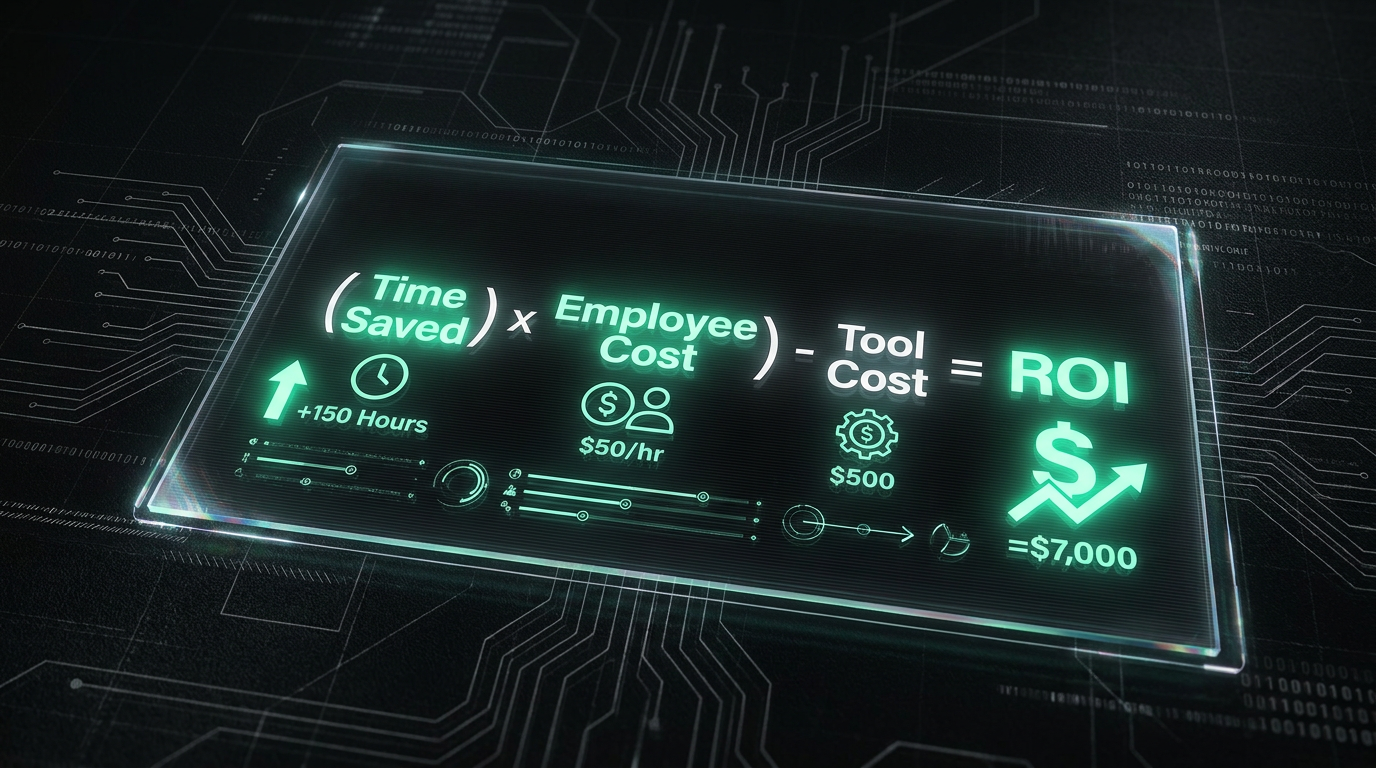
an effective approach to AI for UK SMEs involves starting small with a single, low-cost pilot project that solves a specific, measurable business problem before committing to larger investments. This ensures a clear return on investment and minimises financial risk, turning Artificial Intelligence (AI) from a confusing buzzword into practical infrastructure. Focus on solving one painful, repetitive task first, not on a complete business overhaul. You can use free or low-cost, 'off-the-shelf' AI tools to test the waters without a large upfront budget. Measure success with a simple calculation: (Hours Saved x Employee Cost) - Tool Cost.
Many leaders of Small and Medium-sized Enterprises (SMEs) in the UK feel caught between the hype surrounding Artificial Intelligence (AI) and the reality of tight budgets. You're told AI is essential, yet the path to adoption seems complex and expensive. We're here to tell you that a successful start doesn't require a massive budget or deep technical expertise. In fact, For AI for UK SMEs, the most effective strategy is a pragmatic, step-by-step approach focused on small, measurable wins. This guide offers a clear playbook, moving from identifying the right problem to calculating your return and building a scalable plan for AI implementation in your UK small business. It’s about making smart, incremental improvements that deliver real value.
👤 Written by: Up-Stride Content Team
Reviewed by: Up-Stride Editorial Team, Experts in SME business strategy and AI implementation
Last updated: 17 August 2026
ℹ️ Transparency: This article explores how UK SMEs can strategically adopt AI based on extensive industry analysis, government reports, and our practical implementation experience. Some links may connect to our services. All information is verified by our editorial team to ensure accuracy as of its publication date. Up-Stride is a specialised AI consultancy for UK SMEs, focussed on delivering human-centred AI solutions.
Why the 'Start Small, Win Fast' Method is the Best AI Strategy
Yes, starting small is the most effective AI strategy for a small business. This approach directly counters the two biggest barriers that prevent SMEs from adopting AI. According to a business survey from the Confederation of British Industry (CBI), 'unclear Return on Investment (ROI)' and 'cost' are significant hurdles for UK firms. A large, speculative AI project can feel like a huge gamble. By contrast, a small, focused pilot project makes the ROI, the measure of an investment's profitability, tangible and easy to calculate.
The second major barrier, as identified in the government's 2024 AI Sector Study, is a 'lack of skilled staff' (Department for Science, Innovation and Technology). Many SMEs don't have in-house data scientists or AI developers. The 'start small' method acknowledges this reality by favouring simple, user-friendly tools that solve one problem well.
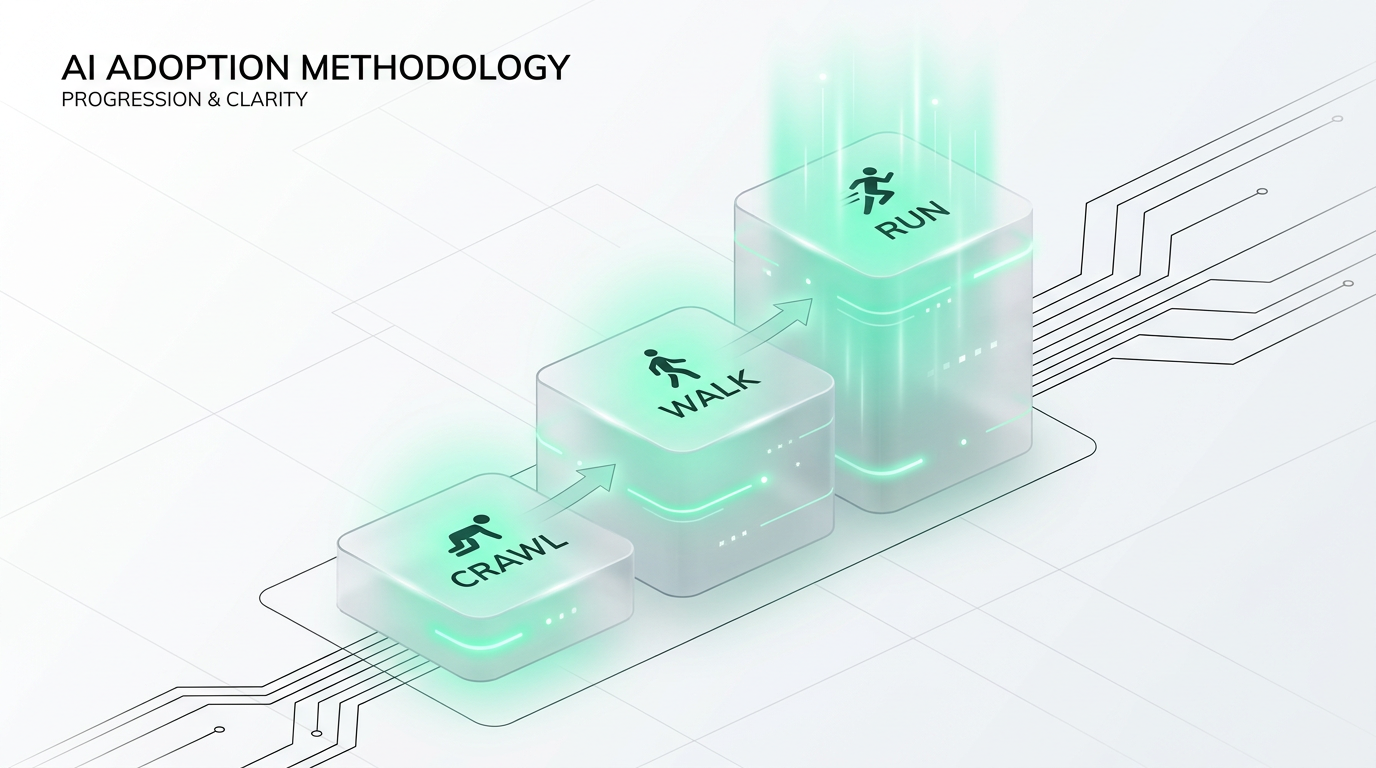
At Up-Stride, we've built our entire approach around this principle, which we call the Crawl, Walk, Run - AI Adoption Methodology.
- Crawl: Start with one high-impact, low-risk pilot project.
- Walk: Prove the value with measurable results and build internal confidence.
- Run: Scale the success across other parts of your business.
This methodology transforms an AI strategy for small business from a daunting, single document into a series of calculated, successful steps. It removes the pressure to get everything right at once and instead focuses on building momentum through quick, demonstrable wins.
Your Practical Kick-start Plan for AI Adoption in UK SMEs
An effective plan for AI implementation in a UK small business doesn't need to be a 50-page document. In our experience, it's a simple, repeatable process. We recommend following these five steps, which form the core of our Crawl, Walk, Run - AI Adoption Methodology. This is your playbook for achieving a fast, cost-effective AI win.
- Identify One High-Pain, Low-Complexity Bottleneck. Don't try to boil the ocean. Look for a task that is repetitive, time-consuming, and universally disliked by your team. Good examples include manually transcribing meeting notes, chasing unpaid invoices, or scheduling social media posts. The key is to pick a single problem where improvement would be immediately felt.
- Research a 'Good Enough' Off-the-Shelf Tool. Your goal here isn't to find the 'well-suited' AI platform for your entire business. It's to find a cost-effective AI tool for this one specific task. Look for tools with generous free trials or monthly plans under £50. This allows you to experiment without a significant financial commitment.
- Run a 30-Day Pilot Project. Define what success looks like before you start. This should be a simple, measurable metric. For example: 'Reduce the time spent on invoice data entry by 50%' or 'Increase our social media engagement by 15% without increasing staff hours'. Assign one or two team members to run the pilot for a fixed period.
- Calculate the ROI. At the end of the 30 days, use the simple formula we'll detail later in this article to calculate the financial return. Did the tool save more money in staff time than it cost? If so, you have a clear business case.
- Decide to Scale, Swap, or Stop. Based on the pilot's results, you make a clear decision. If the ROI is positive, you can 'Walk' by rolling the tool out to the wider team. If it was underwhelming, you can swap it for another tool and run a new pilot. If it failed, you can stop, having invested minimal time and money.
Following this process provides a structured, low-risk path. For a more detailed breakdown, you can explore our practical guide to AI implementation.
Finding High-Impact, Low-Cost AI Tools for Your First Project
Finding cost-effective AI for SMEs is simpler than you might think. The market is filled with tools designed to solve specific problems, many of which offer free or low-cost entry points. The key is to look for practical AI use cases for SMEs that align with your business functions. Instead of searching for 'AI', search for a solution to your problem, like 'automated meeting notes' or 'social media content generator'.
Here are some common categories where you can find high-impact tools:
- Administration: These tools tackle the repetitive back-office tasks that drain productivity. Think of apps that scan and digitise receipts, services that automatically transcribe audio from meetings, or platforms that help manage schedules.
- Marketing: Generative AI has made creating marketing content significantly faster. You can find tools to draft social media posts, write blog outlines, optimise email subject lines for better open rates, and even create simple graphics.
- Customer Service: Simple AI-powered chatbots can be added to your website to answer frequently asked questions 24/7. This frees up your team to handle more complex customer issues, improving both efficiency and service quality.
The table below gives examples of popular, UK-friendly tools that offer a great starting point for your first project. While these off-the-shelf tools are well-suited for the 'Crawl' phase, it's also useful to understand how they compare to bespoke AI solutions and off-the-shelf tools for long-term strategy.
| AI Tool Category | Typical Use Case | Example UK-Friendly Tool | Starting Price (per month) | Key Benefit |
|---|---|---|---|---|
| Transcription | Automatically creating text from meetings & calls | Otter.ai | £0 (Free tier available) | Saves hours of manual typing |
| Content Generation | Drafting social media posts, emails, blog ideas | Jasper / Copy.ai | ~£30-£40 | Overcomes writer's block & speeds up content creation |
| Task Automation | Connecting different apps to automate workflows | Zapier | £0 (Free tier available) | may reduce manual data entry between systems |
| Customer Support | Answering common website visitor questions 24/7 | Tidio | £0 (Free tier available) | Improves response time & frees up support staff |
Beyond these entry-level tools, more advanced practical AI use cases for SMEs exist. However, the principle remains the same: start with a clear problem, then find the right-sized tool.
How to Calculate a Simple, Tangible ROI for AI
One of the biggest hurdles to AI adoption is the 'Vague ROI Barrier'. It's hard to justify spending money on a tool if you can't prove it's providing value. That's why we advise clients to ignore complex calculations at first and use a simple, powerful formula to measure the impact of any project aimed at AI for business efficiency UK.
The Formula:(Time Saved in Hours Per Month x Average Employee Hourly Wage) - Monthly AI Tool Cost = Monthly ROI in £
Let's walk through a worked example.
#### Case Study: Cheshire Components Ltd
- Challenge: An accounts administrator at Cheshire Components Ltd spent approximately 10 hours every month manually entering data from supplier invoices into their accounting software. With an average hourly wage of £15, this single task cost the business £150 per month in labour.
- Solution: They ran a 30-day pilot of an AI-powered invoice scanning tool that cost £25 per month. The tool automatically extracted the data and fed it into their system, reducing the manual work to just 1 hour per month for review and verification.
- Results:
- Time Saved: 9 hours per month
- Calculation: (9 hours x £15/hour) - £25/month = £110 Monthly ROI
- This equated to an annual saving of £1,320 from a single, low-cost tool.
- Key Insight: By focusing on a small, quantifiable pain point, they could prove a clear financial benefit, making it easy to justify keeping the tool and looking for the next automation opportunity.
This simple calculation gives you a hard financial metric to present to stakeholders. While there are often 'soft' benefits like improved employee morale (no one enjoys manual data entry) or better data accuracy, starting with a clear pound-and-pence figure is the most powerful way to build a business case. For a deeper dive, explore our practical framework for measuring AI ROI.
How to Avoid the Most Common (and Costly) AI Mistakes for UK SMEs
While starting small minimises risk, there are still common pitfalls that can derail your AI journey. Being aware of them is the first step to avoiding them. Here are the three most frequent (and costly) mistakes we see UK SMEs make.
- The 'Shiny Object' Trap: This is the mistake of adopting AI for its own sake rather than to solve a genuine business problem. A competitor might announce they're using AI, creating pressure to do the same. However, without a clear 'why', you'll likely invest in a solution that doesn't fit your workflows, leading to wasted money and frustrated staff. Typically start with the problem, not the technology.
- Ignoring Your Data Duties: This is arguably the biggest risk. Many free AI tools are not designed for business use and may not comply with the United Kingdom General Data Protection Regulation (UK GDPR). Inputting sensitive customer or employee data into an unvetted public tool could result in a serious data breach and significant fines from the Information Commissioner's Office (ICO). It's crucial to understand the risks of ungoverned 'Shadow AI' and have clear policies on which tools are approved for business use.
- Forgetting the Humans: The goal of AI in an SME should be to augment your team, not replace them. A report from the World Economic Forum (2023) notes that while AI will change job roles, it also creates new opportunities. If you introduce a new tool without explaining the 'why' and framing it as a 'digital colleague' designed to remove tedious work, you'll face resistance. A human-centred AI approach involves your team in the process, ensuring the technology serves them and the business.
Important Considerations
This guide is based on data and trends available up to August 2026. The field of AI is evolving at an unprecedented pace; specific tools, pricing, and capabilities will change. The principles of starting small, focusing on business problems, and measuring ROI are enduring, but you should typically verify the current features and data security policies of any tool before adoption.
Before investing in AI, consider alternatives. Sometimes, the most effective solution is simply optimising an existing manual process or using non-AI automation tools (like rule-based systems). A thorough process review may reveal that the bottleneck isn't the task itself but a lack of clear procedure. Our advice is to typically solve the process problem before applying a technology solution.
While this guide provides a strong starting framework, complex challenges may require expert guidance. If you are handling large volumes of sensitive personal data, require integration with bespoke legacy systems, or want to build a proprietary AI solution for a competitive advantage, we recommend consulting with a specialised AI partner. They can ensure your implementation is secure, compliant, and strategically sound.
Your Next Step: From Information to Action
Embracing AI for UK SMEs is not about chasing hype but about making smart, incremental improvements to your business. By starting with a small, well-defined problem, using a low-cost tool, and measuring your success, you can de-risk your investment and build a foundation for future innovation. This pragmatic approach transforms AI from an intimidating expense into a powerful engine for efficiency and growth, helping to close the AI advantage gap.
If you've identified a problem but are unsure which tool to choose or how to build a scalable AI strategy for small business, the team at Up-Stride can help. We act as a strategic AI partner for UK SMEs, translating complex technology into tangible business results. Book a free, no-obligation consultation to discuss your first AI win.
Frequently Asked Questions
What is AI for UK SMEs?
AI for UK SMEs is the strategic application of artificial intelligence tools and techniques by small and medium-sized businesses in the United Kingdom to improve efficiency, enhance customer service, and drive growth. It's not about building complex systems from scratch, but about using accessible AI to solve specific business problems and gain a competitive edge.How can AI help prevent common reasons why SMEs fail?
AI can directly combat common failure points like poor cash flow and low productivity by automating critical but time-consuming tasks. For instance, it can automate invoicing and financial reconciliation, freeing up cash and staff time. It also boosts competitiveness by enabling smaller teams to deliver better customer service and more effective marketing, helping them operate like much larger organisations.Why are SMEs so important to the UK economy?
SMEs are the backbone of the UK economy, representing over 99% of all businesses and a huge portion of employment and turnover. Their agility and innovation are vital for national economic growth. Adopting technologies like AI is crucial for them to maintain this role, boost productivity, and remain competitive on a global scale, a goal supported by the UK's national AI strategy.What kind of practical AI tools do SMEs need most?
SMEs benefit most from practical AI tools that solve immediate efficiency problems, such as AI-powered customer service chatbots, workflow automation platforms, and generative AI assistants for marketing. The focus should typically be on practical AI use cases for SMEs that save time and money, rather than on experimental or highly complex technologies. These tools provide a quick and measurable return on investment.Will AI be a major business trend in 2026?
Yes, AI will be a fundamental business utility by 2026, moving far beyond a simple trend. For SMEs, the focus will shift from initial experimentation to deeper integration into core processes. Businesses that have successfully run small pilot projects will be scaling their use of AI, while those who haven't started may face a significant competitive disadvantage.What are the disadvantages of AI for an SME?
The main disadvantages for an SME are potential costs without a clear plan, the need to develop new skills, and significant data security risks. Using employee or customer data without care can breach UK GDPR. Furthermore, relying too heavily on AI without human oversight can lead to costly errors. A 'start small' approach helps mitigate all of these risks effectively.Do I need to be a tech expert to use AI in my business?
No, you strongly do not need to be a tech expert to get started with AI. Modern AI tools are increasingly designed with non-technical users in mind, featuring intuitive interfaces and 'no-code' setups. The key is understanding your business problem, not the underlying code. If you can describe the task you want to improve, you can find a user-friendly tool to help.How much should I budget for a first AI project?
For a first pilot project, you can often start with a budget of zero to under £100 per month. Many powerful AI tools offer free tiers or affordable trials that are well-suited for testing a solution's value. The goal of this initial project is to prove value with minimal financial outlay. Only after you've calculated a positive ROI should you consider a larger budget.What is the number one data risk when using AI?
The number one risk is the misuse or breach of personal information, leading to a violation of UK GDPR and significant fines. This often happens when employees input sensitive customer or company data into unapproved, public AI tools. It's critical to have a clear policy on which tools are vetted and approved for business use to protect your company and your customers.Can AI help with my legal duties, like informing HMRC?
While AI cannot fulfil your legal obligations for you, it can significantly help with the preparation and accuracy of your submissions. For example, AI-powered accounting software can automate the categorisation of expenses and generation of financial reports. This makes it faster and more accurate to prepare your tax returns for HMRC, though the legal responsibility for submission remains with you.References
- Department for Science, Innovation and Technology (GOV.UK) - (2024) AI Sector Study. This report identifies 'lack of skilled staff' as a major barrier to AI adoption for UK businesses.
- UK Government - (2021) National AI Strategy Paper. This paper outlines the UK's 10-year national strategy to support the AI ecosystem and ensure effective governance.
- Information Commissioner's Office (ICO) - (Ongoing) Official Guidance. Provides toolkits for ensuring AI usage complies with UK GDPR and the Data Protection Act 2018.
- Stanford Institute for Human-Centered Artificial Intelligence (HAI) - (Annual) AI Index Report. Tracks global trends in AI investment, model costs, and public perception.
- Organisation for Economic Co-operation and Development (OECD) - (Ongoing) International Policy Observatory. Provides international principles for trustworthy AI and live data on AI readiness across member countries.
- Innovate UK - (2023) 'AI for Services' Report. Details opportunities and barriers for UK service-based businesses using AI to improve productivity.
- The Alan Turing Institute - (2019) Economic Research Report. Defines AI as a 'general-purpose technology' and outlines its potential to boost the UK economy.
- World Economic Forum - (2023) Future of Jobs Report. This global survey projects that 75% of companies will adopt AI and identifies 'AI specialists' as a top-trending role.
- Confederation of British Industry (CBI) - (2023) Business Survey Report. This survey of UK firms reveals 'unclear ROI' and 'cost' are significant barriers to AI adoption.
- London & Partners - (2023) SME Survey. This report reveals hundreds of London small businesses begin without a formal plan, reinforcing the need for simple, structured starting frameworks.
- Grunberg & Co - (2023) SME Analysis. This analysis discusses the importance of strategic planning and technology adoption for SMEs to move from a survival mindset to a growth trajectory.
- Midven - (2022) Investor Insight Report. Identifies common SME challenges, including managing cash flow and competing with larger players, which AI can help address.

CONCLUSION
Your Next Step: From Information to Action
In summary, AI for UK SMEs is not about chasing hype but about making smart, incremental improvements to your business. By starting with a small, well-defined problem, using a low-cost tool, and measuring your success, you can de-risk your investment and build a foundation for future innovation. This pragmatic approach, the core of a successful AI strategy for small business, transforms AI from an intimidating expense into a powerful engine for efficiency and growth.
If you've identified a problem but are unsure which tool to choose or how to build a scalable AI strategy, the team at Up-Stride can help. We act as a strategic AI partner for UK SMEs, translating complex technology into tangible business results. Book a free, no-obligation consultation to discuss your first AI win.