AI Guides
How to Use AI in Business: A Practical Step-by-Step Guide for UK SMEs
Learn how to use AI in business effectively. Our 5-step guide helps UK SMEs identify problems, implement solutions, and measure ROI.
12 September 202622 min read

🎯 Key Takeaway
To successfully use AI in business, UK Small and Medium-sized Enterprises (SMEs) should adopt a 'problem-first' approach, identifying a specific operational challenge before selecting any technology. This method ensures that Artificial Intelligence (AI) serves a clear purpose and delivers measurable value. Focus on a single, high-impact business problem for your first project to guarantee a clear outcome. Prioritise UK-specific governance by adhering to Information Commissioner's Office (ICO) guidelines on data protection from the outset. Finally, calculate a realistic Return on Investment (ROI) by measuring tangible metrics like hours saved or error reduction. This guide provides a five-step framework to move from AI curiosity to confident implementation.
For many UK SME leaders, the prospect of how to start using AI in business can feel overwhelming. It's often presented as a complex, expensive technology reserved for large corporations. However, that practical AI infrastructure is more accessible than ever, and failing to engage with it risks widening the AI advantage gap between you and your competitors. The key isn't to adopt AI for its own sake, but to apply it surgically to solve real, everyday business problems.
As of September 2026, over half of UK firms are already using AI, according to a survey by the Confederation of British Industry (CBI) (2024), but many struggle to prove its value. This guide provides a clear, step-by-step AI implementation guide designed specifically for SMEs. We'll show you how to move from initial idea to measurable results, following Up-Stride's human-centred approach to technology.
👤 Written by: Mark Blake (Founder & CEO), Gabriel Imevbore (Client Experience & Sales), Thomas McElroy (Brand & Communications)
Reviewed by: Up-Stride Editorial Team, Enterprise AI Specialists
Expertise: Our authoring team combines C-suite business experience with deep technical knowledge, ensuring our AI guidance is grounded in real-world operational and strategic challenges faced by UK business leaders.
ℹ️ Transparency Disclosure: This article explores how UK SMEs can strategically implement AI, based on an analysis of UK government reports, international academic research, and our own client work. Some links may connect to our specialised AI consulting services. All information is verified by our editorial team to ensure accuracy and relevance for UK business leaders.
Best For: Mid-sized UK SMEs with 50-250 employees, business leaders seeking a structured AI adoption framework, and operations managers looking to solve specific efficiency bottlenecks.
Not effective For: Large enterprises with established AI teams or micro-businesses seeking simple, single-task automation without a strategic component.
Step 1: Start with Your Business Problem, Not the Technology
The most common mistake we see is leaders asking, 'What AI tool should we buy?' This is the wrong question. The right question is, 'What is our most expensive, time-consuming, or frustrating problem?' Before you even think about technology, you must first understand your own operational pain points. This is the foundation of how to start using AI in business successfully.
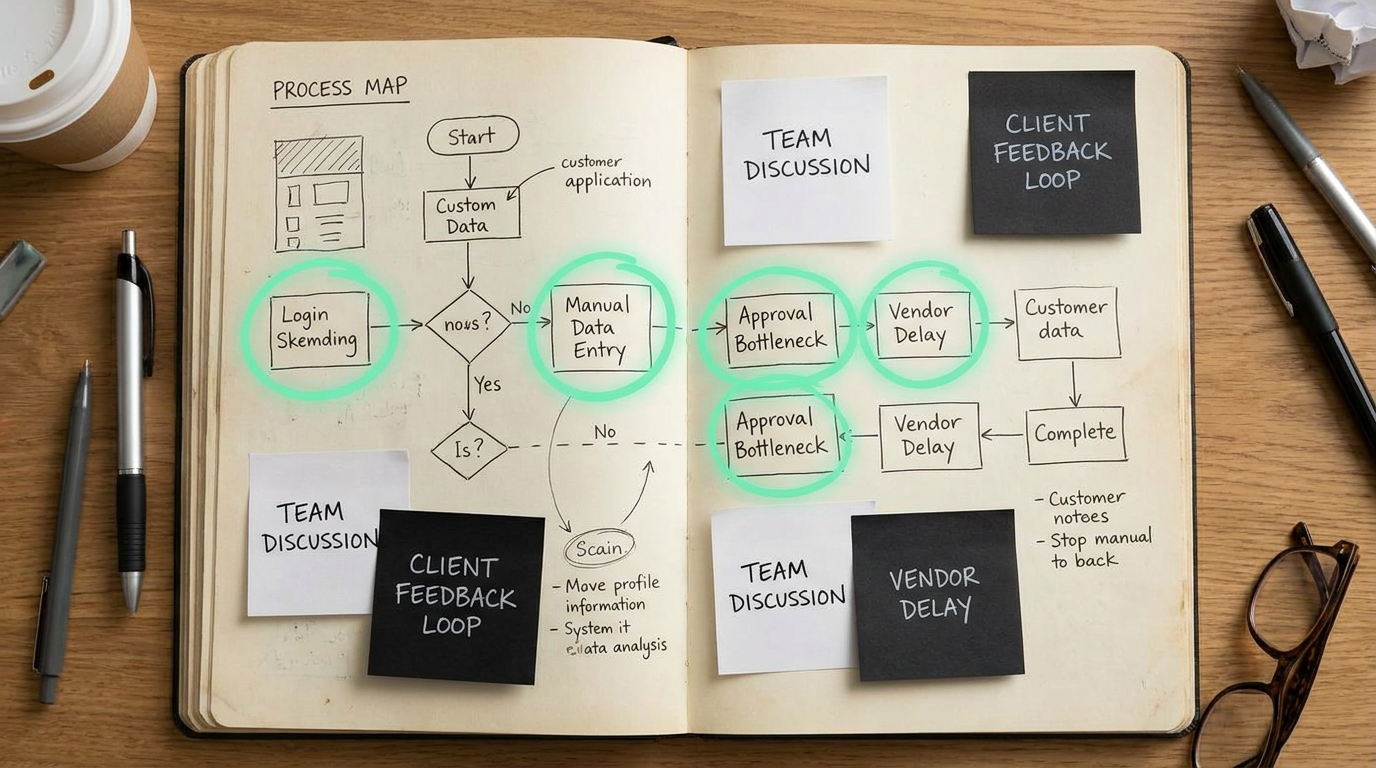
In our experience, an effective approach is to map out a core business process. Pick one, such as customer onboarding, accounts payable, or sales lead qualification. Follow it from start to finish and ask your team:
- Where are the bottlenecks?
- What tasks are repetitive and manual?
- Where do the most errors occur?
- What simple questions do we answer over and over again?
Research from The Alan Turing Institute (2022) highlights AI's potential to solve these exact productivity challenges that hold back the UK economy. By identifying these issues, you are essentially creating a prioritised list of opportunities. This is where a concept like business process automation, the use of technology to execute recurring tasks or processes, becomes relevant. Many of these problems can be solved with simple automation, but the ones requiring judgment, pattern recognition, or understanding unstructured text are prime candidates for AI. The goal of this step isn't to find an AI solution; it's to create a clear, prioritised list of business problems that need solving.
Step 2: Identifying Your First High-Impact AI Pilot Project
Once you have your list of problems, you need to choose where to begin. We strongly recommend starting with a single, contained pilot project. The goal is to secure a quick, measurable win that builds internal confidence and research suggests the business case for AI. A detailed AI implementation guide should typically advocate for a phased approach.
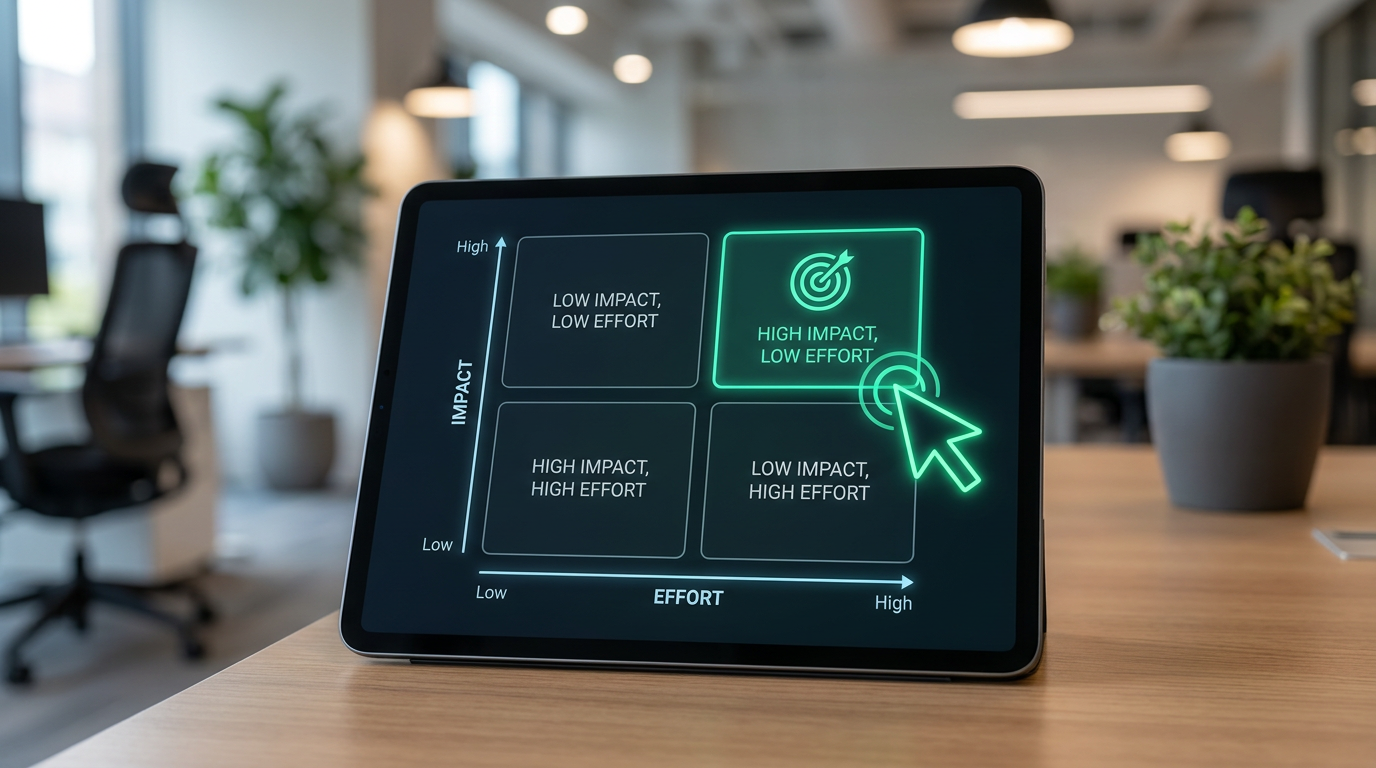
To select the right pilot, use a simple 'Impact vs. Effort' matrix. Plot each problem from Step 1 on this grid:
- Impact: How much value will solving this create? (e.g., cost savings, revenue growth, time saved).
- Effort: How difficult will it be to implement? (e.g., cost, technical complexity, time).
Your first project should be in the 'High Impact, Low Effort' quadrant. These are the quick wins. Some practical AI applications for SMEs that often fall into this category include:
- Automated Customer Support: An AI-powered chatbot on your website to handle common out-of-hours queries, freeing up your team to handle complex issues.
- Intelligent Document Processing: An AI tool that automatically extracts data (e.g., invoice number, amount, date) from supplier invoices and enters it into your accounting software.
- Sales Intelligence: An AI system that enriches new leads with company and contact data, allowing your sales team to personalise outreach far more effectively.
A survey from the Confederation of British Industry (CBI) (2024) found that 'unclear ROI' is a major barrier to adoption. By choosing a pilot with a clear success metric (e.g., 'reduce invoice processing time by 80%'), you directly address this concern from day one.
Step 3: Finding the Right AI Tools and Partners for Your Business
With a clear problem and a pilot project defined, you can now explore solutions. For AI for small businesses UK, there are generally three paths you can take. Your choice depends on your budget, technical resources, and the uniqueness of your problem.
- Off-the-Shelf SaaS Tools: Many platforms you already use (like your CRM, marketing software, or accounting system) now have built-in AI features. This is often the easiest and cheapest way to start, but you are limited to the functionality they provide.
- No-Code/Low-Code Platforms: Tools like Zapier and Make.com allow you to connect different applications and integrate AI capabilities. For example, you could build a workflow that automatically sends new customer support tickets to a Large Language Model (LLM), a type of AI model that can process and generate text, to be categorised and summarised before being assigned to a human agent. This offers more flexibility than off-the-shelf tools.
- Bespoke Solutions: For unique or complex problems, partnering with a specialist AI consultancy like Up-Stride is the most effective route. A partner can help you design and build a custom solution that fits your exact workflow, ensures compliance, and integrates perfectly with your existing systems. You can explore a deeper comparison of Bespoke AI vs. Off-the-Shelf Tools to understand the trade-offs.
The UK's AI market is substantial, valued at an estimated £106 billion according to a 2024 report from the Department for Science, Innovation and Technology. However, the same report notes that a lack of skilled staff is a key barrier. This is why finding a partner who not only has technical expertise but also understands the UK's business and regulatory landscape is so crucial for success.
Step 4: How Do You Build a UK-Compliant AI Governance Framework?
To safely integrate AI into business operations, you must establish a clear governance framework from the very beginning. This isn't about creating bureaucracy; it’s about setting up essential safety rails to protect your business, your employees, and your customers from legal, financial, and reputational damage. The biggest danger is the growth of 'Shadow AI' - AI tools used by employees without official approval or oversight. This practice introduces significant risks of 'Shadow AI', including data leaks and breaches of the UK General Data Protection Regulation (UK GDPR).
UK GDPR is the legal framework governing data protection in the United Kingdom. According to the Information Commissioner's Office (ICO), the UK's independent authority for data protection, any use of AI involving personal data must be lawful, fair, and transparent. The principles laid out by international bodies like the Organisation for Economic Co-operation and Development (OECD) (2023) also stress accountability and human-centred values.
For a UK SME, a simple starting point for an AI policy is a three-point checklist:
- Maintain an AI Register: Keep a simple, shared document listing every AI tool approved for use in the business, its purpose, and what kind of data it is permitted to handle.
- Prohibit Public AI for Sensitive Data: Mandate that no confidential client or personal employee data is ever entered into public AI tools like the free version of ChatGPT. If such tools are needed, use enterprise-grade versions with data privacy controls.
- Designate an Owner: Assign a single person (e.g., the Operations Director or Head of IT) the responsibility for overseeing AI use, approving new tools, and ensuring the policy is followed.
Step 5: Measuring ROI and Scaling Your AI Success
The final step is to measure the success of your pilot project and use that data to inform your next move. As the CBI found, proving Return on Investment (ROI) is essential for wider adoption. When you integrate AI into business processes, you must track its impact.
We recommend measuring both quantitative and qualitative metrics.
- Quantitative Metrics: These are the hard numbers that directly impact your bottom line.
- Time Saved: Hours per week saved on a task, multiplied by the employee's hourly cost.
- Cost Reduction: Direct savings from reduced software licences, materials, or outsourcing.
- Error Reduction: A percentage decrease in errors for a specific process.
- Increased Output: Higher number of leads qualified, reports generated, or customers served.
- Qualitative Metrics: These are harder to measure but are just as important for the business case.
- Employee Morale: Feedback from staff on reduced tedious work and increased job satisfaction.
- Customer Satisfaction: Improved CSAT or NPS scores from faster, more accurate service.
- Brand Perception: Being seen as an innovative, modern company.
The table below gives some examples of how to track this for typical SME pilot projects.
| AI Pilot Project Example | Primary Metric to Track | Estimated Monthly Cost (SaaS) | Potential ROI |
|---|---|---|---|
| AI Chatbot for Website | Reduction in routine support tickets | £150 - £400 | 3-5x by reallocating agent time |
| Invoice Data Extraction | Hours saved in manual data entry | £100 - £300 | 4-6x based on admin salary cost |
| AI Sales Email Generator | Increase in meeting booking rate | £50 - £200 per seat | 2-4x based on increased sales pipeline |
| Meeting Summary Tool | Hours saved by senior staff | £20 - £50 per seat | 5-10x based on high value of manager time |
Once you have successfully proven the ROI of your first project, you have a powerful internal case study. You can use this data to secure buy-in for tackling the next problem on your list or for scaling the pilot solution across other departments. This creates a virtuous cycle of improvement and innovation.
Step 1: Pinpoint High-Impact Opportunities for Using AI in Business
The most effective way to begin is by analysing your internal operations, not the external AI market. Before you look at a single tool, you need to identify the specific business pain points where AI can deliver a clear and measurable benefit. This problem-first approach ensures that your initial investment in AI is tied directly to a tangible outcome, like saving time, reducing costs, or improving quality.
To find these opportunities, look for tasks within your business that are:
- Repetitive and Manual: Think data entry, report generation, or scheduling.
- Data-Intensive: Tasks that involve analysing large volumes of information, like customer feedback, sales data, or market trends.
- Time-Consuming: Processes that create bottlenecks and slow down your team.
The CBI (2023) survey indicates that the top drivers for AI adoption are improving productivity and reducing operational costs. Our experience shows an effective starting points are often in areas like marketing content creation, lead qualification, or customer service administration. The Alan Turing Institute, the UK's national institute for data science and AI, describes AI as a 'general-purpose technology' because of its wide applicability across industries. This means opportunities exist in almost every SME, from manufacturing to professional services. Once you have a list of potential tasks, you can prioritise them based on their potential impact versus the effort required to implement a solution.
Step 2: Choose the Right AI Tools (A UK GDPR-First Approach)
No, you don’t need to build a custom AI system from scratch. For most SMEs, an effective entry point is through accessible, off-the-shelf software. The key is to understand the options and, most importantly, to prioritise compliance from day one, especially for any business handling customer data. A 2024 government report from the Department for Science, Innovation and Technology highlights 'lack of skilled staff' as a key barrier to AI adoption, which is why user-friendly, pre-built tools are so vital for the AI for business UK market.
There are two main categories of tools to consider:
- Off-the-Shelf SaaS Tools: These are cloud-based platforms with built-in AI features. Think of AI enhancements in your Customer Relationship Management (CRM) system, email marketing software, or accounting program. They are typically subscription-based, easy to set up, and require no coding knowledge. Platforms like Zapier and Make.com also enable powerful AI automation for business by connecting different apps.
- Bespoke AI Solutions: These are custom-built applications designed to solve a unique business problem. While powerful, they involve a significant investment in time and resources and are generally reserved for more mature stages of AI adoption. You can explore a deeper comparison in our guide on Bespoke AI vs. Off-the-Shelf Tools.
For any tool you consider, compliance with the UK General Data Protection Regulation (UK GDPR) is non-negotiable. The Information Commissioner's Office (ICO), the UK's data protection regulator, provides specific guidance on using AI lawfully. You must ensure any vendor has clear data processing agreements and transparent policies.
| Factor | Off-the-Shelf AI Tools | Bespoke AI Solutions | Key Consideration for SMEs |
|---|---|---|---|
| Cost | Low initial cost (monthly subscription) | High upfront investment | Start with subscriptions to prove ROI before committing large capital. |
| Implementation Speed | Fast (hours or days) | Slow (months or years) | Quick wins from off-the-shelf tools build momentum and team confidence. |
| Customisation | Limited to available features | Fully customisable to specific needs | Bespoke is only necessary if no existing tool can solve your unique problem. |
| Compliance (UK GDPR) | Vendor's responsibility (verify) | Your responsibility to build in | typically perform due diligence on a vendor's data security and privacy policies. |
Step 3: Build Your Phased AI Implementation Plan
A phased implementation plan is crucial for managing risk, controlling costs, and ensuring success. Instead of attempting a company-wide overhaul, we strongly advocate for our Crawl, Walk, Run - AI Adoption Methodology. This approach, central to our work with UK SMEs, prevents overwhelm and ensures each step delivers value. The UK's National AI Strategy (2021) emphasises supporting the ecosystem and governing AI effectively, and a phased plan aligns perfectly with this principle of responsible adoption.
Here’s a simple three-phase plan based on this methodology:
- Phase 1: Pilot Project (Crawl): Select one well-defined problem from your analysis in Step 1. Choose a high-impact, low-complexity task for your first project. For example, you could pilot an AI-powered chatbot to handle out-of-hours customer queries or use an AI tool to generate initial drafts for social media posts. The goal is a quick, contained win.
- Phase 2: Measure & Refine (Walk): Before scaling, you must measure the pilot's success. Define your key metrics upfront. Did you save a specific number of hours? Did you increase lead response speed by a certain percentage? Did customer satisfaction scores improve? Use this data to refine the process. We've developed a practical framework for measuring AI ROI to help with this critical step. According to the Organisation for Economic Co-operation and Development (OECD), accountability is a core principle for trustworthy AI, and measurement is key to this.
- Phase 3: Scale (Run): Once you have proven the value and refined your approach, you can begin scaling. This could mean rolling out the solution to other departments, integrating more advanced AI tools, or tackling more complex problems.
This structured approach transforms AI adoption from a daunting leap into a series of manageable steps. For more detail, see our detailed AI implementation guide.
Step 4: Lead Your Team Through the AI Transition
Managing the human element of an AI transition is just as important as the technology itself. Your team's adoption and confidence in new tools will ultimately determine their success. The focus must be on human-centred AI - tools that augment and empower your staff, not replace them. This requires clear communication, targeted training, and proactive change management.
The World Economic Forum's Future of Jobs Report (2023) projects that 75% of companies plan to adopt AI, but it also highlights the need for reskilling. Frame AI as a collaborative partner that handles tedious tasks, freeing up your team to focus on strategic, creative, and high-value work. Involve them in the process early, asking for their input on which repetitive tasks are most frustrating.
A critical risk to manage is the use of unapproved tools, often called 'Shadow AI'. This happens when employees, trying to be efficient, use free AI platforms without vetting them for security or compliance, potentially exposing sensitive company data. Establishing a clear AI governance policy is essential. Our guide on the risks of 'Shadow AI' provides a framework for creating one.
To build trust, we recommend following principles outlined by institutions like the Stanford Institute for Human-Centered Artificial Intelligence (HAI), which focus on fairness, transparency, and accountability. When your team understands the 'why' behind the change and sees AI as a tool for their benefit, you create a culture of innovation rather than fear.
Frequently Asked Questions
What is use AI in business?
Using AI in business refers to the strategic application of intelligent technologies to solve specific operational problems, improve efficiency, and create new opportunities for growth. It involves identifying areas like customer service, marketing, or finance where AI can automate repetitive tasks, provide data-driven insights, or enhance decision-making, ultimately delivering a measurable return on investment.How can I effectively integrate AI into my business?
Effective integration starts with a clear strategy, beginning with a small, measurable pilot project to prove value before scaling. Ensure you have a simple governance policy to manage data security, provide basic training for your team, and continuously measure the results. It's a gradual process of testing, learning, and expanding what works across the organisation.What are some practical ways AI is used today?
Businesses commonly use AI to automate customer service with chatbots, personalise marketing campaigns, process invoices automatically, and generate first drafts of reports or social media posts. The key is applying it to tasks that are rule-based, repetitive, or involve analysing large amounts of data to find patterns that humans might miss.Do I really need to use AI?
While it's not mandatory, your competitors are likely exploring AI to become more efficient, and ignoring it may create a competitive disadvantage. The real question is whether you have operational bottlenecks or growth opportunities that AI could solve. If so, strategically adopting AI could be one of the most impactful decisions you make.What are the top 3 most used types of AI?
In a business context, the most common applications are generative AI (like ChatGPT for content creation), machine learning for predictive analytics (like sales forecasting), and AI-powered automation for streamlining workflows. These three categories power everything from simple chatbots to complex data analysis tools used by both SMEs and large corporations.What type of AI is ChatGPT?
ChatGPT is a form of Generative AI, built on a technology called a Large Language Model (LLM). Its primary function is to understand user prompts and generate human-like text in response. Businesses use it for tasks like drafting emails and summarising reports, but must be extremely cautious about inputting any sensitive company or customer data.Where do I go to start using AI?
A great starting point is to explore the AI features within software you already use, such as your CRM or Microsoft 365. You can also experiment with public tools like ChatGPT for non-sensitive tasks to understand their capabilities. For a more strategic implementation, consulting a specialist who understands the SME landscape is highly recommended.How do I use AI to make money?
AI helps businesses make money primarily by either drastically reducing operational costs or by increasing sales and marketing effectiveness. For example, it can save thousands in administrative overhead or improve sales conversions by better identifying high-potential leads. Both of these outcomes directly impact your bottom line and profitability.Which jobs will be most affected by AI?
Jobs involving highly repetitive and predictable tasks, such as data entry, basic customer service, and scheduling, are most likely to be automated. However, roles requiring creativity, strategic thinking, and emotional intelligence are more likely to be augmented by AI, not replaced. The focus is shifting towards using AI as a powerful tool to enhance human skills.What should I not ask an AI?
You should rarely input sensitive, confidential, or personal data into a public AI tool unless you have a private, enterprise-grade version. This includes customer information, employee data, financial records, or company intellectual property. Doing so can lead to serious data breaches and violate UK GDPR, resulting in significant fines and loss of trust.Important Considerations and Alternatives
This guide is based on publicly available data and established best practices as of September 2026. The AI landscape is evolving at an unprecedented pace; specific tools and costings mentioned are illustrative and subject to change. The effectiveness of any AI implementation is highly dependent on individual business context, data quality, and team readiness, which cannot be fully addressed in a general article.
Before committing to a complex AI solution, consider simpler alternatives. Often, significant efficiency gains can be achieved through better process definition or standard business process automation using tools like Zapier or Make.com, without the need for machine learning. A thorough 'problem-first' analysis, as outlined in Step 1, will determine if a process truly requires AI's cognitive capabilities or just straightforward automation.
While this guide provides a strategic framework, implementing AI involves technical and regulatory nuances. For projects involving sensitive data, complex integrations, or the development of a bespoke solution, we strongly recommend consulting with a specialised AI partner. An expert can help navigate compliance, ensure data security, and maximise the return on your investment while avoiding common pitfalls.
Your Next Step Towards Becoming an AI-Confident Organisation
Making the decision to use AI in business is the start of a transformative journey. By following a structured, five-step approach - starting with your business problems, running a small pilot project, choosing the right tools, ensuring compliance, and measuring your results - you can demystify artificial intelligence and turn it into a powerful engine for growth and efficiency. This strategic process moves your organisation beyond the hype and towards tangible, sustainable value.
If you're a UK SME leader ready to identify your first high-impact AI opportunity but would like expert guidance, Up-Stride can help. We specialise in creating human-centred AI solutions that are secure, compliant, and built to solve real-world business challenges. Book a free, no-obligation consultation to discuss your specific needs and discover how we can help you build a more intelligent and efficient business.
References
- Department for Science, Innovation and Technology (GOV.UK) - 2024 Government Report. The UK AI market size is estimated at £106 billion, but 'lack of skilled staff' is a major barrier to implementation.
- UK Government - Government Strategy Paper (2021). Outlines the UK's 10-year plan to support the AI ecosystem and ensure effective governance.
- Information Commissioner's Office (ICO) - Regulatory Guidance (updated 2024). Provides official guidance and a risk toolkit for using AI in compliance with UK GDPR.
- Stanford Institute for Human-Centered Artificial Intelligence (HAI) - Annual Academic Report (2024). Tracks global trends in corporate AI investment, model capabilities, and public perception.
- Organisation for Economic Co-operation and Development (OECD) - International Body Policy Observatory (2023). Provides international principles for trustworthy AI, including human-centred values and accountability.
- Innovate UK - 2023 Government Agency Report. Details opportunities and barriers for UK service businesses using AI to improve productivity.
- The Alan Turing Institute - National Institute Research Paper (2022). Details AI's potential as a 'general-purpose technology' to boost the UK economy.
- World Economic Forum - 2023 Global Survey Report. Projects that 75% of companies plan to adopt AI, with 'AI specialists' being a top-trending role.
- Confederation of British Industry (CBI) - Business Organisation Survey (2024). Over half of UK firms are using AI, but 'unclear ROI' is a significant barrier to adoption.
- Federation of Small Businesses (FSB) - SME Guidance Article (2024). Provides a starting point for small businesses looking to understand AI's potential.
- Grow with Google - Training Resource (2024). Offers introductory training and tools designed to help small businesses use AI.
- Upwork - Industry Report (2024). Analysis of how businesses are using AI, with examples across marketing, operations, and IT.
Frequently Asked Questions About Using AI in Business
What is use AI in business?
To use AI in business is to strategically apply artificial intelligence technologies to solve specific problems, improve efficiency, or create new opportunities for growth. It involves moving beyond simple automation to leverage systems that can perform tasks requiring human-like intelligence, such as understanding language, recognising patterns, and making predictions. The goal is to create tangible value, whether through cost savings, increased revenue, or competitive advantage.
How can I effectively integrate AI into my business?
Effective integration involves starting small with a pilot project, ensuring you have a governance policy in place, training your team, and measuring results. It is a gradual process of identifying a high-impact problem, testing a solution, and then
scaling what works across the organisation.
What are some practical ways AI is used today?
Businesses commonly use AI for automating customer service with chatbots, personalising marketing emails, processing invoices automatically, and generating first drafts of reports or social media posts. The key is to apply it to tasks that are rule-based, repetitive, or involve analysing large amounts of data to find patterns. This frees up human employees for more strategic, creative, and customer-facing work, boosting overall productivity.
Do I really need to use AI?
While no business has to use AI, your competitors are almost certainly exploring it to become more efficient and productive. The real question is whether you have operational bottlenecks or high administrative overhead that AI could solve. According to the World Economic Forum, 75% of companies are looking to adopt AI. Ignoring it may mean missing out on significant competitive advantages in the near future.
What are the top 3 most used types of AI?
In a business context, the most common applications are generative AI, machine learning for predictive analytics, and AI-powered automation. Generative AI (like ChatGPT) creates content, machine learning finds patterns in data for sales forecasting, and automation streamlines workflows. These technologies power everything from simple chatbots to complex data analysis tools used by SMEs and large corporations alike.
What type of AI is ChatGPT?
ChatGPT is a type of Generative AI, specifically built on a Large Language Model (LLM). Its primary function is to understand prompts and generate human-like text in response. Businesses use it for tasks like drafting emails, creating marketing copy, and summarising reports. However, it is critical to use it cautiously and avoid inputting any sensitive company or customer data into public versions.
Where do I go to start using AI?
For beginners, a great starting point is exploring the AI features within software you already use, like your CRM or Microsoft 365. You can also experiment with public tools like ChatGPT for simple, non-sensitive tasks to understand their capabilities. For a more strategic implementation that solves a specific business problem, consulting with a specialist who understands the UK SME landscape is recommended.
How do I use AI to make money?
AI primarily helps businesses make money in two ways: by drastically reducing operational costs and by increasing sales effectiveness. For example, it can save thousands of pounds in administrative time by automating invoice processing or improve sales conversions by better identifying high-potential leads from your data. Both of these outcomes directly impact your bottom line by either saving money or earning more revenue.
Which jobs will be most affected by AI?
Jobs involving highly repetitive, predictable tasks like data entry, basic customer service responses, and scheduling are most likely to be automated by AI. However, roles requiring creativity, complex problem-solving, and strategic thinking are more likely to be augmented by AI, not replaced. The focus is shifting towards using AI as a powerful tool to enhance human capabilities and free up staff for higher-value work.
What should I not ask an AI?
You should never input sensitive, confidential, or personal data into a public AI tool unless you have a private, enterprise-grade version. This includes any customer information, employee data, financial records, or company intellectual property. Doing so can lead to serious data breaches and violate UK GDPR regulations, resulting in significant fines and a permanent loss of customer trust.
Your Next Step Towards Becoming an AI-Confident Organisation
In summary, to use AI in business is the start of a transformative journey. By following a structured, five-step approach—starting with your business problems, running a small pilot project, choosing the right tools, ensuring compliance, and measuring your results—you can demystify artificial intelligence and turn it into a powerful engine for growth and efficiency. This strategic process moves your organisation beyond the hype and towards tangible, sustainable value.
If you're a UK SME leader ready to identify your first high-impact AI opportunity but would like expert guidance, Up-Stride can help. We specialise in creating human-centred AI solutions that are secure, compliant, and built to solve real-world business challenges. Book a free, no-obligation consultation to discuss your specific needs and discover how we can help you build a more intelligent and efficient business.