AI Strategy
AI for Small Business: The Complete UK Guide to ROI, Costs, and Risks
As of September 2026, the question on many UK SME leaders' minds is, 'Is AI worth it for small business?'.
12 September 202615 min read

🎯 Key Takeaway
AI for small business is worth it when applied to specific, high-impact problems like automating repetitive tasks or enhancing customer service, delivering a clear return on investment. For most UK companies, the key is starting small.
• Analyse costs versus benefits using a simple ROI framework to avoid expensive mistakes.
• Focus on practical applications in marketing, operations, and customer support for immediate value.
• Prioritise data security and General Data Protection Regulation (GDPR) compliance by following Information Commissioner's Office (ICO) guidelines to mitigate significant risks.
This guide provides a jargon-free framework to help you make the right decision for your business.
As of September 2026, the question on many UK SME leaders' minds is, 'Is AI worth it for small business?'. With so much hype, it's easy to feel caught between the fear of being left behind and the fear of making a costly mistake. The key is to shift focus from the technology itself to the business problems you need to solve. For many, the journey begins with simple automation, which you can learn more about in our automation playbook for non-technical founders. For AI for small business, success isn't about having the most advanced technology; it’s about using the right tools to become more efficient, competitive, and customer-focused. This guide provides a pragmatic framework to help you decide if and how Artificial Intelligence (AI) fits into your growth plans, particularly for AI for UK SMEs.
👤 Written by: Up-Stride Content Team
Reviewed by: Mark Blake (Founder & CEO), Gabriel Imevbore (Client Experience & Sales), and Thomas McElroy (Brand & Communications). Our team has extensive C-suite and operational experience, ensuring our AI guidance is grounded in real-world business strategy.
Last updated: 15 September 2026
ℹ️ Transparency Disclosure: This article explores whether AI is a worthwhile investment for UK small businesses, based on analysis of governmental reports, academic studies, and industry data. This disclosure indicates our commitment to transparency. Some links may connect to our AI consulting services, which are designed to help UK SMEs bridge the AI advantage gap. All information is verified by our editorial team. Up-Stride is a specialised AI consultancy for UK SMEs.
The SME's AI Dilemma: Separating Hype from Reality
The current AI landscape presents a classic dilemma for small and medium-sized enterprises (SMEs). On one hand, data shows significant momentum. The World Economic Forum (2023) Future of Jobs Report projects that 75% of companies will adopt AI technologies. On the other hand, the Confederation of British Industry (CBI) reports that whilst over half of UK firms use AI, 'unclear ROI' remains a primary barrier to adoption. This creates a tension between the pressure to innovate and the practical need to manage costs and risks.

For an SME, 'AI' shouldn't be an intimidating, abstract concept. In practice, it refers to a set of practical tools that perform tasks which typically require human intelligence. This includes:
- Machine Learning (ML): Software that learns from data to make predictions, like forecasting sales trends.
- Natural Language Processing (NLP): Technology that understands and responds to human language, powering chatbots and email assistants.
- Automation: Using software to handle repetitive, rule-based tasks, freeing up your team for more strategic work.
The key to success is not adopting AI, but adopting the right AI for the right reasons. According to a 2024 report from the Department for Science, Innovation and Technology (GOV.UK), a major barrier for UK businesses is a 'lack of skilled staff'. This is where a phased approach becomes critical. Instead of trying to become AI experts overnight, successful SMEs focus on solving one specific problem at a time, proving the value before expanding.
Calculating the Real ROI of AI for Small Business
The most effective way to build an AI business case is to rigorously calculate the potential Return on Investment (ROI). ROI, a performance measure used to evaluate the efficiency of an investment, is your best tool for cutting through the hype. Before you spend a single pound, you need a clear answer to the question: will this investment generate more value than it costs?

In our experience, the simplest formula is often the most powerful:
ROI = (Financial Gains - Cost of Investment) / Cost of Investment
A positive ROI means the investment is profitable. To make this calculation practical, you must quantify both the gains and the costs. We recommend a structured approach, looking at both tangible and intangible benefits against all associated expenses. This helps you analyse the AI cost for small business in a realistic context.
Quantifying Tangible Benefits
Tangible benefits are the measurable financial gains your business will see. Start by identifying a specific, repetitive process that is costing you time and money. For example, consider manually processing 200 invoices a month.
- Time Saved: If each invoice takes 15 minutes (0.25 hours) to process manually, that's 50 hours per month. If you automate 80% of this work with an AI tool, you save 40 hours. At an average staff cost of £25/hour, that's a saving of £1,000 per month.
- Reduced Error Rate: Manual data entry can have an error rate of 1-4%. If errors on 2% of your invoices cause delays or disputes costing an average of £50 each to resolve, that's another £200 per month in hidden costs. An AI tool could reduce this to near zero.
- Increased Output: The 40 hours saved can be redirected towards value-adding activities, such as sales outreach or customer relationship management, generating new revenue.
Accounting for All Costs
It's crucial to look beyond the sticker price of an AI tool. The true AI cost for small business includes several components.
- Direct Costs: This is the most obvious expense, such as a monthly subscription for a Software-as-a-Service (SaaS) tool.
- Implementation Costs: This could involve one-time setup fees or the cost of a consultant to integrate the tool with your existing systems.
- Indirect Costs: Don't forget the cost of staff training. How many hours will your team need to learn the new system? This is a real cost to the business.
- Maintenance and Support: Some platforms have ongoing support fees or require periodic updates.
Fortunately, the UK government offers incentives. An analysis from JPMorgan Chase (2023) on small business tech adoption highlights the importance of financial planning. Some AI-related development may be eligible for R&D tax credits, which can significantly offset your initial investment.
| AI Solution Type | Typical Cost Range (UK) | Key Cost Drivers | Example Use Case |
|---|---|---|---|
| Off-the-Shelf SaaS Tools | £20 - £200 /user/month | Number of users, feature tier, data volume | AI-powered CRM, email marketing, social media scheduling |
| No-Code Automation Platforms | £50 - £500 /month | Number of tasks/operations, complexity of workflows | Automating data transfer between apps (e.g., Shopify to Xero) |
| AI-Powered Chatbots | £100 - £1,000+ /month | Number of conversations, customisation, integrations | 24/7 customer support, lead qualification on website |
| Custom AI Development | £5,000 - £50,000+ (Project) | Data complexity, model training, developer time | Bespoke fraud detection, predictive maintenance for machinery |
Practical AI Applications for Small Business Success
The most valuable practical AI applications for SMEs are those that solve common, resource-draining problems. Instead of chasing futuristic concepts, focus on tools that deliver immediate value to core business functions. According to a report by Innovate UK on AI for the services sector, the biggest opportunities lie in improving productivity and creating new value from existing data.
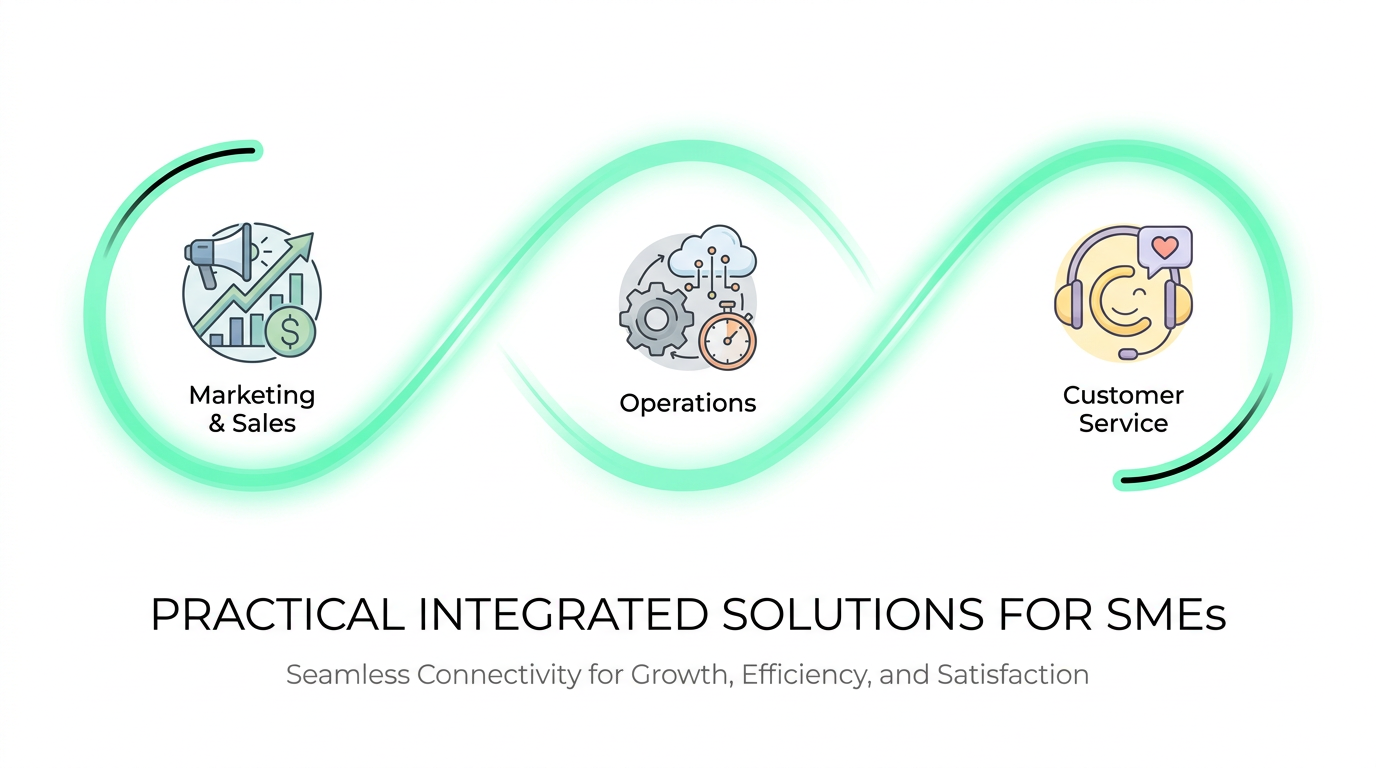
Here are three areas where we see UK SMEs achieving quick wins:
1. Marketing and Sales Automation
- Problem: Your sales team spends too much time on research and not enough on selling. Your marketing feels generic.
- Solution: Use AI-powered tools to automate lead research, generate personalised email outreach, and optimise digital ad spend.
- Tool Type: AI-enhanced Customer Relationship Management (CRM) systems, content generation platforms (e.g., Jasper, Copy.ai), and lead intelligence tools.
2. Operations and Process Efficiency
- Problem: Repetitive administrative tasks are bogging down your team and leading to burnout. Manual data entry is causing costly errors.
- Solution: Implement Robotic Process Automation (RPA) or no-code platforms to automate tasks like invoice processing, data entry between systems, and employee onboarding paperwork. This forms the foundation of a practical AI infrastructure.
- Tool Type: No-code automation platforms like Zapier or Make.com, AI-powered accounting software, and specialised RPA tools.
3. Customer Service and Support
- Problem: You're struggling to provide 24/7 support, and customers face long wait times for simple queries.
- Solution: Deploy an AI chatbot on your website to handle frequently asked questions, qualify leads, and book appointments. More advanced tools can analyse customer emails for sentiment, prioritising urgent issues for human agents. These can evolve into sophisticated AI agents that can automate complex workflows.
- Tool Type: Chatbot platforms (e.g., Intercom, Drift), helpdesk software with AI features, and sentiment analysis tools.
Navigating the Risks: A UK SME's Guide to AI Governance
For AI for UK SMEs, the biggest risks often revolve around data protection and compliance. The excitement of new technology can't come at the expense of your legal and ethical responsibilities. The Information Commissioner's Office (ICO), the UK's independent authority for data protection, provides clear AI and data protection guidance that all businesses must follow.
One of the primary disadvantages of AI for business is the risk of "Shadow AI". Shadow AI is the unapproved use of AI tools by employees within an organisation. An employee using a free online tool to summarise sensitive meeting notes, for example, could inadvertently leak confidential company data or client information, breaching the General Data Protection Regulation (GDPR). To mitigate these risks, you need a simple governance framework.
Here's a mini-checklist for vetting any new AI tool:
- Data Residency: Where will our data be stored and processed? For UK GDPR compliance, it's preferable if data stays within the UK or European Economic Area (EEA), or that the provider has adequate safeguards for international transfers.
- Data Processing Agreement (DPA): Does the provider have a clear DPA that outlines their responsibilities as a data processor under UK GDPR? This is non-negotiable.
- Security Certifications: Does the provider hold recognised security certifications, such as ISO 27001 or SOC 2? This indicates a commitment to reliable security practices.
- Purpose Limitation: What will the AI provider do with your data? Ensure they will only use it to provide the service to you, not to train their models on your confidential information without your explicit consent.
Ignoring these steps can lead to significant fines and reputational damage. It's crucial to understand the risks of ungoverned or 'Shadow AI' before they impact your business.
Frequently Asked Questions About AI for Small Business
What is AI for small business?
AI for small business involves using smart software tools to automate repetitive tasks, analyse business data for insights, and improve customer interactions. It's not about building robots; it's about leveraging accessible technology to increase efficiency, make better decisions, and gain a competitive edge. This practical approach helps SMEs operate more effectively.
How much does AI cost for a small business?
Costs can range from £20 per month for simple SaaS tools to many thousands for custom-built solutions. The key is to avoid over-investing. We recommend starting with a low-cost, high-impact tool to solve a single problem. This allows you to prove the ROI before committing a larger budget, following our Crawl, Walk, Run methodology.
What are the 5 disadvantages of AI?
The main disadvantages are high initial implementation costs, data security and privacy risks, the potential for biased or inaccurate outputs, integration challenges with older systems, and the need for staff upskilling. However, these are not insurmountable barriers. With proper planning, governance, and a phased adoption strategy, these risks can be effectively managed.
When not to use AI?
You should avoid using AI for tasks that require deep empathy, complex ethical judgment, or nuanced creativity. It's also not suitable when the problem is poorly defined or when the cost and complexity of an AI solution far outweigh the potential benefits. Typically start with a clear business case; if the ROI isn't there, don't use AI.
What are three dangers of AI?
For a business, the three main dangers are data breaches from insecure 'Shadow AI' tools, making critical decisions based on flawed or biased AI analysis, and reputational damage from poorly implemented customer-facing AI, like an unhelpful chatbot. These dangers highlight the importance of reliable governance, human oversight, and choosing trusted technology partners.
Will AI take over jobs in 10 years?
It's more likely that AI will augment and change jobs rather than eliminate them entirely. Repetitive and data-heavy tasks will increasingly be automated, freeing up human workers to focus on more strategic, creative, and interpersonal aspects of their roles. Continuous learning and upskilling will become more important than ever for the workforce.
Which jobs will survive AI?
Roles that rely heavily on creativity, critical thinking, complex problem-solving, leadership, and high emotional intelligence are the most resilient to automation. This includes strategic managers, scientists, artists, therapists, and skilled tradespeople who perform non-routine physical work. These are jobs where uniquely human qualities provide the most value.
Where would AI be in 10 years?
In ten years, AI will likely be a deeply integrated and almost invisible utility, similar to electricity or the internet in today's business software. It will function as a standard 'co-pilot' in most applications, capable of understanding more natural language and handling complex, multi-step tasks. The focus will shift from 'using AI' to simply using smarter, more efficient software.
What was Stephen Hawking's warning about AI?
Stephen Hawking's primary warning concerned the long-term, hypothetical risk of developing a superintelligence that could evolve beyond human control and potentially pose an existential threat. He was not talking about the practical business AI tools used today. His concern was a philosophical one about the ultimate trajectory of AI development, not its current applications.
Can AI replace teachers?
AI is highly unlikely to replace teachers, but it can become a powerful assistant. AI can automate administrative work like marking, provide personalised learning paths for students, and free up teachers to focus on what they do best: mentoring, inspiring, and providing human connection and support. AI is a tool for teachers, not a replacement.
Important Considerations: Limitations, Alternatives, and When to Seek Help
This guide provides a strategic framework, but it's important to acknowledge its limitations. The AI landscape, particularly regarding costs and capabilities, is evolving at an incredible pace. The figures and tool suggestions here are representative as of September 2026, but you must conduct your own due diligence. Furthermore, the success of any AI implementation depends heavily on the quality of your own data and the clarity of your existing processes. AI is a powerful amplifier; it cannot fix a broken business model.
Before diving into AI, consider simpler alternatives. For many SMEs, the most logical first step is Business Process Automation (BPA) using no-code tools. Platforms like Zapier and Make.com allow you to connect the apps you already use and automate workflows without writing a single line of code. This approach builds a solid foundation of efficiency. Mastering BPA is often a more pragmatic and cost-effective precursor to adopting more complex AI, allowing you to get your processes in order first.
We recommend seeking professional help in three specific scenarios: when your project involves large volumes of sensitive customer data, when you need to integrate with complex or legacy IT systems, or when you are developing a business-wide strategy for AI adoption. In these cases, partnering with a specialist consultancy like Up-Stride ensures security, compliance, and a much higher probability of achieving a positive ROI without overwhelming your team.
Your Next Step in a Practical AI Journey
Ultimately, the decision to adopt AI for small business comes down to a clear, pragmatic analysis of cost versus benefit. By focusing on solving a specific, high-impact problem and building a solid business case, you can move past the hype and confidently answer the question, "is AI worth it for my company?". This human-centred approach transforms Artificial Intelligence from a daunting buzzword into a practical tool for driving efficiency, growth, and a real competitive advantage for your UK SME.
If you've identified a clear opportunity and are ready to take the next step, our practical guide to AI implementation can help you plan your project. For those who want expert guidance to build the business case, handle the risks, and implement a solution that delivers measurable results, our team is here to help. We specialise in creating human-centred AI solutions for businesses like yours. To discuss your ideas, book a free, no-obligation consultation with our experts today.
References
- Department for Science, Innovation and Technology (GOV.UK) - Government Report (2024). Identifies 'lack of skilled staff' as a major barrier to AI adoption for UK businesses and estimates the UK AI market size.
- UK Government - Government Policy Paper (2021). Outlines the UK's 10-year plan to support the AI ecosystem and ensure effective governance.
- Information Commissioner's Office (ICO) - Regulatory Guidance. Provides the official framework for complying with UK GDPR when using AI systems.
- Stanford Institute for Human-Centered Artificial Intelligence (HAI) - Annual Academic Report. Tracks global trends in AI investment, capabilities, and public perception.
- Organisation for Economic Co-operation and Development (OECD) - International Standard. Defines principles for trustworthy AI, including human-centred values and accountability.
- Innovate UK - Government Agency Report (2023). Details opportunities and barriers for UK service sector SMEs adopting AI, with specific use cases.
- The Alan Turing Institute - National Institute Report. Analyses AI's potential as a 'general-purpose technology' to boost the UK economy.
- World Economic Forum - Global Survey Report (2023). Projects that 75% of companies will adopt AI and highlights 'AI and machine learning specialists' as a top-trending role.
- Confederation of British Industry (CBI) - Business Organisation Survey. Reveals that over half of UK firms use AI, with 'unclear ROI' being a key adoption barrier.
- JPMorgan Chase - Institute Report (2023). Analysis based on 1.3 million firms' transaction data shows tech adoption patterns among small businesses.
- British Business Bank - Guidance Article. Outlines key AI trends and practical applications for small businesses, including marketing and customer service.
- 25eight - Industry Analysis. Provides a cost-benefit framework for small businesses considering AI, weighing subscription costs against efficiency gains.
Your Next Step in a Practical AI Journey
In summary, the decision to adopt AI for small business hinges on a clear, pragmatic analysis of cost versus benefit. By focusing on solving specific problems and building a solid business case, you can move past the hype and determine if AI is worth it for your unique situation. This approach transforms AI from a daunting technology into a practical tool for driving efficiency and growth in your UK SME.
If you've identified a clear opportunity but need guidance on implementation, our practical guide to AI implementation provides a detailed roadmap. For more hands-on support, our team at Up-Stride specialises in creating human-centred AI solutions for businesses like yours. We can help you build the business case, navigate the risks, and implement a strategy that delivers real value. To discuss your ideas, book a free, no-obligation consultation with our experts today.
Important Considerations: Limitations, Alternatives, and When to Seek Help
While data shows the AI landscape is evolving rapidly, it's important to approach it with a clear perspective. We believe that this guide provides a durable strategic framework, but it is not definitive financial advice. Real-world results depend heavily on the quality of your business's own data, the clarity of your processes, and your team's ability to adapt. It is crucial to recognise that AI is not a magic bullet; it cannot fix a fundamentally flawed business model or a poor market strategy.
For many UK SMEs, the most pragmatic and cost-effective first step isn't complex AI, but rather simpler Business Process Automation (BPA). Before investing in machine learning models, consider using established no-code platforms